
The Alliance and our members have always been committed to population health as a fundamental part of our Model of Health and Wellbeing. This includes many of the key elements of a connected neighbourhood health home (NHH):
- Collaborating with community and system partners;
- Providing low- and no-barrier health and wellbeing programming for community members who receive primary health care elsewhere;
- Tailoring programs, services, and outreach to the communities each member serves;
- Providing care coordination and system navigation to help people access acute or specialist care when necessary;
- Providing the highest-quality preventive care and chronic disease management; and
- Serving as neighbourhood health home (NHH) - a place where clients and community members feel a sense of belonging and are supported throughout their life course as whole people with unique needs, assets, and goals.
Working in close partnership across sectors within a community makes comprehensive primary health care - health promotion, disease prevention, and chronic disease management as well as episodic care - accessible to more people in the community. It is also an essential step towards ensuring that people access the care they need from the right organization, in the right place, at the right time.
The strategies and case examples listed in this chapter exemplify how Alliance members work in partnership with others to build connected neighbourhood health homes. They illustrate how a comprehensive primary health care team makes an ideal "hub" where clients directly access comprehensive primary health care and are seamlessly connected to other resources and partner agencies when needed.
However, access is only the beginning. It helps stabilize people and keep them out of hospital, and it lays the foundation for deeper relationships of trust, but attachment is essential for care continuity, relationship-building, and ongoing access to care across their life course. In Chapter 9, we showcase some examples illustrating how to begin the shift from access to attachment.
# The Neighbourhood Health Home
The Alliance has developed a Neighbourhood Health Home (NHH) model which consists of a set of core components that can be applied to your local context. This model is built on the work our members have been doing in Ontario for over 50 years - providing care for people and communities as described in our Model of Health and Wellbeing (MHWB). Key to the Neighbourhood Health Home is that it reaches out beyond the doors of a single organization, creating partnerships and integrating health and social care.
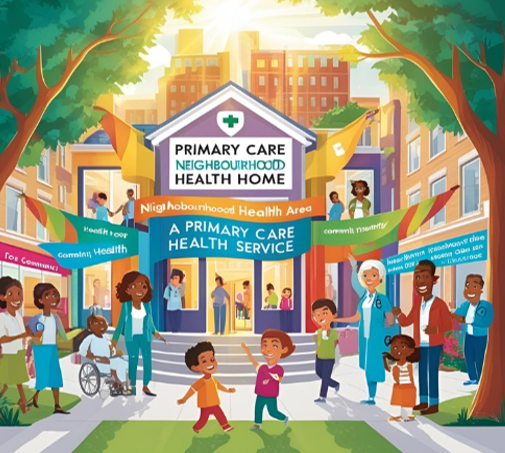 The Neighbourhood Health Home expands on this by laying out a "hub and spoke" design for locally integrated care. Within each NHH, a community-based, comprehensive primary health care team operates as the hub, and other providers and organizations within the community are the spokes. This model offers a way to reach attachment goals while also addressing health inequities. It has been designed to make best use of resources including the skills, expertise, and interests of the primary care clinicians, teams, and organizations that serve a community or population.
The model is built on six pillars:
- Interprofessional, collaborative primary health care
- Community governance and engagement
- Population-based approach to health
- A strong data foundation
- A focus on equity and the determinants of health
- Accountability and efficiency
It is important to note that the hub does not need to be a physical location where community members access care, and it does not require the creation of a new organization or facility. The hub is a primary health care organization that already exists and has taken on the role of coordinating care and providing health promotion support and access to link workers. This ensures seamless connections between the community, clinical care, and social care.
Additionally, the neighbourhood health home does not need to be defined geographically. In some cases, the expanded team is mandated to serve a particular population within a larger region. The NHH in such a case consists of the communities that make up population served, as well as the health and social care agencies that support them. Check out the webinars and resources below for more about this model and the practical steps you can take to implement it in your community.
- In the first webinar (April 2025) Sarah Hobbs, CEO, and Jennifer Rayner, Director of Research and Policy at the Alliance, shared an overview of this vision and described how, if implemented, it has the potential to advance health equity and vastly improve the health and wellbeing of people across Ontario.
- In two follow-up webinars (October 2025), we focused on how organizations have and will be putting this vision to action and provided practical steps on how to include the Neighbourhood Health Home in your EOI applications. Sarah Hobbs and Jennifer Rayner were joined by Kimberley Floyd, CEO of Wellfort CHC, who shared a real-world example describing how her community has implemented this model.
- These slides from a presentation to RISE in January 2026 provide an overview of how WellFort CHC has implemented the NHH and how this reflects health system priorities for IPCT expansion.
The Vital Role of Link Workers
A link worker is a key part of the Neighbourhood Health Home. Often associated with social prescribing, link workers support clients to improve their health and wellbeing by connecting them to nonmedical, community-based supports and services. They can help coordinate care among partner organizations in diverse health and social care organizations, allowing physicians, nurse practitioners, and their teams to focus on medical care while ensuring their clients get support for social and practical issues affecting their health.
- The Alliance has created a Link Worker Job Description Template to help you recruit a link worker to your team.
- This short report created by the Alliance outlines the evidence for the impact of link workers on community and individual health.
- This position statement outlines the case for including link workers in every neighbourhood health home. Consider drawing from it when advocating for funding to build your capacity for attachment.
Partnership Agreements for your Neighbourhood Health Home
Within Neighbourhood Health Homes, organizations are creating partnerships and agreements with multiple partners. Some of these are more formal than others, and we have gathered examples of partnership letters and letters of collaboration:
- EOI Sample Letter of Support for Partners (download editable version here)
- IPCT Sample Partner Agreement (download editable version here)
- Sample Service Purchase Agreement (download editable version here)
- EOI Sample Letter from Community Physician (download editable version here)
These letters outline the responsibilities of the partners. If the partner is a primary care organization (e.g., FHO), the examples provided include the types of supports that the HUB could provide to the physician(s) and the numbers of new clients that the physicians are expected to attach.
# Streamlined Access to Other Service Providers
Neighbourhood Health Homes and intersectoral collaborations can also improve access to social supports and specialist care beyond the primary health care team. System navigators, link workers, and others can help coordinate and streamline referral processes and systems, reducing wait times, lost referrals, and duplication.
- Seamless Care Optimizing the Patient Experience (SCOPE) was designed to help primary health care providers connect directly with specialists. SCOPE operates a central hub through which over 1900 clinicians can access specialists and other health care professionals for referrals, consultations, and system navigation support. Family physicians and nurse practitioners access SCOPE through a central contact point (the SCOPE Hub), and that provider and their client are then connected with appropriate expertise and care.
- Social Prescribing is a worldwide phenomenon that took root in the United Kingdom in the early 2000s. The Alliance and eleven of our members brought Social Prescribing to Canada beginning in 2018 with Rx:Community, a pilot program of our "made-in-Ontario" take on the model. Social Prescribing establishes and formalizes linkages between primary health care providers and social care services that support the determinants of health: food security, social connectedness, access to nature, and more. Social Prescribing includes internal linkages between clinical and non-clinical programs and services within the same comprehensive primary health care team as well as external ones between primary care providers and other agencies in their communities.
- TeamCare enables solo providers to connect their clients to interprofessional teams, system navigators, diagnostic services, and more at a CHC, FHT, or other organization that offers comprehensive primary health care services. The relationship between the client and their usual primary care provider is preserved; clear communication and feedback allows the provider to monitor the client's journey and see the impacts of the team-based care they access.
Team Care
Team Care and its regional variants (SPIN, PINOT, and PACT) provide a pathway for solo providers to connect their clients to interprofessional teams. This ensures that their most medically and socially complex clients can get the comprehensive supports they need without losing their relationship with the family doctor or nurse practitioner they've known for years. Team Care isn't just a referral program; it’s a collaborative care team. The client's usual primary care provider and the interprofessional team stay in contact so everyone is kept up-to-date on the client's care and progress. A member of the interprofessional team does a full assessment with the client, and the team works with the client and their provider to develop a care plan.
Every Team Care program is unique. They vary according to local needs and resources. The case examples below were shared by Alliance members to illustrate the range of possibilities:
-
Team Care in East London (formerly known as PINOT) allows primary care providers in the community to access the full suite of clinical and social services at the London InterCommunity Health Centre (LIHC). This program uses a registration model, in which local primary care providers sign up for access. LIHC conducted extensive outreach to physicians in their community prior to launching the program publicly. System navigators at LIHC assess the circumstances of each client and connect them to LIHC's internal programs and services as well as external resources, at no cost.
- For more information, check out this presentation slide deck (LIHC, 2019)
-
The Windsor Team Care Centre began as a partnership between a community FHT and a CHC. It is now wholly a project of the Windsor Family Health Team.
- See their multi-media presentation about the team and the project here.
- See their infographic here.
- In September 2019, they received a Bright Lights award from the Association of Family Health Teams of Ontario (AFHTO), in the category Access to Care: Improving Team-Based Care. You can see the writeup here.
- In June 2020, they received a Transformative Change award from the Alliance for Healthier communities. Watch an excerpt of the award video, showing Team Care in action, at right.
-
At People Accessing Care Teams (PACT) in Toronto’s Black Creek community, system navigators from the Black Creek Community Health Centre are embedded right in the ER of the Humber River Hospital.
- For more information, check out their presentation slides here (Black Creek CHC, 2019).
- The Allied Health -- People Accessing Care Teams (PACT) at Vaughn CHC’s Keswick and Vaughan locations is available to people experiencing barriers to health and health care. It can be accessed through a referral from their family physician or nurse practitioner.
- Team Care in the Thunder Bay region is available at multiple locations through a partnership with NorWest Community Health Centres and several local health clinics. The CHC’s foot care, mental health therapy, system navigation, dietary care, wellness & health promotion services are available at each of the clinical sites for people who face challenges accessing health care services or who have multiple and/or complex health care needs. It is available by referral only.
-
Team Care - formerly People in Need of Teams (PINOT) - at South East Grey CHC (SEGCHC) enables local family physicians to refer their clients to the CHC’s interprofessional team. The SEGCHC also works with the hospital to make sure everyone in their community gets primary-care follow-up within 24 hours of leaving the hospital, and they have partnered with the Alzheimer’s Society to offer community memory clinics to pre-Alzheimer's patients.
- In 2017, this program won the South West LHIN’s 2017 quality award. Watch the award video here.
- CarePoint Health in Mississauga is a collaborative program that brings together interprofessional providers and primary care clinicians. Providers can register on their website to begin referring their clients; individuals without a primary care provider can connect directly to the program through CarePoint Connects.
# More Team Care resources:
- Advancing Access to Team-Based Care - Presentation slide deck (Alliance for Healthier Communities, 2019)
- PACT - People accessing Care Teams - Presentation slide deck (Black Creek CHC, 2019)
- Expanding Team Based Care - Presentation slide deck (Rideau CHS, 2019)
- Mental health, foot care, coming to 3 Thunder Bay medical clinics - News article (CBC, 2019)
- Team Care launched to improve health care in city - News article (TB Newswatch, 2019)
Social Prescribing
Social prescribing is a holistic approach to health care that brings together the social and medical models of health and wellbeing. It provides a formal pathway for health providers to address the diverse determinants of health, using the familiar and trusted process of writing a prescription. Each social "prescription" is tailored to the goals, needs, and gifts of the client and is developed through a co-design process, thus supporting the client's sense of autonomy and self-determination. This has been shown to support self-management and reduce repeat clinical visits, thereby reducing demands on providers' time.
Social prescribing can also support primary care attachment, as described in this webinar (watch below) from October 2025
Programs and services accessed through social prescribing are developed with the sociodemographics of the clients and community in mind. This helps to ensure that they are culturally appropriate and accessible and that they support the health of the whole community. Numerous organizations have even reported that their social prescribing programs have bolstered community capacity.
As social prescribing has matured within our sector, the range of "prescribers" has expanded to include not only clinicians, but other members of the interprofessional team. Many organizations find that having a dedicated link worker is a key ingredient for success.
To learn more about how to start or expand a social prescribing program at your organization, check out these links:
- Webinar: The future is social prescribing: Why it's key to an integrated, accessible, resilient health system. (Alliance, 2024)
- Online Social Prescribing Course (Alliance, 2024)
- Video Series: What Social Prescribing looks like across Ontario (Alliance and members, 2023-2024)
To learn more or access coaching supports (available to Alliance members only), email SocialPrescribing@AllianceON.org.
Case Example: Centralized Intake at the Waterloo Wellington Regional Coordination Centre
Barriers to health care can be worsened by inefficient intake and waitlist management processes. Referrals are often rejected if they don’t align with the provider’s scope of practice or get lost in the system because wait times are too long. This could lead to providers sending duplicate referrals to multiple specialists in search of the shortest wait times, which worsens gridlock and increases the administrative burden. To address this, the Waterloo Wellington Regional Coordination Centre (WWRCC), hosted at Langs Community Health Centre, streamlines various central intake processes in order for providers and clients to access care easily and in a timely manner.
The WWRCC offers central intake pathways across Waterloo Region, Wellington County, and beyond for diabetes, orthopedics, cataracts, Ontario Seniors' Dental Care. The service provides navigational support for clients and expedited access for those on waitlists. Diabetes Central Intake allows for improved access to care through self-referral, and central intake for the Ontario Seniors' Dental Care program provides phone support to help seniors living with low incomes navigate the application and appointment booking process. Cataract Central Intake helps reduce wait times for non-surgical cataract procedures.

This process improves referrals by:
- Helping to ensure even referral distribution across specialists
- Maintaining detailed wait-time information
- Reducing duplicate referrals
- Ensuring the right specialist is selected
- Maintaining consistent data monitoring
- Ensuring continuity of care
# A Measurable Impact
To date, WWRCC has processed over 200,000 referrals across four different central intakes and have sent over 120,000 referrals to various specialists across the different programs and region.
-
Orthopedic Central Intake | May 2011 - October 2025
-
84,148 referrals processed
-
76,901 clients referred to hip and knee specialists
-
-
Diabetes Central Intake | May 2011 - October 2025
-
99,636 referrals processed
-
26,883 clients referred to specialists
-
-
Cataract Central Intake | April 2021 - October 2025
-
20,465 referrals processed
-
19,913 clients referred to specialists
-
-
Ontario Seniors Dental Care Program | June 2022 - October 2025
-
5,242 referrals processed
-
This has had a profound effect on health outcomes and quality of life, as seen in the dramatic drop in wait times for cataract care. In April 2021, the average wait time for cataract consult and surgery in the region was 22 months; by October 2025, just four and a half years later, it had been reduced to 7 months.
# Regional Spread and Scale
To help spread and scale this model, WWRCC has developed a Framework for the Development and Implementation of a Regional Central Intake for organizations looking to develop a similar process in other regions. It outlines strategies for developing, scaling, and spreading a central intake model. They are also working with organizations in neighbouring regions to help them develop and implement models like theirs.
# Primary Healthcare Access for People who are Uncertainly Attached.
Creating low- and no-barrier access points to primary health care is an essential first response. It creates the conditions for people to be stabilized and reduces hospitalizations and emergency department visits for episodic care. It also lays the groundwork for ongoing attachment to primary health care by connecting clients to the providers, teams, and partner organizations that can best meet their needs. When barriers are lowered and eliminated, any door can lead to a health care team, whether it's the door to a solo provider's office, a shelter, or even a bus.
# Case Examples
Thorncliffe Park Community Hub and the East Effort Collaborative
The Thorncliffe Park Community Hub (TPCH), in northeast Toronto, opened in 2025. Co-led by the Flemingdon Health Centre (FHC) and The Neighbourhood Organization (TNO), The Hub is a community-driven initiative that providing a wide array of community, social, and health services. Every day, more than 3000 people have local access to integrated primary health care, dental services, midwifery services, legal aid, childcare, language classes, homework help, and more.
The Hub was not built in a day. FHC has over 50 years of experience serving and collaborating with two neighbouring communities: Flemingdon Park and Thorncliffe Park. FHC's main site is located in Flemingdon Park, and Thorncliffe Park is connected to it by a bridge. Staff at FHC heard from Thorncliffe Park community members that having to cross this bridge was often a barrier for them, so in 2011, FHC and TNO jointly launched Health Access Thorncliffe Park (HATP) - an experimental "test of change" that began integrating health and social services in a new way. Community Health Ambassadors, who live in the neighbourhoods, help make HATP (and now The Hub) even more accessible by doing direct outreach and providing system navigation. The Hub is the next evolution of HATP, incorporating a wider array of services and supports, with space contributed by the United Way.
One key learning from HATP is that while co-location can be an essential way to remove barriers and support integration, organizations can successfully partner in this work without needing to merge. When clients enter the facility, they may encounter staff from FHC, TNO, or even the Michael Garron Hospital.
However, this is seamless to the clients. A consistent HATP logo and "look and feel" visually erase the distinctions between the organizations, and linked health records ensure that clients will not have to re-tell their stories to multiple providers.
In this video, FHC's CEO Jen Quinlan reflects on the evolution of HATP into The Hub, and she shares her goals and vision for the future of The Hub. This video was produced by the Canadian Association of Community Health Centres (CACHC) as part of their Community Matters podcast and used with their permission. Check out other episodes of Community Matters to learn more about the work CACHC is doing federally, including advocacy for CHCs and integrated health care.
The Hub grew out of East Effort, a collaborative, local response to COVID-19 that was sponsored by the Flemingdon Health Centre. The work began with tenants in the Flemingdon Park highrises supporting each other during lockdowns by distributing supplies, sharing public health information, and helping each other access vital services. Recognizing the value of this community-led work, staff at the Flemingdon Health Centre launched the Community Health Ambassadors (CHA) program. Together, Flemingdon staff and the CHAs hosted pop-up clinics in the buildings and helped connect people to health and social care services.
More organizations became involved, and the scope expanded to cover a large portion of East Toronto and include STI testing and meningococcal vaccine information, food distribution, a community hotline, community-based social programming, and more. In 2024, East Effort and the Community Health Ambassadors received a Transformational Change award from the Alliance for Healthier Communities; the award video at right showcases the project and its impact.
Access Clinics and MobileCare at Chatham-Kent OHT
The rural community of Chatham-Kent has the second-highest material deprivation score in Ontario and some of the province’s highest rates of chronic disease. With a single walk-in clinic and over 30,000 residents who didn’t have access to a primary care provider, many people were left to rely on the emergency department for care. In 2024, the Chatham-Kent Ontario Health Team (CHOHT) launched two initiatives to address this gap in access:
- BridgeCare is a weekend walk-in primary care clinic serving unattached people in the community.
- MobileCare, a walk-in clinic on wheels, travels to various locations to provide access to primary care and care for mental health and addictions, for people who may have difficulty travelling to access care.
In just under a year, BridgeCare and MobileCare have seen over [NUMBER] people. This has relieved pressure on the local hospital and has provided options for referral pathways after hospital discharge. Chatham-Kent Community Health Centre (CKCHC), one of the CKOHT partners, has been able to access more resources for rostering high-needs clients, and the OHT has been able to provide a greater focus on providing primary care as well as care for mental health and addictions to underserved community members.
In addition to being part of the BridgeCare and MobileCare initiatives, CKCHC operates “First Five,” preventative health promotion services for children aged 0-5 who do not have access to a primary care provider. People do not have to live in Chatham-Kent to access the program.
These initiatives are now ready to scale up and to spread to other communities. Because the model is flexible, it can be adapted for diverse and evolving needs. CKOHT plans to expand both initiatives and adapt them to serve additional community members.
Access Clinics at Thames Valley FHT
Thames Valley Family Health Team (TVFHT) offers comprehensive primary health care services across a large geography spanning London, Oxford, Middlesex, Elgin, and the Strathroy-Caradoc municipality. Recently, the team has been expanding its services and group programs in a shift towards a population health model based on deeper integration with community partners. This case study describes how TVFHT’s two Interprofessional Primary Care Team (IPCT) projects are facilitating access and attachment to team-based primary health care for individuals living within Elgin County and the City of London.
Key elements of their expanded services in Elgin County include:
- An Unattached Population Clinic in Elgin County that opened its doors in September 2024 and has served close to 5000 unattached individuals as of July 2025.
- Increased collaboration and integration with other funded models in the community, including recruitment and funding of staff for Central CHC's mobile healthcare clinic; creating a direct referral pathway from the St. Thomas - Elgin General Hospital for unattached people visiting the Emergency Department for primary care services; and partnerships with pharmacies in Elgin who can provide low-barrier care for minor ailments.
In London, TVFHT has expanded primary care access by creating a new, low-barrier primary care team in partnership with the London InterCommunity Health Centre (LIHC). This team is housed in a Community Hub along with other service organizations, so clients can access primary care and social services in a single location. The team also conducts outreach to clients in shelters, supportive housing, and encampments. One of their outreach partners, the Salvation Army Centre of Hope - has seen a 50% reduction in ambulance calls since TVFHT's primary care team began making biweekly visits.
As the expansion moves into Year Two, the team at TVFHT will be shifting their focus to move from access to attachment, using a stepped-care approach.
The Mission United Program in Durham
The Mission United Program in Durham Region is a centralized, low-barrier health hub that offers integrated primary health care, mental health supports, crisis counselling, housing, and addiction services. It also serves as a rest centre where individuals can receive a daily meal between 10 a.m. and 1 p.m. It is led by CMHA Durham and housed at the Back Door Mission; numerous other social care agencies also offer services at the hub.
Through this innovative model, CMHA Durham has had over 14,000 clinic visits and 7500 harm reduction interactions, and it has provided essential care to over 1100 clients, including nearly 250 first-time visitors.
The hub has facilitated over 31000 visits and over 56000 food security visits. It has prevented over 400 emergency department visits and supported over 1300 unhoused individuals.The Mission United Program received a 2025 Transformative Change Award from the Alliance for Healthier Communities. Watch their award video at right to learn more about the program.
Care Bus in Thunder Bay
The Care Bus is a low-barrier transportation service and mobile service hub in Thunder Bay, spearheaded by NorWest Community Health Centres and supported by numerous system partners. The Care Bus fosters strong ties with Indigenous organizations,
including the Ontario Native Women's Association, to provide crucial health and social support services during winter months. It is staffed by individuals with lived experience, which helps to make it one of the most vital winter services in the community. In 2023-24, the Care Bus served over 5800 clients.The Care Bus received a 2025 Transformative Change Award from the Alliance for Healthier Communities. Watch their award video at right to learn more about the program.
Lower Limb Wound Prevention and Treatment Clinic in Windsor
The Lower Limb Wound Prevention and Treatment Clinic in Windsor is led by the Windsor Family Health Team in collaboration with the Windsor Regional Hospital, Windsor Essex Community Health Centre (weCHC), City of Windsor, Canadian Mental Health Association - Windsor-Essex County Branch (CMHA-WECB) and Windsor-Essex Ontario Health Team. The clinic offers interprofessional care aimed at preventing amputations in high-risk populations, including those with diabetes, vascular disease, or experiencing homelessness.
Supported by Windsor Essex CHCs' specialized foot care services, the clinic applies best practices in wound management while addressing social determinants of health. Partnering with the City of Windsor and CMHA-WECB, the clinic extends outreach to homeless hubs by equipping non-clinical staff with wound care training and essential supplies, ensuring
clients’ needs are met promptly. Clients gain access to vital resources, primary care, and free transportation. It also offers education for clients and providers.The Lower Limb Wound Prevention and Treatment Clinic received a 2025 Transformative Change Award from the Alliance for Healthier Communities. Watch their award video at right to learn more about the program.
Collaboration and Expansion at CMHA Windsor-Essex County Branch
Through extensive partnerships, proof of concept testing and a commitment to health equity, Canadian Mental Health Association – Windsor-Essex County Branch (CMHA-WECB) and its partners have employed a four-pronged strategy to facilitate access and attachment to comprehensive primary health care across the Windsor-Essex region. Their expansion initiatives include:
- Mobile Medical Support (MMS) - a mobile medical and mental health care support unit for people who lack regular access to primary care (collaboration with Erie Shores Healthcare).
- A Shelter Health program that provided over 3400 service interactions (collaboration with four downtown shelters, Shelter Health Associates, the City of Windsor, and the Windsor Regional Hospital).
- Addition of more nurse practitioners within the CHC that enabled them to reduce the local Health Care Connect waitlist.
- Attaching unattached individuals experiencing challenges related to mental health or addiction after they are discharged from local emergency departments.
This case example describes these initiatives as well as the impact each one has made on improving access and attachment to care.
Want help applying some of these learnings to support connected care in your community? Email QI@AllianceON.org to access more resources and coaching support.


We welcome your feedback! Please complete this survey or send an email to LHS@AllianceON.org to share your experience using this toolkit.
