Félicitations au CSC Chigamik CHC et à ses partenaires pour un nouvel édifice dédiée au partage des connaissances et à la collaboration pour des soins centrés sur le client

le Jeudi 28 Mai 2020
Carol Lambie, présidente et chef de la direction du Centre de soins de santé mentale Waypoint, et David Jeffery, directeur exécutif du Centre de santé communautaire Chigamik, se tiennent devant le nouveau centre de santé communautaire de Midland

[Carol Lambie, présidente et chef de la direction du Centre de soins de santé mentale Waypoint, et David Jeffery, directeur exécutif du Centre de santé communautaire Chigamik, se tiennent devant le nouveau centre de santé communautaire de Midland].

Le Centre de santé communautaire Chigamik Community Health Centre (CSC Chigamik CHC), et le programme de santé mental pour patients externes et le Centre HERO du Centre de soins de santé mentale Waypoint (Waypoint) (hébergement, emploi, réadaptation et Our Place – programmes du club social) sont heureux d’annoncer qu’ils déménageront dans le nouveau Carrefour santé communautaire de Midland, situé au 287, promenade Bayshore, au centre-ville de Midland. Le déménagement aura lieu la semaine du 25 mai 2020 et l’édifice ouvrira officiellement les portes le lundi 1er juin 2020. Quoique la prestation de la plupart des programmes et des services offerts par les deux organismes se fasse par voie virtuelle pendant le déménagement, ils fixent toujours les rendez-vous en personne au besoin.

« Nous sommes ravis d’annoncer que l’édifice du nouveau Carrefour santé communautaire de Midland est maintenant achevé. Le nouveau bâtiment rassemblera beaucoup de services de soins de santé dans la communauté sous un seul toit, y compris les soins primaires et les soutiens en santé mentale, les programmes pour les jeunes, la guérison traditionnelle et les services sans rendez-vous. Ceci permettra une croissance accrue en collaboration et offre aux clients et aux résidents un meilleur accès aux soins de qualité axés sur le client, » a dit David Jeffery, directeur général, CSC Chigamik CHC.

Les installations mesurant 40 000 pieds carrés représentent un projet de collaboration qui hébergera le CSC Chigamik CHC et les programmes communautaires et pour patients externes de Waypoint ainsi que certains aspects communs tels l’aire de réception, les salles de réunion, une cuisine communautaire et des installations pour la physiothérapie. Plusieurs salles ont été désignées pour la « cérémonie de la boucane » afin de desservir la communauté autochtone. Tous les services et programmes de chacun des organismes demeurent inchangés.

« Nous sommes très enthousiastes de converger avec le CSC Chigamik CHC dans nos nouveaux locaux physiques, » a dit Carol Lambie, présidente-directrice générale du Centre de soins de santé mentale Waypoint.

« Waypoint et Chigamik ont conçu des plans visionnaires pour le regroupement des services en un seul endroit et ainsi améliorer l’accès des clients et de leurs familles, plans qui s’harmonisent avec l’engagement du gouvernement en matière d’intégration des systèmes de prestation des soins. »

Parmi les autres organismes communautaires qui partageront également l’espace : Carrefour bien-être pour les jeunes de Simcoe Nord, Conseil des patients, des clients et des familles, Clinique d’accès rapide pour le traitement de la toxicomanie (ARTT/RAAM) (assurée par le Centre régional de santé Royal Victoria), Clinique de santé mentale sans rendez-vous (assurée par Catholic Family Services of Simcoe County), sages-femmes Midland Midwives By the Bay, et plus.

« Ce nouveau Carrefour santé communautaire est le résultat de partenariats solides qui ont été cultivés au cours de la dernière décennie » affirment Betty Valentine, membre du conseil d’administration de Waypoint et Tammy Stadt, membre du conseil d’administration du CHC Chigamik CSC, co-présidentes du Comité immobilier. « C’est un endroit où nos équipes travailleront en collaboration, partageront des connaissances et fourniront des soins intégrés aux résidents, et où tout le monde se sent apprécié et trouve un sens d’appartenance. »

Pour garantir la sécurité de tout le personnel, des clients et des membres de la communauté pendant la pandémie de la COVID-19, tous les organismes qui aménageront dans le Carrefour santé communautaire ont pris des mesures de santé et de sécurité supplémentaires. Suivant les conseils de la santé publique, l’éloignement physique demeure en vigueur et la circulation des personnes dans le nouveau bâtiment sera limitée. Les rendez-vous pour les consultations en personne sont fixés au besoin.

Le CSC Chigamik CHC et Waypoint tiennent à remercier le ministère de la Santé et des Soins de longue durée de l’Ontario, le comté de Simcoe, la ville de Midland, le cabinet Lett Architects et tous les partenaires communautaires du travail de collaboration exécuté pour appuyer le développement d’un nouveau Carrefour santé communautaire de Midland.

Congratulations to CSC Chigamik CHC and its partners on a new home dedicated to sharing knowledge and collaboration for client-centred care

le Jeudi 28 Mai 2020

[Carol Lambie, President and CEO of Waypoint Centre for Mental Health Care and David Jeffery, Executive Director of Chigamik Community Health Centre, stand in front of the new Community Health Hub in Midland].

A decade in the making, the Midland Communuity Health Hub is a result of deep partnerships and a drive to collaborate better across organizations to better serve clients.

Centre de santé communautaire Chigamik Community Health Centre (CSC Chigamik CHC) began its move to its new building in Midland Ontario this week, with doors set to open officially June 1. Of course, many programs continue to be offered virtually while COVID-19 response continues in the area, with steps taken to ensure safety of staff and clients when in-person services are needed.

Chigamik will share the new Midland Community Health Hub space with its partners Waypoint Centre for Mental Health Care’s Outpatient Mental Health program and the HERO Centre (Housing, Employment, Rehabilitation and Our Place Social Club programs).

“Waypoint and Chigamik were visionary in planning for this co-location of services to improve access for our clients and their families which aligns with the government’s commitment to integrated care delivery systems,” said Carol Lambie, president and CEO of Waypoint.

The 40,000-square-foot facility is a collaborative project that will house CSC Chigamik CHC and Waypoint’s outpatient and community programs and a number of common elements such as a reception area, meeting rooms, a community kitchen and physiotherapy facilities. Several rooms are designated for “smudging” to serve the Indigenous community. All services and programs from each organization will remain the same.

“We’re very excited to announce that the new Midland Community Health Hub building is complete," said David Jeffery, executive director of CSC Chigamik CHC. "This new building will consolidate many healthcare services in our community under one roof including primary care and mental health supports, youth programming, traditional healing and walk-in services. This will allow for more collaborative growth and provide our clients and residents with more access to quality, client-centered care.” 

Other community organizations who will share the space include the North Simcoe Youth Wellness Hub, the Patient, Client and Family Council, the Rapid Access Addiction Medicine (RAAM) clinic (facilitated by the Royal Victoria Regional Health Centre), the Mental Health Walk-In Clinic (facilitated by the Catholic Family Services of Simcoe County), the Midland Midwives By the Bay and more.

"This new Community Health Hub is the result of deep partnerships that have been fostered over the last decade,” says Betty Valentine, Waypoint Board Member and Tammy Stadt, CHC Chigamik CSC Board Member and Property Committee Co-Chairs. “This is a place where our teams will work together, share knowledge, and provide integrated care to our residents, and where everyone will feel like they are valued and belong.”

Ontario Needs a Proactive COVID-19 Strategy that Includes Sentinel Testing

Date: 
le Jeudi 21 Mai 2020

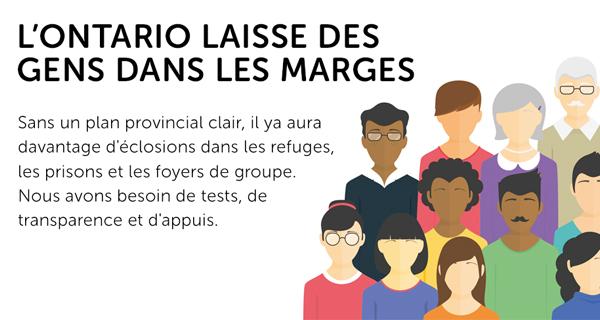
(Image created by Russell Tate)

We are writing to express our concern over reopening Ontario’s economy before public health protections are more fully established. Public health experts have sounded the alarm, stating that reopening the economy with only limited testing – rather than proactive sentinel testing of asymptomatic at-risk populations – is an unnecessary risk that could set Ontario back in its recovery efforts. They recognize that we can’t be sure of whether Ontario is ready to reopen, because the province is neither testing widely enough among key vulnerable populations nor transparently releasing comprehensive population status data to the public.

We’ve known for months that COVID-19 patients may be asymptomatic. Failure to conduct proactive sentinel testing of asymptomatic essential workers and vulnerable populations could be putting these communities – and the broader population – at high risk. Media reports show at-risk essential workers, from personal support workers to taxi drivers, dying preventable deaths from a lack of COVID-19 protections and testing. At the same time, outbreaks have been reported in congregate settings from mental health facilities and shelters, to group homes and farm worker housing. Three weeks after the announcement of a 'COVID-19 Action Plan for Vulnerable People' there is still no plan for sentinel testing, no public reporting of outbreaks and cases for these populations, and no guidance for health and social service providers working in congregate settings or with vulnerable at-risk populations.

We are heartened to hear that testing for symptomatic individuals – promised three weeks ago and overdue even then – will now be expanded to “vulnerable populations, including those in retirement homes and other shared living spaces like shelters and group homes”.  But we remain concerned that this reactive strategy will not prevent the asymptomatic spread of COVID-19.

The province will only have a complete picture of the pandemic’s impact by systematically and proactively testing all people living in group settings and the workers in those and other high risk settings.

We urge the province to act now to protect communities who continue to be deeply impacted by this pandemic.

Pour la version française de cette lettre, appuyer ici.

Signed by 35 organizations and 210 individuals.

  1.  Addictions & Mental Health Ontario
  2. AdvantAge ontario
  3. Algoma Nurse Practitioner Led Clinic
  4. Alliance for Healthier Communities
  5. Brain injury Association Peterborough Region
  6. Bridges Community Health Centre
  7. Brock Mission
  8. CHC of Northumberland
  9. Citizens Alive
  10. Davenport Perth Neighbourhood and Community Health Centre
  11. East End CHC
  12. Flemingdon Health Centre
  13. Grand Bend Area CHC
  14. Hesperus Fellowship Community of Ontario
  15. Lanark community programs
  16. LKGroup Inc
  17. London InterCommunity Health Centre
  18. Noojmowin-teg health centre
  19. NPAO
  20. Ottawa Senior Pride Network
  21. Peterborough 360 Degree Nurse Practitioner-Led Clinic
  22. Quest Community Health Centre
  23. Regent Park CHC
  24. Seaway Valley Community Health Centre
  25. South East Ottawa Community Health Centre
  26. Stonegate Community Health Centre
  27. The Healing Collective
  28. Toronto Board of Health
  29. United Jewish People's Order
  30. Vibrant Healthcare Alliance
  31. WellFort Community Health Services
  32. Western Ottawa Community Resource Centre
  33. Windsor Essex Community Health Centre
  34. Women's Health in Women's Hands CHC
  35. Woolwich Community Health Centre

Focusing on digital equity to keep people connected: Telus donation helps address barriers for marginalized people

le Jeudi 30 Avril 2020
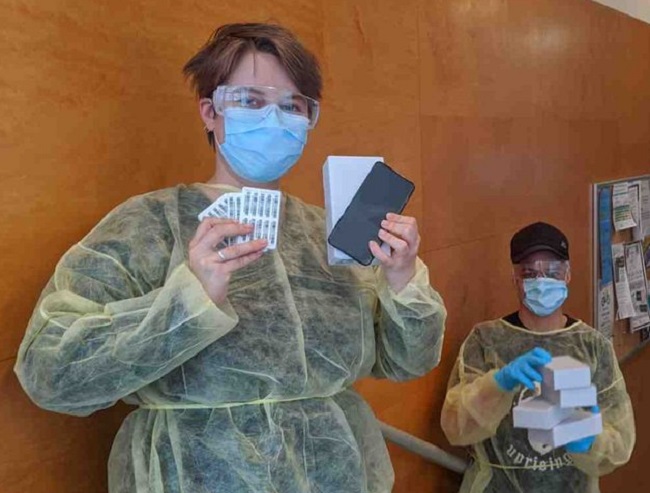
Staff at Guelph CHC pose with cellphones donated by Telus to help support outreach efforts and marginalized populations.

[Staff at Guelph CHC pose with phones donated via Telus with voice and data plans to help support marginalized people to be able to connect to the supports they need and stay safe during the COVID-19 response.]

“I couldn’t imagine what I would do if I didn’t have a connection to my supports right now,” said Chris Morton, an outreach worker with the primary care outreach team at Kitchener Downtown CHC.

It’s a sentiment that most of us can relate to. Now imagine, for a moment, not having access to a phone, or the internet, during the pandemic.

Morton, who works with people experiencing homelessness in Kitchener, says that early on in the pandemic response, outreach teams across the community began to notice they couldn’t connect with the people they were used to seeing. For outreach staff like Morton, not being able to be mobile and meet people in the usual locations, such as the public library or meal locations quickly became a barrier to supporting people.

“We quickly saw people’s wellbeing decline. We saw struggles with substance use increase because of isolation, while their mental health and wellbeing was negatively impacted.”

Morton didn’t despair or stand still, though. He said the outreach team at KDCHC started by identifying that they needed to prioritize access to phones. That’s when Morton reached out to Telus, and was referred to their #AllConnectedForGood program.

“I explained who we are and what we do, and detailed our request for support through technology to support the people we’ve been connected to and serving for many years in the community.”

Telus responded with a donation that Morton said will help their clients, but which has also been able to support other organizations doing similar work in the area. The donation included smartphones and $0 talk and data plans to help get people connect during the COVID-19 pandemic.

“This has been a community-wide initiative, and goes far beyond us,” he said. “We’ve been able to get phones out to other people who are also doing this type of outreach work, so it’s been a community-wide effort to ensure people are getting connected to the supports they need.”

In fact, the Telus donation via Morton has been able to support people who use Consumption and Treatment Services, as well as other people who are isolated or served by outreach programs across Ontario -- at centres such as South Riverdale CHC, NorWest CHC, Sandy Hill CHC, Windsor Essex CHC, Regent Park CHC, Somerset West CHC, Guelph CHC, Carea CHC and Street Health in Toronto.

Staff at South Riverdale CHC, in fact, have now launched their own #DeviceDrive, aiming to meet even more technology and connection needs being faced by the people they serve and the wider community.

While the need is still great, the recognition of this gap by Telus, and its generous donation, helps to highlight the areas that need action. As Telus announced its nationwide commitment to deliver 10,000 phones to isolated seniors and other vulnerable people during COVID-19, Alliance CEO Adrianna Tetley thanked the telco giant while focusing on the digital access barriers people face, in a time when so many health and social services are dependent on users having devices and high-speed internet connections.

“COVID-19 is an unprecedented challenge, especially for people experiencing homelessness, those who use drugs, and other marginalized and isolated people,” said Adrianna Tetley, CEO of Alliance for Healthier Communities, Ontario. “We must remember that the digital equity divide is real. This donation of phones and data plans demonstrates the lifeline technology can provide between the people who need our help the most right now and the community health providers who’ve built trust with them.”

[Kitchener Downtown CHC outreach worker Chris Morton holds up one of the phones donated by Telus to help marginalized people connect to supports and resources during COVID-19. The help for communities that Morton got started from Telus has gone well beyond Kitchener, reaching people supported by CHCs across Ontario.]