Health Equity Heroes: 'This is by far the most important work I do'
le Jeudi 19 Octobre 2017

What is health equity? What is the work that enables and promotes it? Why is this work so vital? During Community Health and Wellbeing Week 2017, AOHC members are demonstrating the ways that they put Health Equity at the Centre. As part of those efforts, we're going to bring you a stellar lineup of Health Equity Heroes all of this week (and beyond). Get to know the heroes among you, and the ones in neighbouring communities, and let's all celebrate and support this important work that helps everyone achieve their best possible health and wellbeing. Follow this space to read about more heroes, and check out the hashtags #CHWW2017 and #HealthEquityHeroes on social media to learn about even more.

What’s your name, how long have you worked at the centre, and what role(s) do you fill there?

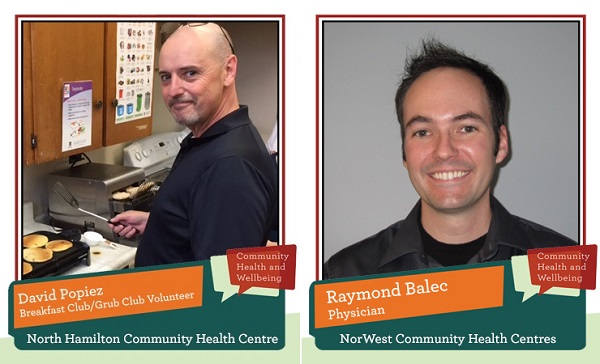
My name is David Popiez, and I’ve worked for a year as a volunteer at North Hamilton Community Health Centre’s Breakfast Program and Grub Club.

What does health equity mean to you, and how do make a health equity approach part of your work?

It means providing equal access to health care and social programs, regardless of your socioeconomic status. I volunteer at the centre’s programs to try and provide proper nutrition and knowledge to help youth be more independent, so they can learn important life skills.

Why is taking a health equity approach so important to your work?

It helps me to know I can make a difference. It is important that everyone has access to nutrition, and also that youth know that they are important. That way they can learn to care for and respect all people, and can develop skills and confidence to be contributors to society. This work is by far the most important work that I do, and it is the favourite part of my week.

In what ways is your centre able to support your health equity approach?

Watching Scott Paige and Jenna McHugh (Community Development Workers at North Hamilton CHC) – in the approach to how they deliver their programs, and how they interact with youth – has inspired me beyond words. They are amazing.

__________________________________________________________________________

What’s your name, how long have you worked at the centre, and what role(s) do you fill there?

I'm Raymond Balec, and I’ve worked for six years as a Family Physician at NorWest Community Health Centres.

What does health equity mean to you, and how do make a health equity approach part of your work?

A system with health equity is a system in which measures are taken to equalize the determinants of health. I make health equity a part of my work by offering health services to people who might not otherwise receive health care.

Why is taking a health equity approach so important to your work?

I have had a number of transgender patients tell me they had not previously been able to find a health care provider able to meet their needs for primary care. This has been rewarding.

In what ways is your centre able to support your health equity approach?

Our centre has supported a health equity approach to providing care to transgender patients by ensuring access to primary care providers and therapists experienced in addressing gender dysphoria, providing access to support groups, and by using inclusive language on all of our forms that ask about gender identity.
 

Ontario Indigenous Cultural Safety Program launches new brand and logo in push to educate providers across the province

le Jeudi 27 Juillet 2017

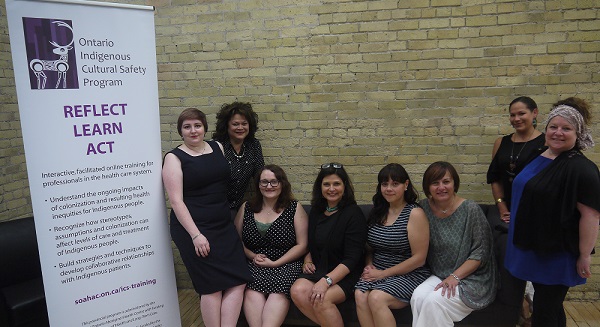
L to R: Jocelyn Raikes, Provincial Registration and Data Coordinator; Cheryl Ward, Interim Director of Indigenous Health at PHSA and San’yas ICS curriculum developer; Jessa Bear, ICS Online Facilitator; Diane Smylie, ICS Provincial Director; Leila Monib, ICS Provincial Practice Lead; Gertie Mai Muise, Provincial Director of Aboriginal Health Access Centre Transformation at the AOHC and former Associate Director of SOAHAC; Vanessa Ambtman-Smith, Indigenous Health Lead at the South West LHIN; Michèle Parent-Bergeron, Provincial ICS Practice Lead

It’s been an exciting summer for the Ontario Indigenous Cultural Safety (ICS) Program, which celebrated the launch of its new brand in June and July, complete with a new logo designed by Lisa Boivin, a member of the Deninu Kue First Nation, interdisciplinary artist, and a MSc candidate at the Rehabilitation Sciences Institute at University of Toronto Faculty of Medicine.

The ICS program is also marking the launch of its online training for health providers across the province. The program, which began in 2014, was developed for Ontario in partnership with San’yas ICS training – a program of the Provincial Health Services Authority of British Columbia. It is led and administered through the Southwest Ontario Aboriginal Health Access Centre (SOAHAC) and was originally funded through the South West LHIN. The ICS program now works across LHINs and all health/public health sectors to build collaborative partnerships that accelerate organizational and systemic changes to improve Indigenous patient experiences. Focused on eliminating systemic colonial narratives and stereotypes held by health and social service providers (usually unconscious), the ICS program aims to surface and address any and all biases that can cause harm and maintain barriers to equitable access for Indigenous people, families and communities. 

Using an innovative and hands-on approach of facilitated online learning, the ultimate goal of the ICS program is to ensure that Indigenous people can trust they will be treated with empathy, dignity and respect when seeking health and social services.

On June 15 in London, local Traditional Knowledge Keeper Liz Akiwenzie led a celebration and traditional ceremony to honour number of people who helped guide the development of the ICS program and ensure its success. Honourees included: Brian Dokis, Executive Director, SOAHAC; Kelly Gillis, VP of Strategy, System Design and Integration, South West LHIN; Lindsay Blackwell of the MOHLTC; Gertie Mai Muise, Director of Indigenous Strategy and Relations, AHACs, AOHC; Cheryl Ward, Director of Indigenous Health at PHSA and San’yas ICS curriculum developer; Guy Hagar, formally of SOAHAC; Jessa Bear, ICS Facilitator, SOAHAC; Vanessa Ambtman-Smith, Indigenous Health Lead, South West LHIN; Dr. Chris Mackie, London-Middlesex Medical Officer and CEO.

The new ICS logo, which features Boivin’s deer painting, was developed in consultation with the program’s partners, and the design is meant to be a meaningful representation of what the program aims to achieve, as reflected in ICS’s statement that accompanied the logo release: “The deer embodies generosity by giving us his flesh for nourishment, hide for clothing, bones for tools, and antlers for Sweatlodge. Deer’s generosity helps us to survive. Similarly, cultural safety training provides for us by offering intellectual nourishment for learners and the tools to interact with one another in a good way. Like the Deer, cultural safety provides for many needs. It is a versatile knowledge that is linked to all areas of life -- not just in the clinic or the office. Cultural safety must be practiced everywhere.”

Refugee symposium brings together health and resettlement providers to learn from Syria response

le Jeudi 13 Juillet 2017

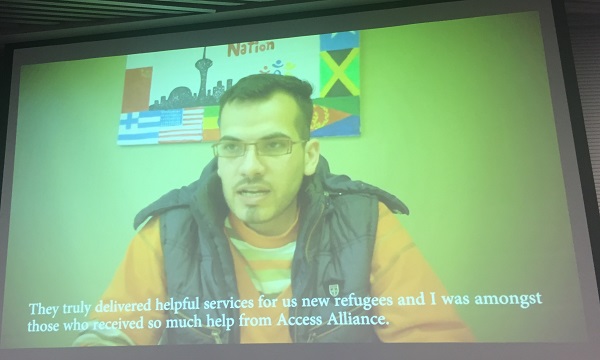
Even though there were challenges to providing Primary Care to newly arrived Syrian refugees with pressing medical needs, providers were still able to deliver a level of care that inspired grateful testimonials that were part of the June 28 symposium presentation.

Since it was first announced in fall 2015 that Canada would accept an increased number of Syrian refugees to help alleviate a growing humanitarian crisis in the Middle East and Europe, AOHC members across the province stepped up to help fill the gap in Primary Care and welcome newcomers with open arms (and a wide array of programs).

But staff from any centre touched by the influx of refugees will tell you: the work was not without its challenges and late nights. From forging new partnerships with organizations also struggling with the sudden volume of work, to finding ways to manage new resources, whether they were donations, volunteers or funds, the last 18-24 months have presented a nearly unprecedented chance to learn from these challenges and successes.

“We had a sincere desire to learn from the experience of a collaborative response to the Syrian refugee influx,” said Axelle Janczur, Executive Director of Access Alliance CHC, which hosted the June 28 Best Practices Symposium in Toronto. Other partners on hand to share learnings during a panel discussion included Toronto Public Health, COSTI Immigrant Services, Scarborough Centre for Healthy Communities, and the Syrian Canadian Foundation.

Some key findings:

    • Intersectoral collaboration was key for meeting Primary Care needs in a timely fashion
    • Transportation and medical interpretation/translation need to be part of early planning conversations, since they can each become pain points when trying to organize care
    • Having dedicated staff and large numbers of volunteers is good, but organizations need capacity to train both staff and volunteers on what they’re doing (since it’s often different from day-to-day routines), but also in self-care and recognizing fatigue
    • Media attention must be carefully managed to ensure a reduced burden of requests for access/interviews, and to use media outlets as a way to publicize areas of need

Overall, Access Alliance's research lead for the project, Fatima Mussa, said she hopes that providers can take Best Practice learnings from the work and implement them to collaborate better in the future.

“This research highlights the need for providers to consider how we allocate resources and support in advance during planning phases with partners, to make sure that services are equitable for all newcomers,” Mussa said. “It also highlights that there are significant advocacy points that providers can collaborate together on, in order to address policy and funding gaps in resettlement services.”

A cross-sector report, which included contributions from peer researchers, health providers, and resettlement groups, was presented alongside video testimonials from newcomers themselves.

Read the summary report: Refugee Resettlement: Lessons Learned From the Syrian Response.

Les récits sur le sentiment d’appartenance incarnent les raisons pour lesquelles nous nous efforçons de placer l’#équitéensanté au cœur de chaque conversation

le Mercredi 28 Juin 2017

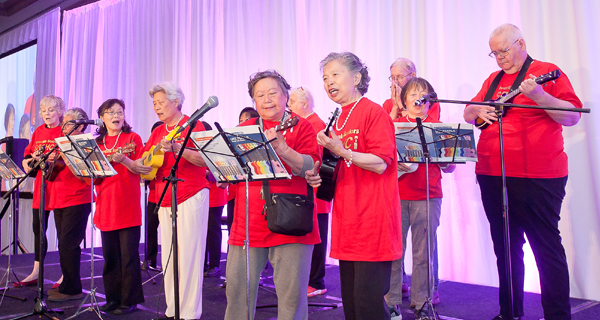
Le groupe de musiciens RISE du CSC de Riverdale-Sud se produit au congrès Changer la conversation : Santé communautaire et bien-être. Ce groupe est un exemple de la manière dont les membres de l’ACSO consolident le sentiment d’appartenance pour promouvoir la santé et le bien-être.  


Par Kate Mulligan, Directrice, politiques et communications

Les priorités de notre société sont inscrites sur notre corps. Notre état de santé – en tant qu’individus et entre populations et groupes – raconte des histoires importantes sur nos conditions de vie. Ce sont parfois des histoires que nous n’avons pas les mots pour exprimer. Parfois, nos corps nous disent que nous sommes solitaires, exclus, marginalisés ou oubliés. Plus que de cesser de fumer ou de perdre du poids, c’est le sentiment d’appartenance – d’inclusion sociale, de liens chaleureux et d’amitié – qui change tout pour la durée et la qualité de notre vie. C’est le message que Susan Pinker, psychologue en développement, chercheuse, auteure et chroniqueuse au Wall Street Journal, a présenté au récent congrès annuel de l’ACSO. 

Au congrès, j’ai appris de première main comment les centres membres de l’ACSO jouent le rôle de ce que Pinker appelle les « troisièmes espaces » – des lieux dans le monde qui nous ancrent dans nos communautés et créent un sentiment d’appartenance, qui est, pour l’être humain, un impératif biologique. Tout au long du congrès, et lors du sommet sur l’appartenance avant le congrès, j’ai pu constater le travail émotif des membres du personnel – le soin et l’aménagement des lieux nécessaires à la création d’espaces d’appartenance si essentiels à la promotion d’une bonne santé. J’ai entendu le leadership, l’empathie, le courage, la vision et la persévérance. Pendant les séances de discussion et les conversations de couloir, et grâce à des questions réfléchies et des présentations d’affiches, j’ai été témoin du leadership transformateur dans les soins de santé primaires complets présentés de tant de façons créatives par le personnel des membres de l’ACSO. J’ai pensé aux mots de Mary MacNutt, la directrice des communications de l’ACSO qui prend sa retraite, pour qui le congrès représente la tâche de « réfléchir le travail des membres de l’AOHC vers les personnes qui le rendent possible. »

J’ai observé votre leadership pour ce qui est de rappeler aux dirigeants politiques et à nous-mêmes l’importance d’accueillir des conversations importantes, comme celle sur le racisme anti-Noir et la santé. J’ai entendu parler des engagements à long terme concernant la santé des Autochtones et le travail de réconciliation avec les nations autochtones. J’ai vu le travail accompli pour favoriser les Maillons santé pour les personnes qui ont le plus besoin d’appartenance et de soins. J’ai ressenti le dévouement émotionnel envers un pair chef de file dans la réduction des méfaits des toxicomanies et de la maladie mentale. Et j’ai ressenti le sentiment d’appartenance et de reconnaissance que de nombreux délégués ressentent année après année – attirés par les champions de la santé communautaire qui n’ont ménagé aucun effort pour s’assurer que je me sente bien accueillie à mon tout premier congrès de l’ACSO.

En tant que géographe de la santé, je vois la santé humaine comme une authentique incarnation de nos milieux de vie – le dialogue permanent entre notre univers matériel et notre univers social. En tant que nouvelle directrice des politiques et des communications de l’ACSO, je souhaite faire évoluer ce dialogue – en partageant les histoires sur la santé des membres avec les personnes qui doivent les entendre, en nous nous-mêmes et nos communautés représentés équitablement dans notre monde social et politique et en façonnant nos milieux grâce au travail acharné de plaidoyer, d’analyse politique et de changement de politique.

Lors du congrès, j’ai vu comment nos membres travaillent dur pour « changer la conversation » au quotidien. Leurs histoires sont souvent celles que vous n’entendez pas représentées dans les médias. Mais elles sont au cœur des problèmes les plus pressants de notre époque : l’équité en matière de santé et le bien-être de la communauté.

Au cours des dernières années, nous avons réussi à transmettre des conversations sur l’équité en matière de santé et la promotion de la santé, et à faire inscrire ces points au programme du gouvernement. L’équité en matière de santé et la promotion de la santé sont mentionnées explicitement dans les lettres de mandat du RLISS et dans la loi accordant la priorité aux patients. On en parle dans les médias et elles sont dans la mire pour les prochaines élections, grâce aux engagements sur l’assurance médicaments déjà pris par les libéraux et le NPD – les premières promesses électorales touchant l’équité à sortir des blocs de départ. Bientôt, nous allons pousser la conversation un peu plus loin en mettant l’équité en matière de santé non seulement sur la table, mais au centre : du travail que nous faisons, des conversations publiques sur l’avenir de l’Ontario, des politiques de soins de santé primaires et du travail visant à bâtir des collectivités plus saines.

Individuellement, nous ne sommes pas infatigables. Comme Desmond Cole l’a souligné dans son discours d’acceptation du Prix des médias au congrès de l’ACSO, notre travail peut hypothéquer notre organisme, nos relations personnelles et notre santé. Mais ensemble, nous sommes implacables dans notre travail pour l’équité en matière de santé et le bien-être de la communauté.

Nous avons tant d’histoires à raconter. Pour apporter de réels changements, nous devons les raconter maintenant. Quelle est la vôtre?

Si vous avez des histoires à partager, envoyez-les à Jason Rehel, producteur de contenu et rédacteur en chef à l’ACSO, à jason.rehel@aohc.org. Pour les points saillants du congrès, consultez ce résumé dans Storify

Guelph CHC is leading a Collective Impact approach to improve children's and families' health and wellbeing

le Mercredi 5 Juillet 2017

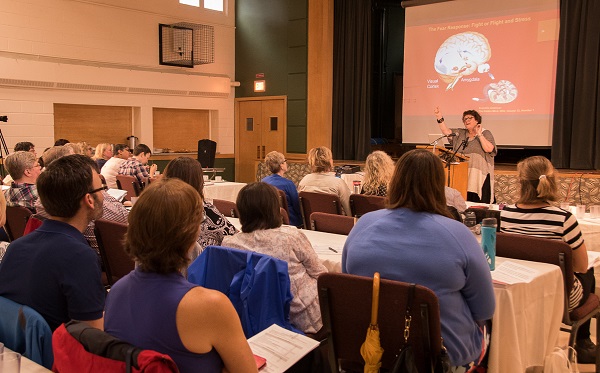
Dr. Jean Clinton, a child psychiatrist and professor of psychiatry, outlines the connection between the stress response to an adverse childhood experience and poorer health later in life for a Collective Impact audience brought together by Guelph CHC.

If you want to go upstream to make a difference to factors that could affect a child’s health and wellbeing for the rest of their lives, it doesn’t make sense to paddle alone. That’s why Guelph Community Health Centre is using a Collective Impact approach to address a complex social issue that has direct impacts on children’s and families’ health.

Adverse Childhood Experiences (or ACEs, for short) is a term given to all types of abuse, neglect, or other traumatic experiences that occur when individuals are under the age of 18. Although research in this area is relatively new, a groundbreaking study – conducted between 1995 and 1997 with 17,000 people – discovered profound and strong connections between having ACEs and poorer mental and physical health. The study tied a person’s ACE “score” – or the number of ACEs they had – to the likelihood of a range of chronic diseases and illnesses later in life, such as cancer, diabetes, stroke, COPD, and depression.

On June 23, Guelph CHC, in partnership with other local service providers, hosted an event focused on ACEs, where Dr. Jean Clinton, a child psychiatrist and professor of Psychiatry and Behavioural Neurosciences at McMaster, spelled out the connection between ACEs and poor health explicitly, focusing on the developing brain’s reactions and adaptations to stressful stimuli. Dr. Clinton’s talk was part of a call to action in Guelph to develop a comprehensive plan to prevent and mitigate the effects of ACEs. Dr. Clinton also drove home to her audience that ACEs are not our destiny. Her message? Yes, there is hope. But you will need to take action in many different ways. Resilience can be built – in communities, in neighbourhoods, in families, in individuals – but it takes love, building connections, and giving people different tools and strategies to cope with stress, Clinton noted.

The rest of the day was focused on building a Collective Impact approach to ACEs in Guelph and Wellington County, by developing and strengthening the partnerships of the Toward Common Ground coalition. Stakeholders – including Guelph CHC, the Guelph Neighbourhood Support Coalition, the local Public Health Unit, Family and Children Services, the Canadian Mental Health Association, municipal and provincial politicians, the local police department, and other local leaders and change-makers – put their heads together to develop new ideas for how to best support families and individuals at risk for ACEs, and each other as service providers.

One great idea that’s already making a difference is Guelph CHC’s Parent Outreach Worker Program (POW). The POW program supports families and children in many different ways to reduce the risk of ACEs, while trying to mitigate and build resilience around the effects of adverse experiences that people have already had.

“My work could involve providing one-on-one support to a mom who is isolated,” says Katie Davis, one of three Parent Outreach Workers embedded in three different neighbourhood groups in Guelph. “Once a relationship is developed, I could refer the mom to a local group coffee hour program where she has a chance to meet and chat with other parents in the neighbourhood, which can often lead to friendships and support for parents from other parents as well as their children.”

(Click on the image above for the full POW Evaluation Report.)

The POW program aims to: increase social connection; improve access to basic needs such as food, clothing, and school supplies; create greater awareness of and access to formal services and supports, such as mental health counselling, legal aid, and Ontario Works; and increase community safety and connections overall.

As Davis points out, though, it’s the local, neighbourhood-based approach that has allowed for trust to be built between isolated parents and the providers reaching out to help them.

“Parents feel comfortable accessing services where they feel a sense of familiarity,” Davis says. “Being embedded in the neighbourhood group, I can connect and offer a warm hand off to parents to the programs offered by the group. An example would be connecting a mom with Guelph CHC’s Garden Fresh Box program.”

Davis says she knows it’s the relationships she’s been able to foster that have led to the great early results yielded by the POW program.

“It takes time to build relationships. Parents come from a variety of backgrounds with trauma and high ACE scores, and they are often distrusting,” Davis notes. “But once a relationship has developed parents are more willing to engage in services and programs in the neighbourhood as well in the city with support from myself.”

Here's a preliminary Evaluation Report of the Parent Outreach Worker program for more background. The POW program is part of the Nurturing Neighbourhoods Initiative in Guelph.