To effectively support marginalized people most impacted by COVID-19, Ontario needs a community response strategy

le Mardi 17 Novembre 2020

Late last week, like many other stakeholders in the province’s health system, we were encouraged to see the Ontario government modify its COVID-19 Response Framework to lower thresholds for putting public health restrictions in place in different regions.

The Alliance and its members remain very concerned, however, that not nearly enough is being done by the Ontario government to coordinate and resource local responses to support marginalized people during the pandemic. For those at higher COVID-19 risk -- including front-facing workers, racialized people, people living on low incomes and in crowded living conditions, people experiencing homelessness, and those dealing with addictions issues and the overdose crisis -- a robust community-based response strategy is needed from provincial leaders. One-size-fits-all public health messages and directives – such as telling people to work from home, physically distance from people outside your household, get your food/meals delivered, get tested if you have symptoms, isolate for 14 days – when many of these directives are near impossible for marginalized people to follow, is ineffective, inequitable and unjust. The result of the government’s continued inaction to support marginalized communities has been a direct and stark correlation between existing health inequities in Ontario and the worst impacts of COVID-19. Ontario’s marginalized communities, the least supported during the pandemic, are being forced to bear the brunt of the consequences of this continued inaction and lack of local supports.

People in higher risk groups face challenges such as housing and food insecurity, mental health concerns, increased stigma and distrust of the health system, often due to racism, and lower or loss of income due to the pandemic. Unfortunately, the current Ontario COVID-19 response framework and messaging from the Chief Medical Officer of Health continues to be focused on individual responsibility ahead of systemic strategy, interventions and supports. We’ve seen criticism in recent days of the focus on “individual responsibility” as ineffective given the lack of clarity and consistency in messaging from the province in the last two months. For people already at higher COVID-19 risk due to social and economic factors, the lack of a systemic response focused on health equity goes from ineffective to being (avoidably) tragic.  

COVID-19 has made (and continues to make) health and economic disparities worse; this pattern will continue unless action is taken to support marginalized communities and the organizations responding to their needs. The need for an equity-focused COVID-19 response is the key thesis in the Chief Public Health Officer of Canada’s annual report From Risk to Resilience: An equity approach to COVID-19, released in October.

Just last week, community health leaders pointed again to trust and local support as the key missing elements of Ontario’s COVID-19 response plan. While Community Health Centres in Ontario hotspots such as northwest Toronto, Peel, Ottawa and across the province have worked diligently with partners to provide testing and other supports to marginalized populations where positive COVID-19 test rates are the highest, messaging, outreach and community level supports need be resourced, coordinated and more robust. Local lines of trust and support are critical now to infection prevention and control, and the same lines of community-built trust will be vital to the successful uptake and distribution of a COVID-19 vaccine.

A common and widely understood response framework is important in Ontario’s COVID-19 efforts, but it can only be one piece of a robust strategy. For marginalized people and communities, targeted and tailored approaches are needed to ensuring local needs are being met, unique barriers to staying healthy and safe are mitigated, and that people at higher risk of COVID-19 are not left behind. As experts in community health have pointed out again and again, including those at Black Creek and Rexdale Community Health Centres in Toronto, Thunder Bay, Ottawa, and elsewhere, the province needs to support an equitable and coordinated response – both during the pandemic to help people prevent and control infections, but also crucially during the vaccine and recovery phases. The health and wellbeing of everyone in Ontario depends on it.

Transformative Change Awards 2020

le Mardi 10 Novembre 2020
Graphic with illustration of birds flying with words: Transformative Change Awards Prix du changement transformateur

Congratulations to the 2020 Transformative Change Award recipients!

Here is the full list of honurees, plus videos featuring the three innovative programs chosen as this year's Transformative Change Award recipients by the Alliance Board.

Joe Leonard Award (description of this career recognition award)

Notisha Massaquoi, former executive director, Women's Health in Women's Hands CHC.

Health Equity Champions: "commitment to dismantling barriers to equitable health and championing policies and interventions that address discrimination and oppression" - Also, as a special tribute to the late Denise Brooks, the award will now be known annually as the "Denise Brooks Health Equity Champion Award" to honour Denise's legacy of health equity and anti-poverty leadership in Ontario.

Denise Brooks, Hamilton Urban Core CHC, for dedication and inspiring leadership in health equity, anti-racism and anti-poverty work in Hamilton, Ontario and across Canada.

Dr. Andrea Sereda. London Intercommunity Health Centre, for advocacy and support on harm reduction and the breakthrough of safer supply to help save lives during the overdose crisis.

Community Health Champions: "outstanding contributions to improving community health and advancing health equity"

Ontario Oral Health Alliance, for their contributions to advocacy for publicly-funded oral health and dental care, and for the achievement of the Low Income Seniors Dental Program in Ontario.

Adrianna Tetley Legacy Award (new): "an emerging leader who inspires contributions to primary health care transformation to improve the health and wellbeing of people and communities facing barriers"

Adrianna Tetley (inaugural year)

Transformative Change Awards (three): "work at the forefront of transformative change to achieve the best possible health and wellbeing for everyone living in Ontario"

CANDID ServicesNurse Practitioner-Led Clinic, Canadian Mental Health Association Durham:

________________________

Équipe du site de Kirkland Lake (Rx: Communauté – La prescription sociale)Centre de santé communautaire du Témiskaming:

________________________

Windsor Team Care Centre Windsor Family Health Team:

Budget de l’Ontario de 2020 : Déclaration et analyse de l’Alliance pour des communautés en santé

le Vendredi 6 Novembre 2020

Le 5 novembre 2020, le gouvernement provincial a publié son budget annuel, qui s’inscrit dans son Plan d’action pour la protection, le soutien et la relance dans le cadre de la COVID-19 et qui contient des prévisions pluriannuelles. En tout, les investissements sont de l’ordre de 45 milliards de dollars, dont plusieurs avaient été annoncés antérieurement.   

Bien que ce budget ait pour principal objectif de répondre aux impacts immédiats de la pandémie de la COVID-19 par l’augmentation de la capacité des soins actifs et des soins de longue durée et du soutien aux entreprises, l’Alliance est préoccupée par le manque de clarté en ce qui concerne des mesures particulières pour les personnes et les communautés marginalisées. Les aînés isolés, les personnes à risque en raison de la crise des surdoses, les populations noires, les communautés autochtones, les personnes à faible revenu, et d’autres personnes qui ont été touchées de façon disproportionnée par la pandémie sont pour ainsi dire invisibles dans ce budget.

Nous sommes aussi préoccupés par le fait que bien que les soins de santé primaires en équipes aient joué un rôle de premier plan dans les réponses locales contre la COVID-19, par la collaboration avec des partenaires et des bureaux de santé publique pour appuyer le dépistage, le travail de proximité et d’autres mesures relatives à la COVID-19, il y a peu de mentions spécifiques ou de ressources affectées à ces efforts dans le budget. Dans l’ensemble, les objectifs du budget sont les bons, soit de soutenir et de protéger les individus pendant la pandémie et de faire en sorte qu’ils ont ce dont ils ont besoin pour se remettre sur pied lors du rétablissement. Cependant, afin d’assurer un rétablissement dynamique qui fonctionne pour tous, il faut en faire encore bien plus, particulièrement pour les personnes marginalisées plus susceptibles d’avoir de mauvais résultats en santé maintenant et lors du rétablissement.    

Soins primaires

Les organisations de soins primaires, dont les membres de l’Alliance, ont joué, et jouent toujours, des rôles essentiels dans la vie des gens, ayant depuis des années établi des relations de confiance entre les fournisseurs et les communautés. La confiance est essentielle, surtout chez les communautés marginalisées, pour assurer des mesures équitables relatives à la COVID-19, et le sera d’autant plus au moment de distribuer les vaccins. Même si le gouvernement prend des mesures dans le budget pour couvrir certains des coûts liés à la pandémie, peu de détails sont offerts sur l’aide directe que recevront les fournisseurs de soins primaires pour leurs activités et la gestion des coûts additionnels associés à la pandémie. Des investissements provinciaux sont toujours requis pour des initiatives communautaires de travail de proximité, de dépistage, de vaccination contre la grippe, de services sociaux, et de visites pour assurer le bien-être, ainsi que pour des services de soins de santé et de promotion de la santé de base. La prestation par les membres de l’Alliance de soins de santé primaires complets est essentielle pour garder les personnes en santé et en sécurité pendant la pandémie, surtout si l’on considère les difficultés additionnelles auxquelles les gens font toujours face, et leur travail sera essentiel à des rétablissements communautaires dynamiques et durables.

Comme en fait état un article paru cette semaine dans la publication Healthy Debate, le plan de l’Ontario pour contrôler la deuxième vague doit inclure la participation des soins primaires. L’Alliance poursuit ses efforts de sensibilisation et de revendication avec ses membres et ses partenaires du secteur pour que le travail essentiel des soins de santé primaires complets soit reconnu et qu’il reçoive des ressources et du financement adéquats de ce gouvernement. 

Crise des opioïdes et des surdoses

Nous sommes très préoccupés par l’absence de mention de la crise des intoxications aux opioïdes et des surdoses, d’un approvisionnement plus sécuritaire, de la réduction des méfaits et de mesures connexes pour soutenir les communautés. Sans reconnaissance ou financement, ce budget ne prévoit aucun plan d’action concernant cette crise qui s’aggrave et son impact sur les personnes et les communautés de la province. Les personnes meurent toujours, le taux de mortalité de surdoses en Ontario étant à son niveau le plus élevé depuis l’aggravation de la crise il y a quelques années. Les fournisseurs de soins de santé mentale et de réduction des méfaits ont besoin d’investissements pour lutter contre cette crise qui continue de s’aggraver. Dans le cadre de ses efforts de revendication, ce travail demeurera prioritaire pour l’Alliance dans toutes ses discussions avec le ministère de la Santé.

La santé des Noirs et le racisme envers les Noirs

Lors de son adresse à l’Assemblée législative le 5 novembre, le ministre des Finances de l’Ontario, Rod Phillips, a reconnu qu’il avait réfléchi aux conversations importantes qui ont lieu dans les communautés sur le racisme envers les Noirs. Il a aussi déclaré que l’Ontario est un endroit où toutes les personnes ont droit au respect et aux possibilités d’atteindre tout leur potentiel. Il a ajouté qu’il est inacceptable que le racisme systémique et d’autres formes de haine demeurent des obstacles, et que dans bien des cas, la COVID-19 a exacerbé des inégalités existantes. Il a conclu en disant que des efforts importants étaient déjà entrepris concernant ces enjeux.

Cependant, à l’exception du financement accru pour le Plan d’action pour les jeunes noirs, une nouvelle bien accueillie, aucun autre investissement n’a été annoncé pour des stratégies ou des programmes pour favoriser la santé des Noirs ou pour lutter contre le racisme envers les Noirs. Comme l’Alliance l’avait expliqué dans sa soumission prébudgétaire au gouvernement, la création et le financement d’une stratégie provinciale de promotion de la santé des Noirs sont essentiels pour engendrer des changements et pour lutter contre le racisme envers les Noirs dans les soins de santé et d’autres secteurs.

Conclusion

Nous entendons les gens parler de plus en plus du déficit imminent qui sera causé par la pandémie. Cette notion d’un manque de ressources va bien au-delà d’un déficit financier. Lorsque les communautés doivent faire des compressions et offrir plus de services sans un financement accru, ce sont généralement les personnes et les communautés marginalisées qui ne reçoivent pas de services et qui en subissent les conséquences sur leur santé. Dans ce budget, l’absence de solutions communautaires et le manque d’importance accordée aux soins primaires et aux équipes interprofessionnelles risquent d’entraîner l’Ontario dans un « déficit communautaire » causé par la COVID-19. De plus, le budget n’adopte aucune mesure substantielle concernant les priorités pour l’équité en santé, comme la lutte contre le racisme et les questions liées aux déterminants sociaux de la santé, dont la pauvreté, la sécurité alimentaire, l’emploi juste et stable, le logement abordable et des écoles plus sécuritaires. L’Alliance demeure préoccupée par le fait que l’absence de gestes concrets et de leadership du gouvernement provincial concernant l’équité en santé engendrera des déficits communautaires à l’avenir qui seront ressentis davantage par les personnes pouvant le moins porter le fardeau de cette pandémie. Nous poursuivrons nos efforts avec nos partenaires pour demander des mesures et des ressources visant à promouvoir l’équité en santé.


Ontario Budget 2020: Alliance for Healthier Communities' statement and analysis

le Vendredi 6 Novembre 2020
Graphic that reads: Ontario needs to make community a priority

On November 5, 2020, the provincial government released its annual budget, which further builds on its COVID-19 Action Plan to Protect, Support and Recover, and contains a multi-year forecast. Overall, there are $45 billion in investments, many of which were previously announced. 

Although this budget focused heavily on addressing immediate impacts of the COVID-19 pandemic through increasing acute care and long-term care capacity and supporting businesses, the Alliance is concerned at the lack of clarity about specific supports for marginalized people and communities. Isolated seniors, people at risk due to the overdose crisis, Black populations, Indigenous communities, people living on low incomes, and others who've borne disproportionate impacts of the pandemic are largely invisible in this budget.

We're also concerned that, although team-based primary care has been foundational in local COVID-19 responses – working with partners and local public health units to support testing, outreach, and other supports related to COVID-19 – there are few specific mentions or dedicated resources in the budget to support this work. On the whole, the budget has the right goals in mind: to support and protect people throughout the pandemic and to ensure people have what they need to get back on their feet in recovery. But in order to ensure a healthy recovery that works for everyone, much more needs to be done, particularly for those marginalized people at much higher risk of poor health outcomes both now and in recovery.

Primary Care

Primary care organizations, Alliance members among them, have played and continue to play foundational roles in people’s lives, with years of trust built between providers and communities. Particularly among marginalized communities, trust is essential to ensuring equitable COVID-19 responses, and will be especially vital when it’s time to distribute vaccines. While the government addresses some health provider costs related to the pandemic in the budget, there are few specifics as to how this will directly aid primary care providers in their operations and in managing additional costs related to the pandemic. Provincial investments are still needed for community-driven outreach and testing, flu vaccination, wrap-around social supports, virtual wellness checks, as well as core healthcare and health promotion services. Alliance members’ delivery of comprehensive primary health care is vital to keeping people healthy and safe during the pandemic, especially considering additional barriers people continue to face, and their work will be vital to healthy and sustainable community recoveries.

As recognized in a Healthy Debate article published this week, Ontario's plan to contain second wave "needs a dose of primary care engagement". The Alliance will continue to advocate with its members and sector partners for the critical work of comprehensive primary health care to be recognized and adequately resourced by this government.

Opioid and Overdose Crisis

We are very concerned about the lack of mention of the opioid poisoning and overdose crisis, safer supply, harm reduction, or any related measures to support communities. With no recognition or funding, there is no acknowledgement or plan of action in this budget for the worsening crisis and its impact on people and communities across the province. People continue to die; the rate of deaths from overdose in Ontario is the highest since the crisis worsened several years ago. Mental health and harm reduction providers need investments to address this ongoing and worsening crisis. We need concrete support for effective programs like safer supply. This work is and will continue to be an active priority for the Alliance in all our conversations with the Ministry of Health and in our continued advocacy work.

Black Health and Anti-Black Racism

When addressing the house yesterday, Ontario’s Minister of Finance Rod Phillips acknowledged that he had “been reflecting on the important conversations that have been happening in communities about anti-Black racism.” He also stated that “Ontario is a place where every person deserves respect and the opportunity to be all that they can be. Unfortunately, systemic racism and other forms of hate still get in the way, and that is simply unacceptable. In many cases, COVID-19 has exacerbated existing inequities. Important work is already underway to address these issues.”

However, aside from the welcomed increase to funding for the Black Youth Action Plan, there is no other investments being made in Black Health or anti-Black racism strategies or programs. As the Alliance laid out in our pre-budget submission to the government, creating and funding a provincial Black health strategy is essential to enabling change and addressing anti-Black racism in health care and other sectors.

Conclusion

We increasingly hear people talking about the looming “pandemic deficit”. The notion of a lack of resources during this time goes beyond the purely financial. When communities are forced to make cutbacks and deliver more services with the same funding, it’s generally marginalized people and communities who aren’t served and end up with poorer health outcomes. This budget, with its lack of any meaningful focus on community-driven solutions, primary care, interprofessional teams and the social determinants of health, leaves Ontario at risk of a “community deficit” due to COVID-19. In addition, the budget doesn’t take any meaningful action on health equity priorities, such as anti-racism or the social determinants of health (SDOH), including poverty reduction, food security, fair and stable employment, affordable housing or safer schools. The Alliance remains concerned that a lack of action and leadership from the provincial government on health equity will mean that future community deficits are felt most deeply by those who can least afford to carry more burden from the pandemic. We will continue to work with our partners to seek out action and resources on health equity.


Delhi Family Health Team awarded AFHTO Bright Lights Award for dedication and nimble work with partners to support COVID-19 response for farm workers

le Jeudi 22 Octobre 2020
Nurses from Delhi FHT who worked as part of primary care response team serving seasonal agricultural workers during COVID-19. The team has won an AFHTO Bright Lights Award for their efforts.

When the Medical Officer of Health for Haldimand and Norfolk called her on a Saturday morning last spring as COVID-19 outbreaks were overtaking many Ontario farms, Robin Mackie, a registered nurse and executive director of Delhi Family Health Team, didn't hesitate for a moment.

"I said, 'OK, what do you need?' and Dr. [Shanker] Nesathurai said, 'We need you guys in the field, can you go out and do this?' I thought he meant Monday, but then he asked, "Can you get out there today? We need to flatten the curve as much as we can." 

Mackie, who herself had battled a serious COVID-19 infection that resulted in a transfer to hospital in March, said it clicked in her head in a split second, given the barriers that seasonal agricultural workers face in terms of language, access, housing and co-morbidities.

"Even though we have a seasonal agricultural program (to serve workers in need of primary care, the FHT operates a clinic serving 3,300 workers), it’s very dependent on the workers getting to us. With this virus, and its ability to spread so quickly, how were the farm workers going to get to us safely?" Mackie explained in a recent interview with the Alliance. "When Dr. Nesathurai suggested going to the farms, the first thing I thought was, 'That’s a fantastic idea. Bring health care to them.' I didn’t even think of the logistics of how we were going to do it. I just knew that we were going to do it. Honestly, there was no option."

In the next few hours, Mackie called her team and assembled a plan. One thing there was never any doubt about was the dedication of the Delhi Family Health Team doctors, nurses and other staff.

"I knew that my team was that good, that they were that prepared, and I knew that they were that dedicated," Mackie said. "So I put out a call saying, 'I have no idea how we’re going to do this, but this community needs us. This vulnerable population needs us.' And my team just said, 'Where do you want us, and when?' "

Within hours, Mackie had gathered a team of two doctors and four nurses with PPE and they headed to the farm’s bunkhouses. Later, efficiencies were created by utilizing medical directives, onsite Nurse Practitioners, translators and nurses who often traveled to multiple bunkhouses by way of their own a pickup truck. In the coming weeks, staff relied on interpreters and translation apps to assess the needs of the farm workers. Their work encompassed physical screening, testing, assessment, and treatment of workers -- but also went beyond those public health imperatives.

The Delhi team would conduct 673 "in the field" visits on the farm in 30 days, with Mackie noting that she remained on call for her team, which often spanned 12-14 hours with some evenings in June until 10 p.m. Together with strong, trusted community partners from the Canadian Mental Health Association, Grand River CHC, and community parademics, along with public health, the core Primary Care Mobile Response Team led by Delhi FHT was able to put in place supports and interventions to help prevent outbreaks, serious illness and hospitalizations. Over time, the workers opened up to staff about more than just medical concerns -- also speaking of missing families and children, their fears about money and health. One evening, nurse Practitioner Rebecca Spencer-Knight was already finished her shift when she texted Mackie for permission to stay longer. “A gentleman was crying, he was so home sick. She didn’t think he should be alone,” Mackie said.

The nurses “were the heroes here,” said Dr. William Thorogood, assistant professor and Simcoe site lead for McMaster University’s Department of Family Medicine and preceptor with the Delhi Family Health Team., “and this is a story of their collaboration with Emergency Medical Services and Public Health in a broad community effort. It’s the story of nurses who gave much more than medicine.”

Earlier this month, the Association of Family Health Teams of Ontario recognized and honoured this amazing group and their partners with its highest honour, a Bright Lights Award. The recognition means a lot to Mackie, not just as a health leader, but also for her team and team-based health care in general.

"Team-based care has always been behind the scenes doing work and we don’t seem to be noticed, and we’re kind of a humble group. We know what the right thing to do is, and we do it," Mackie said. "This award isn’t about ourselves, it’s about our community. And it’s about recognizing how well team-based care can work."

Mackie also credits the community governance at the Delhi Family Health Team for their trust and support of her leadership and staff, and being an important enabler of the nimble response for farm workers.

"For our board, their gut response is always to support community. They trust me to do what’s right for the people we serve and our broader community."

#CHWW2020: Learn about the impact of arts on health & wellbeing - webinar recording and inspirational ballet video

le Vendredi 9 Octobre 2020

Isolation and COVID-19 measures are often difficult and can harm mental and physical health. Taking steps to mitigate the effects of the measures on health and wellbeing is important, and that's why Alliance members work with many partners, such as through the social prescribing Rx Community project, to find novel ways to get people connected, moving, and feeling good.

For Community Health and Wellbeing Week, the Alliance partnered with Canada's National Ballet School, to bring you a webinar earlier this week: Arts on Prescription: Improving health and wellbeing through arts participation.

If you missed the webinar, wish to review it, or would like to share it with colleagues and community partners, you can access the webinar recordingslide deck, and additional resources online. Contact information for all panelists are included in the additional resources document, you are welcome to reach out and connect further.

Before you check out the webinar recording, slide deck, and amazing additional resources above from Arts on Prescription, we encourage you to check out the video at the top of this post for some inspiration and ideas for feeling good, courtesy of the team at Canada's National Ballet School who produced the video along with students across Canada. It's truly an uplifting three minutes, and helped to remind us what joy can come from moving around, even if it's just in front of your own mirror at home.

We are grateful to our webinar panelists Melissa Smith (AGO), Megan Ferris (Canada National Ballet School), Rebecca Barnstaple (CHIGAMIK Community Health Centre), Sabrina La Tona (North York Family Health Team), and Surkhab Peerzada (South Riverdale community Health Centre) for sharing a wide range of innovative integration between arts and health through different perspectives and contexts.

We hope this webinar will help to spark new inspirations and further dialogue in your practices and teams!


Logos of Alliance, Canada's National Ballet School, AGO, South Riverdale CHC, CSC CHIGAMIK CHC, and North York FHT

We need Ontario's provincial leaders to support communities to slow COVID-19 spread

le Lundi 5 Octobre 2020
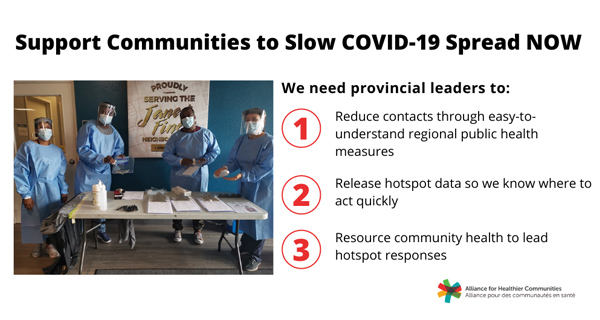
Text graphic with picture of staff at community testing site in Toronto Jane/Finch neighbourhood, that reads: Support Communities to Slow COVID-19 Spread NOW   We need provincial leaders to:   1. Reduce contacts through easy-to-understand regional public health measures 2. Release hotspot data we know where to act quickly 3. Resource community health to lead hotspot responses

We're asking everyone to join our call to the Ontario government and public health leaders: Community models work to control outbreaks. Black Creek Community Health Centre, Rexdale Community Health Centre and others have led a community-based response. We need Ontario's leaders to invest more in community now to slow COVID-19.

We need Ontario's leaders to:

1. Reduce contacts – clear regional public health measures to limit spread are needed now.

We need to act now to contain COVID-19 and prevent further harm before the second wave spirals out of control. Provincial government and public health leaders must act now to put in place population-wide protections such as limits on public gatherings, limits on businesses, appropriate messaging on social circles, mandating use of masks, and physical distancing measures.

2. Release neighbourhood hotspot data now – we can’t target messages, interventions, supports, and testing if we don’t know where to act.

Ontario needs to be more transparent with COVID-19 data and helping the public to understand what’s really going on in our province, but also in their individual communities. We need to know who COVID-19 is impacting and how it is spreading in our communities. Without this information, our healthcare and public health systems cannot intervene quickly in the right places. The province must transparently report on how COVID-19 is impacting our communities now so that we can target community-led interventions to slow the spread.

3. Resource communities now – community health centres and providers are the experts, and ensure that BIPOC and marginalized communities they serve are represented at decision making tables

We need funding now to take control of this spiralling situation where we live. A one-size-fits-all approach isn’t working in Ontario. Some communities (and areas within communities) are harder hit and the people who live in them face more barriers in accessing care. Ontario needs solutions that are responsive to what is happening on the ground. We need provincial leaders to work with community-led organizations on the ground to roll out testing strategies in hot spots. Fund community-led and mobile testing now to reach communities that are being left behind. We also need the province to ensure that the right people are sitting at decision making tables and ensure the voices of the most impacted aren’t left behind.

Take Action: Support Communities to Slow COVID-19 Spread NOW

Contact your local MPP today and join our call to the Ontario government and public health leaders: Community models work to control outbreaks. Black Creek Community Health Centre, Rexdale Community Health Centre and others have led a community-based response. We need Ontario's leaders to invest more in community now to slow COVID-19.

A template letter is provided below. Use the “Find my MPP” function on the Legislative Assembly of Ontario website to find your MPP’s contact information.


Dear MPP <insert name of your local representative here>

I am writing to you today because our community urgently needs your help. With the risk rising every day that COVID-19 cases will spiral out of control, thousands of people’s lives and families are in danger. Marginalized communities, many with high numbers of racialized people, people living on low-incomes, and people who work front-facing jobs and take public transit, are at far higher risk of COVID-19 impacts than others, and need more than blame-and-shame messages to protect themselves. They need community-led interventions, and they need your support to ensure those interventions happen.

I’m calling on you to hold Ontario government leaders accountable. Ontario urgently needs a strategy for slowing the spread of COVID-19 in marginalized neighbourhoods and keeping people safe. That means I need you to call for support of community models for testing and infection/outbreak control. Community-led comprehensive primary health care organizations, such as Black Creek Community Health Centre and Rexdale Community Health Centre, have already demonstrated this approach successfully.

I need you to raise your voice and demand action from the Ontario government NOW on: Reducing contacts, Releasing neighbourhood data, Resourcing communities:

1. Reduce contacts and opportunities for transmission -- Ontario needs clear regional public health measures to limit spread are needed now.

We need urgent action from government and Ontario Public Health to contain COVID-19 and prevent further harm before the second wave spirals out of control. Provincial government and public health leaders must act now to put in place population-wide protections such as limits on public gatherings, limits on businesses, appropriate and consistent messaging on social circles and gatherings, mandating use of masks, and physical distancing measures.

2. Release neighbourhood hotspot data now – We can’t target messages, interventions, supports, and testing if we don’t know where to act.

Ontario needs to be more transparent with COVID-19 data and helping the public to understand what’s really going on in our province, but also in people’s individual communities. We need to know who COVID-19 is impacting and how it is spreading in our communities. Without this detailed, transparent information, our healthcare and public health systems cannot intervene quickly in the right places. The province must transparently report on how COVID-19 is impacting our communities now so that we can target community-led interventions.

3. Resource communities now – community health centres and providers are the experts. We need funding now to take control of this spiralling situation where we live, and  we need to ensure that BIPOC and marginalized communities they serve are represented at decision making tables

A one-size-fits-all approach isn’t working in Ontario. Some communities (and areas within communities) are harder hit and the people who live in them face more barriers to accessing care. Ontario needs solutions that are responsive to what is happening on the ground. We need provincial leaders to work with community-led organizations to roll out testing strategies in hot spots. Fund community-led and mobile testing now to reach communities being left behind. We also need the province to ensure that the right people are sitting at decision making tables and ensure the voices of the most impacted aren’t left behind.

Thank you for your urgent help, leadership and being a true voice for this community.

<Your name>

#CHWW2020: Connecting families and children in Ottawa with supports during the COVID-19 pandemic

le Lundi 5 Octobre 2020
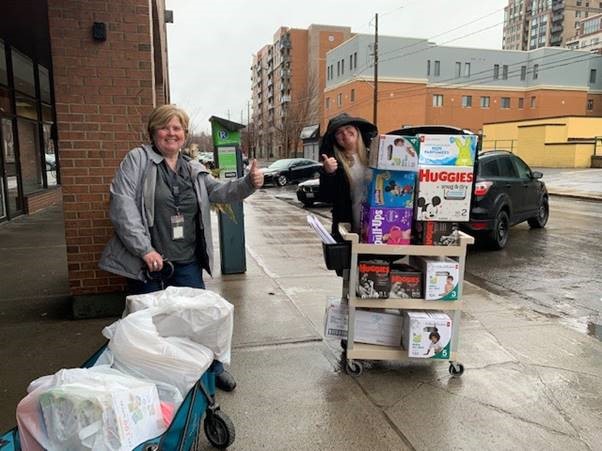
Centretown CHC: Jennifer and Vanessa loading up supplies to bring to families living in a shelter

[Jennifer and Vanessa loading up supplies to bring to families living in a shelter. Photo supplied]

Submitted by the Centretown CHC Early Years Team

Throughout Community Health and Wellbeing Week 2020, we will bring your stories of #PowerInCommunity from across the province. Today, Vanessa Graham and Emily Doolan from the Centretown CHC Early Years team in Ottawa write about the supports they've adapted to serve children and families during the pandemic.

The Early Years and EarlyON team at Centretown Community Health Centre in Ottawa is committed to providing families and children with daily support and services. As a team, we work collaboratively with other teams at the centre to ensure families have access to what they need to navigate community resources or any challenging circumstances during the COVID-19 pandemic. Families are living through a time of uncertainty, overwhelm, stress and isolation all while trying to keep their children well and happy. The team has provided families with information about early childhood development, parenting support and education, outreach services and service navigation. The following highlights how the team has successfully responded to helping families and children during the developing global pandemic.

The Early Years and EarlyON team was actively engaged in supporting CCHC’s pandemic plan. The team diligently assessed where the needs were in the community and began right away to offer their support. Emergency baby supplies were made easily accessible for families to obtain on a monthly basis. These supplies included diapers, wipes, breastfeeding supplies and clothing. In addition, Early Learning Activity Kits were put together with the focus to support at home learning for families. As summer arrived, Physical Activity Kits were created in order to promote outdoor physical activity for families all while practicing social distancing measures. Deliveries were made for families who were faced with barriers on accessing emergency supplies during the early stages of the pandemic. For continuous family connection, the team completed wellness calls to provide virtual support and navigation for services across Ottawa.

[Emily and Vanessa welcoming clients at the self-serve baby weight station]

The services that were deemed essential for community members with young children were adapted and implemented. Breastfeeding support, as well as, pre and postnatal support was continued by telephone to ensure new and expecting mothers had the necessary expertise readily available for them. The Welcome Baby Prenatal Nutrition Program continued providing support to the participants, which included a delivery of a monthly healthy snack pack and a weekly phone call to each participant. With an increased demand for baby weight services, the team offered a weekly self-serve baby weight station at the centre. To meet the needs of the community, the Early Years and EarlyOn programs and services are being offered by telephone support, virtual programming or in person. 

During this evolving time, the Early Years and EarlyOn team continues to utilize their adaptability skills in order to provide quality services to meet the unique needs of families. The team has connected with over 100 families and continues to build relationships with community members in hopes to provide a sense of security and comfort for all families. The ultimate goal for the Early Years and EarlyOn team is to foster healthy and happy children and families.

[Isabelle and Emily packing healthy snacks, activity kits and supplies. Photos supplied]