Black Creek CHC and its partners lead community response to COVID-19 in northwest Toronto

le Jeudi 23 Juillet 2020
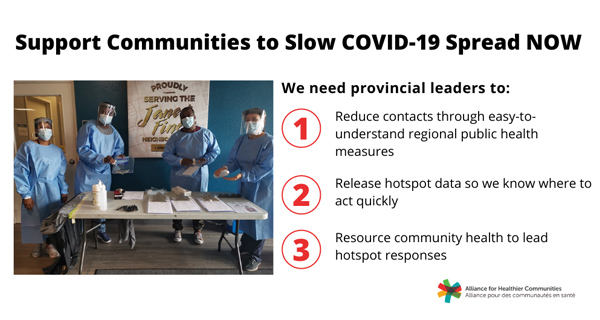
Staff at a community mobile testing site in northwest Toronto in mid-July 2020, after months of advocacy for a more community-focused approach to COVID-19.

[Community health staff pose in the lobby of one of the COVID-19 mobile testing sites that opened July 18, 2020 in the northwest of Toronto to help make services and supports more accessible for people facing higher risk during the pandemic due to marginalization.]

For months, leaders and staff at community health centres in the northwest and other areas of Toronto have advocated tirelessly for a coordinated community response to COVID-19 in support of marginalized people at higher risk of infection due to socioeconomic and other factors, such as the accessibility of testing.

This week, we celebrate the work of Black Creek Community Health Centre and its staff and partners, as mobile testing officially began in the northwest of Toronto on Saturday July 18, as reported by CBC News. This comes after months of advocacy, including in the media, as seen here in April, May and June.

We spoke briefly this week with Cheryl Prescod, Executive Director at Black Creek CHC, about what the community’s reaction was on Saturday to the arrival of mobile testing and a more community-centred model of COVID-19 response writ large, and what it took to get key factors affecting infection rates addressed at the community level.

What has the community’s reaction been to Black Creek CHC and others being able to deliver mobile testing and community-based contact tracing in areas seeing much higher rates of COVID-19?

People are feeling that they’re (finally) being listened to. But they are also still wondering why it took as long as it did. It’s so important that communities are meaningfully involved and have their voices heard in any plan and response to COVID-19, partly because gaining and keeping trust is so important, but also because the community has innovative ideas, strengths and contributions to make to keeping everyone safe during the pandemic. We've tried to amplify those voices, and now they're being heard and reflected in the response.

How are community members now being directly involved in managing and deploying the community response?

There are community outreach volunteers (who are paid honouraria), who are making a big difference in reaching “hard to reach” residents who remain skeptical about the testing. Through these volunteers, we’re able to reach people who speak many different languages and we see people’s cultures represented in outreach strategy, which is important for ensuring trusted relationships, openness with information, etc.

How else are people feeling generally about being able to get the test in their communities, vs. needing to get to a centralized or hospital assessment centre?

It’s big for people, because it means they can get tested, and they can walk to the place to get their test and not worry about taking public transit. And we’re finding that people are much more comfortable coming to a community space they’re familiar with already, vs. an assessment centre or hospital setting where they might have fear of contracting the virus.

What was a key step in making the mobile testing and a more community-focused response happen?

We started by listening closely to community agency partners involved in immediate COVID-19 responses, and hearing the things they found needed to be addressed, and the barriers people were facing. We were also hearing stories from staff doing meal deliveries who were validating those concerns. We also knew from other work that underlying issues in the community would impact infection rates: the types of jobs people have requiring them to interact with the public and others; dwelling conditions where crowding was likely, and newcomers not connected to services, to name a few examples.

Who were some of the key partners in getting things done locally in the northwest of Toronto?

We’ve worked with Emery-Keelesdale Nurse Practitioner Clinic; Toronto Medics; Home and Community Care, Central and Central West LHIN, and of course Ontario Health and Toronto Public Health. We also had support on the political side from Ward 7 Municipal Councillor Anthony Perruzza, who took these issues to the Board of Health and provincial MPP Tom Rakocevic (Humber River-Black Creek) who spoke up in the Ontario legislature about concerns in northwest Toronto. And once we got started with planning the mobile-testing and community outreach, there have been many local partners helping us on the ground, including faith-based organizations who’ve helped with offering spaces for things.

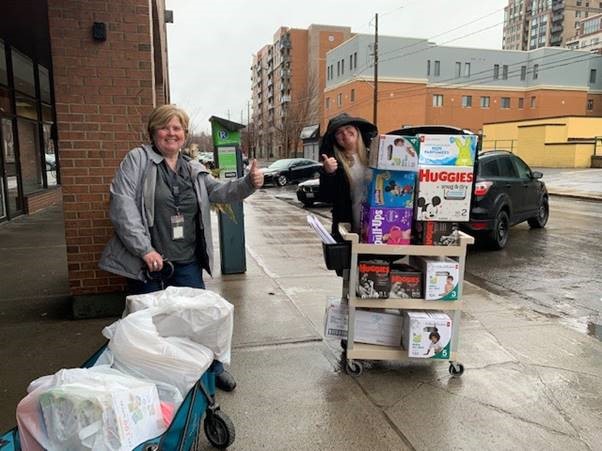
A staff member waits to screen people coming to a COVID-19 mobile testing site in northwest Toronto in July 2020.

 [Community volunteers who are being paid honouraria play an important role in getting information, services and support to hard-to-reach and often isolated people, and getting them to mobile testing sites like the one being staffed here in a northwest Toronto community space, where they can also be connected to other supports.]


COVID-19 Advocacy: Alliance members in the news

le Mardi 30 Juin 2020

Staff and leaders at Alliance member centres were very busy in the media in the last week, advocating on behalf of marginalized people and communities for equitable COVID-19 responses, and supports for people who are disproportionately impacted by the pandemic.

From advocacy people facing systemic barriers and racism during COVID-19 responses, to urging the government to act quickly on housing for people experiencing homelessness, to addressing the intersection of the overdose crisis with COVID-19, Alliance members were raising their voices across Ontario for marginalized communities.

Staff and leaders at Rexdale CHC and Black Creek CHC in northwest Toronto were part of an in-depth story unpacking the missing parts of community level responses to COVID-19, talking about the work they’ve been doing to help people stay safe and get tested, and what’s missing from the provincial COVID-19 strategy for vulnerable people, including mobile testing. The article also goes into detail regarding the lack of primary care access in some parts of the city, and how this has contributed to higher rates of infection and illness among racialized and low-income people living in those areas.

In the Ottawa Citizen, Suzanne Obiorah, director of primary care at Somerset West CHC, discussed how systemic racism and existing health inequities are at the root of what racialized and immigrant communities in Ottawa are experiencing higher rates of COVID-19 and more impacts. “Health inequities are deep-rooted, and they’re a direct consequence of systemic barriers, of systemic racism.”

Parkdale-Queen West CHC executive director Angela Robertson spoke to the media this week about the crucial work that needs to happen to provide housing for people experiencing homelessness ahead of an anticipated second wave of COVID-19. “The pandemic has identified that housing is the most responsive remedy — a medicine for homeless, unsheltered folks who are affected by COVID-19,” Robertson says in the article.

Elsewhere, South Riverdale CHC CEO Jason Altenberg spoke to CBC about the high rates of overdose that have likely resulted from the increased isolation of people who use drugs due to COVID-19 public health measures, also noting that the supply of drugs is more toxic than it was before the pandemic began.

In Thunder Bay, NorWest CHC’s CEO Juanita Lawson and Brad King, supervisor of Path 525, the Consumption and Treatment Services at NorWest, also sounded the alarm in a CBC article, explaining that marginalized communities and staff who support them are dealing with “two intersecting crises and they're affecting our city's and our country's most vulnerable people," with Lawson pointing to staff adapting to work in different ways with their clients as essential, as well as additional support to get harm reduction supplies into the hands of people who need them.


PRIDE 2020: Addressing isolation in the community and reminders of roots in resistance

le Jeudi 25 Juin 2020

Pride 2020 has, not surprisingly, been unfolding unlike any other Pride celebration in history. Events moved to online platforms; celebrations, campaignsgatherings and even Pride Toronto's large events have gone virtual; parades are still happening (at the neighbourhood scale), with physical distancing measures; and the roots of Pride, founded in the resistance of racialized transgendered people against police violence, are reinforced by current protests and resistance to anti-Black and anti-Indigenous racism, and state-sanctioned violence. In a time when isolation risks are high for everyone, but especially for LGBTQ+ and Two Spirit people at risk of re-closeting, the role of community is paramount. Across the province, Alliance members and their staff and volunteers continue to adapt to the realities of supporting LGBTQ2S communities during COVID-19, finding ways to address barriers to health and wellbeing.

“We’ve been hearing that it’s been pretty hard on youth, and people living in less supportive environments,” says Stephanie Vail, a community health worker at Quest Community Health Centre in St. Catharines. Vail works with LGBTQ2S as part of Quest’s Rainbow Niagara LGBTQ+ program serving people across Niagara Region. “But it’s hard for people of all ages being home this much. The LGBTQ community can feel isolated in general, and COVID-19 amplifies that sense of isolation and not being connected to their peers.”

Vail provides individual support for people 12 years of age and up around sexual identity and gender identity, and is continuing to offer phone counselling and Zoom appointments to Quest’s clients. “I’ve been doing a lot of checking in with people and seeing how their mental health is, and how they’re staying connected to people.”

Pride HistoryShe also notes that Quest CHC is still seeing people in person for care, including through Quest’s award-winning Rainbow Niagara program, as well as continuing peer support groups virtually. “Trans people who require injections for hormones, that’s still happening. For those taking hormone blockers, that’s still happening. But we’re trying to do as much as possible over the phone, or video.”

While working on the annual Pride Prom for youth in Niagara back in March, the planning committee had to quickly pivot. In conjunction with Niagara Falls Community Health Centre, staff and volunteers instead planned for a virtual Pride Talent Show, taking privacy and security concerns into consideration for a show of pre-recorded talent videos accompanied by a live online Zoom chat between participants.

That kind of approach to technology and finding ways to keep people connected is essential work for LGBTQ2S communities right now, says Cliff Ledwos, chair of the Alliance's Rainbow Communities Advisory Committee, and Associate Executive Director at Access Alliance Multicultural Health and Community Services in Toronto.

“Bars, restaurants, bathhouses are closed, services and agencies are shut down – all of those places that this community uses to meet people and to be able to interact with other people in the LGBTQ community are unavailable. Add in the requirement to self-isolate at home, and you’ve got a real increased risk of people being shoved back into the closet,” Ledwos says. “The silver lining is that we have technology available, and it allows us to stay connected. It allows agencies and organizations to stay open and in contact with people who are vulnerable. Mature use of this technology to maintain social ties and connections is critically important during COVID-19 for everybody. For LGBTQ communities, it’s life-saving.”[[{"fid":"2775","view_mode":"media_link","fields":{"format":"media_link","alignment":"right","field_file_image_alt_text[und][0][value]":"Pride History","field_file_image_title_text[und][0][value]":false},"link_text":null,"type":"media","field_deltas":{"3":{"format":"media_link","alignment":"right","field_file_image_alt_text[und][0][value]":"Pride History","field_file_image_title_text[und][0][value]":false}},"attributes":{"alt":"Pride History","height":248,"width":248,"style":"border-image-outset: 0; border-image-repeat: stretch; border-image-slice: 100%; border-image-source: none; border-image-width: 1; color: #000000; cursor: default; float: right; font-family: \\\" lucida grande","lucida sans unicode",sans-serif; font-size: 13px; font-style: normal; font-variant: normal; font-weight: 400; letter-spacing: normal; margin-bottom: 0px; margin-left: 20px; margin-right: 0px; margin-top: 0px; orphans: 2; text-align: right; text-decoration: none; text-indent: 0px; text-transform: none; vertical-align: baseline; -webkit-text-stroke-width: 0px; white-space: normal; word-spacing: 0px; border-width: 0px; border-color: currentColor; border-style: none; padding: 0px;","class":"media-element file-media-link media-wysiwyg-align-right","data-delta":"3"}}]]

Pride History2

While Pride 2020 is highlighting creative ways people and providers are staying connected during COVID-19, Ledwos points to the intersections of recent protests and resistance against anti-Black racism and police violence with Pride’s historical roots in resistance as a key theme this year.

“In terms of the LGBTQ community, it was Black transgendered people who were among the first people to stand up and say this is not acceptable,” Ledwos says. “Some members of the community, such as the trans community, still continue to experience state-sanctioned violence and oppression in more immediate ways today. We also see this in the intersectionalities in the LGBTQ+ and Two-Spirit communities. Some parts of the LGBTQ community still feels a lot of the burden, stress, pressure of systemic oppression and violence. That’s why Pride directly relates to Black Lives Matter. It’s important for people in the LGBTQ community, Black community, among women, and among other communities who’ve been excluded to take a really active role in defining what the future needs to look like, not just what it could look like.”

One of the key changes Ledwos and other health leaders say needs to change is the data collected in health care to help identify needs and support health equity for LGBTQ2S and other marginalized populations.

“Collecting data that’s about who people are and who LGBTQ people are, means that they have a voice at the decision-making table,” he says. “When data is collected for the right reasons and with care in the right ways, when it’s meaningful, and when there’s depth to it, the community being captured in that data has a voice from it,” he says.

For Vail, changing the system means that continuing her work of training social services, schools and medical providers in trans health care and LGBTQ2S health issues is vital.

“I did my first training session for other professionals via Zoom last month. That’s really important work and we need to continue it,” she says. “We need to look systemically at education for primary care providers on trans care, and also LGBTQ culturally safe practices in health care, across the board.”

Pride 2020 will be remembered in many different ways. For Ledwos, it’s importantly a time to consider the work still to be done.

“Pride needs to be both a celebration for the victories that have happened, for the changes that have happened, for the freedoms that society has, often grudgingly, given. But also it needs to continue to be an active resistance because the fight isn’t over.”

[All images in this post courtesy Rainbow Niagara/Quest CHC]


Celebrating Indigenous Peoples Day 2020

le Jeudi 18 Juin 2020
Text graphic that reads: Happy National Indigenous Peoples Day, June 21, 2020

Indigenous Peoples Day generally involves plenty of live events, celebrations, talks and gatherings. Of course, during COVID-19, most of these events have been cancelled, but the celebration continues – in many cases virtually. Here, we’ve collected some events, reads, films, resources, and more to help you celebrate, and also to engage and go deeper on expanding knowledge, awareness and understanding of First Nations, Métis and Inuit cultures, histories and issues.

Indigenous Cultural Safety Collective webinar series: 10 webinars and counting covering topics like racism in health, critical race theory, and the health impacts of anti-Indigenous racism

Indigenous Cultural Safety Training, and post-training modules like “From Bystander to Ally” and “Unpacking our Colonial Relationship”: Email Leresha Lickers, llickers@iphcc.ca for info.

Summer Solstice Indigenous Festival: Livestream the virtual edition of the Summer Solstice Indigenous Festival, until June 21.

Film: Documentaries and film are important media for learning about the diverse histories and complex issues faced by FNIM. Check out this list for some good places to start: Reel Injun (trailer); Smoke Signals (trailer); Colonization Road (full documentary); 50 Years of Indigenous-Made Cinema: A Celebration (article); Reel Canada catalogue of Indigenous Made Films

Podcasts: Check out this list of podcasts for their speakers, interviews and insights: Media IndigenaNative CurrentsRyan McMahon’s Red Man LaughingAll My RelationsThe Jig Is UpHomies ChattingMissing and Murdered: Finding CleoThis LandCoffee With My Ma.

Comedy: This episode of CBC Radio’s Unreserved from January brings together Indigenous comedians and satirists for almost an hour of learning through laughter.

Review the Truth and Reconciliation Commission’s 94 calls to action. No. 18-24 focus on health. It’s only by knowing and living these calls that we can hold our leaders and each other to account for them. Looking to go deeper on the TRC’s work? Here’s the full executive summary report.

Music: Art that appeals directly to the heart while also teaching us can be a powerful way to learn, and to understand others. Check out this list of Indigenous musicians across many genres to start your exploration.

Books, books and more books: We love to read and we know you do, too. Here’s a great list from CBC Books of 35 Indigenous authors and important reads that includes audio clips of many of the reads.