
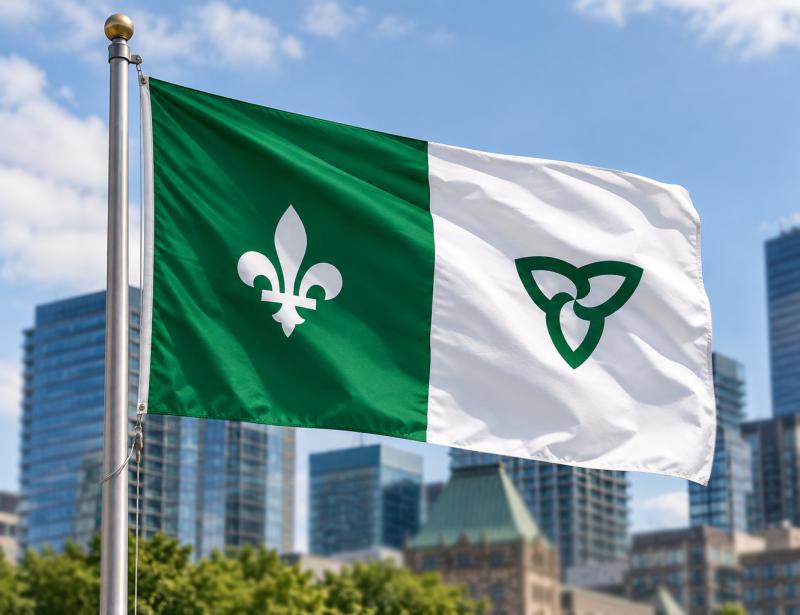
As Franco-Ontarians raise the green and white flag across the province today, the Alliance for Healthier Communities celebrates the more than 744,000 Francophones1 who shape Ontario's communities and renews its call for a health system that serves them in their own language.
In August, French became a national conversation as Canada moved to suspend trade negotiations with the United States after American negotiators sought concessions on protections for the French language, including bilingual labelling requirements, funding for Francophone culture, and rules governing French-language media online. Prime Minister Mark Carney described these as fundamental rights rather than trade costs, and Canadians responded with a solidarity that was immediate and heartfelt.
That solidarity is welcome. It is also a test. Defending French as a principle at a negotiating table is one thing. Delivering it as a service, on a daily basis, to a patient trying to describe chest pain to a clinician who does not speak their language, is another. In Ontario, that second test is the one that determines health outcomes.
We are seeing encouraging signs that recognition is growing. On September 25, the municipality of Shuniah, near Thunder Bay, will raise the Franco-Ontarian flag for the first time. The Association française des municipalités de l'Ontario welcomed the decision, with President Michelle Boileau calling the flag-raising a symbol of pride, recognition and belonging2. We join AFMO in congratulating Shuniah and in encouraging every Ontario municipality to follow. Northwestern Ontario is also a region where French-language health services are among the hardest to find. We hope the flag over Shuniah marks the beginning of a broader commitment.
On September 8, the Centre de planification des services de santé en français (CPSSF) launched its first strategic planning process under the theme "Our voice, our health,"3 to set the priorities of its 2028-2031 Strategic Plan. Consultations are underway right now across the province: Toronto, Hawkesbury, Ottawa, Windsor, Sudbury, Thunder Bay and Barrie, along with virtual sessions and an online survey, supported by a 34-member advisory committee representing all six Ontario Health regions. CEO Natalie Aubin has indicated that primary care is already emerging as a priority.
"A year ago, we welcomed the creation of the CPSSF. Today we are seeing it do exactly what we hoped it would do: ask Francophones what they need, region by region," says Sarah Hobbs, CEO of the Alliance. "We encourage our members, Francophone patients, families and providers across Ontario to take part in these consultations. This is the moment when the priorities get set."
But a strategy is only as strong as what it can move, and there are still some gaps that Ontario needs to close. The first is data. CPSSF's leadership has been candid that the data needed to evaluate real access to French-language health services remains insufficient, that linguistic performance indicators are not yet systematically embedded across health sectors, and that current practice remains at an early stage4. This echoes what the Alliance has long said: better data is a precondition for better planning. We cannot close a gap we cannot see.
Another important gap is timing. The CPSSF's strategic plan will be published in fall 2027 for implementation beginning in 2028. Ontario's Primary Care Action Plan aims to connect everyone in the province to a family doctor or a primary care team by 2029, with the 2026-27 call for proposals investing over $250 million in new and expanded teams and the 2026 Budget adding $325 million more5. The decisions that will determine whether Francophones are attached are being made right now, a full planning cycle before the Francophone strategy arrives.
Encouragingly, Alliance members and Francophone partners across Ontario are already answering the province's call to expand primary care with real new capacity for Francophones. On September 23, at a Franco-Ontarian Day community picnic in Mississauga, the Ontario government announced $2,119,600 in annual funding for a new Centre francophone du Grand Toronto (CFGT) primary care clinic, one of the 124 new and expanded primary care teams funded through the province's 2026-27 call for proposals6. At full capacity, the clinic will serve up to 4,800 Francophone patients through an interprofessional team of physicians, nurse practitioners, registered nurses, therapists and dietitians, with an opening planned for early 2027.
"Francophones everywhere in Ontario deserve to have access to high-quality services that respond to their needs and reflect their realities, including health care in French." said the Honourable Natalia Kusendova-Bashta, Minister of Long-Term Care and Minister of Francophone Affairs, at the announcement. "As a nurse, I know how important it is to understand and be understood. Receiving care in French allows patients to ask questions and better understand the information they are given."
"Across Ontario, Alliance members and Francophone partners are demonstrating that expanding access to primary care in French is both possible and essential. As an exemple, the announcement of CFGT’s new Mississauga clinic reflects this shared commitment to ensuring that Francophones will be able to receive comprehensive, interdisciplinary care in the language in which they are best able to express their needs and participate fully in their health. We must continue building on this momentum, region by region, so that care in French is available wherever Francophone communities live and grow." adds Estelle Duchon, CEO, Centre francophone du Grand Toronto, and Co-Chair of the Alliance’s Francophone Advisory Committee.
Beyond health care, AFO's États généraux7 warned of a risk of gradual decline for the Francophonie in Ontario and set a target of reaching six per cent of the province's population by 2050, with a community action plan to be unveiled at AFO's Conference next month8. Communities that cannot get care in French do not stay, and do not grow. Health is a very important component of this vision.
The Alliance will continue to work with the CPSSF, AFO, our Francophone members, and every partner and ally committed to this goal, until every Francophone in Ontario can access primary care in their own language, wherever they live.
Just as Canadians stood up to defend our language rights on the world stage, we are confident Ontario will show that same resolve by protecting every Francophone's right to be understood by their own clinician.
[1]- Counts francophones as defined by Ontario's Inclusive Definition of Francophone, as well as people who speak French at home, according to the Assemblée de la francophonie de l'Ontario (AFO)’s definition.
[2] - AFMO, August 25, 2026.
[7] - A major collective initiative launched in May 2025 by the Assemblée de la francophonie de l'Ontario (AFO) to shape the future of Franco-Ontarian communities through 2050.