Leading Patient Safety: Essentials for Managers and Directors

This learning program is presented by the Institute for Healthcare Improvement (IHI).

Registration is now open for the Institute for Healthcare Improvement’s (IHI) Leading Patient Safety: Essentials for Managers and Directors program.

Designed specifically for health care managers, directors, and emerging leaders, this 14-week online program provides practical strategies to strengthen patient safety, improve reliability, and build a stronger culture of safety across your organization. 

The course begins on September 1, 2026. It consists of 9 online lessons and 8 live, 1-hour webinars. View the full agenda.

Fees are $995 per person for individuals and $846 per person for groups of 3 or more. A limited number of scholarships are available for this program. Complete the online Scholarship Application by August 4, 2026.
Download the brochure here. 

Details
Tuesday, September 1, 2026 - 11:00
14 weeks starting September 1
Cost: 
$995 per person; group discounts and scholarships available
Internal/External: 
Event Type: 
Location
Online Event

Supporting Farmer Mental Health in Ontario

This webinar is presented by Agricultural Wellness Ontario, a CMHA Ontario program.

Agricultural Wellness Ontario (AgWO) invites you to join this webinar focused on understanding and supporting the mental health needs of Ontario's agricultural community. Farmers face unique stressors that can significantly impact their mental health and well-being. Health care providers and community workers play an important role in creating supportive pathways to care.

# Learning Objectives

During this webinar, you will:

  • Learn about common mental health challenges and stressors experienced by the agricultural community
  • Explore barriers that may prevent farmers from accessing mental health support
  • Gain practical strategies for engaging farmers in conversations about mental health
  • Become familiar with the free mental health resources and services available through AgWO

# Who Should Attend

This session is designed for primary care providers, allied health professionals, mental health practitioners, public health professionals and others who support rural and agricultural communities. This is an open invitation, please share this invitation with your networks!

Details
Wednesday, July 15, 2026 - 12:00
12:00 pm
Cost: 
Free
Internal/External: 
Event Type: 
Location

Building Connection in Harm Reduction & Drug Policy Spaces

This webinar is presented by the RECLAIM Collective as part of their Support. Don't Punish 2026 series.

As harm reduction and drug policy advocates face increasing challenges—including service closures, funding cuts, political attacks, and growing stigma—we believe it is more important than ever to strengthen our relationships, build solidarity, and support one another.
 
This international panel will bring together experienced advocates and organizers from Canada, the United States, and Europe working across harm reduction, healthcare, street outreach, Indigenous wellness, mutual aid, drug policy reform, and human rights. Together, we will explore how our movements can engage in good faith, navigate differences, foster accountability, and build stronger coalitions while avoiding harm within our own spaces. We hope you'll join us for this important global conversation on strengthening our movements, supporting one another, and advancing meaningful change.
 

# Topics will include:

  • Emotional harm reduction
  • Burnout and grief in advocacy work
  • Coalition building and solidarity
  • Accountability and relationship-building
  • Navigating conflict and differences within movements
  • Building resilient communities during challenging political times
This webinar is designed to be interactive, with plenty of time for participant discussion, questions, and shared learning.
  • Nathan Smiddy (United States) – Harm reduction activist, mutual aid organizer, and syringe service provider operating in the southern U.S.
  • Corey Ranger (Canada) – Clinical Director at AVI Health & Community Services, President of the Harm Reduction Nurses Association, Board Director with the Canadian Drug Policy Coalition, and North American Representative to the International Drug Policy Consortium Members’ Advisory Council.
  • Keshia Cleaver (Canada) – Tla’amin Nation harm reduction leader, educator, researcher, and advocate focused on Indigenous wellness and community-driven approaches.
  • Naja Kassir (Canada) – Lebanese writer, educator, and harm reduction advocate working to build cross-sector collaboration and solidarity through knowledge translation, education, and community organizing. 
  • Tamás Kardos (Hungary) – Drug policy expert with the Hungarian Civil Liberties Union and advocate for evidence-based drug policy, harm reduction, and human rights.
 
Details
Wednesday, June 24, 2026 - 16:00
4:00 pm
Cost: 
Free
Internal/External: 
Event Type: 
Location
Online event (Zoom)

Amélioration de l’accès aux soins primaires (cohorte 2)

Ce programme de formation est présenté par Excellence en santé Canada (ESC) dans le cadre de l’initiative Cap Santé.

ESC reçoit actuellement les demandes pour la prochaine cohorte du programme « Amélioration de l’accès aux soins primaires » (AASP). Ce programme s’inscrit dans l’initiative Cap Santé, un mouvement en plein essor visant à améliorer l’accès aux soins en créant des liens et en déployant à grande échelle les pratiques efficaces. Les équipes participantes sont admissibles à un financement de démarrage pouvant atteindre 15 000 $ et bénéficient de l’accompagnement de spécialistes ainsi que d’outils et de ressources fondés sur des données probantes.

# Aperçu du programme

Partout au pays, les équipes de soins primaires font face à une demande croissante, à des pressions sur les effectifs et à des défis grandissants en matière d’accès aux soins en temps opportun. Par l’entremise du programme AASP, les établissements offrant des soins primaires en équipe reçoivent un soutien — notamment un financement de démarrage et l’accompagnement de spécialistes — pour implanter le modèle de l’Accès adapté. Ce modèle aide les cliniques à arrimer l’offre de rendez-vous à la demande de la patientèle, ce qui permet d’optimiser les activités cliniques, de réduire les délais d’attente et de favoriser le bien-être de toute l’équipe de soins.

  • À propos du programme : Le Programme Amélioration de l’accès aux soins primaires (AASP) aide les établissements offrant des soins primaires en équipe à implanter le modèle de l’Accès adapté pour arrimer l’offre de rendez-vous à la demande de la patientèle.
  • L’enjeu : Partout au Canada, les équipes de soins primaires sont confrontées à une demande croissante, à des pressions sur les effectifs et à un lourd fardeau administratif. Le programme AASP aide les cliniques à instaurer des changements durables qui améliorent l’accès aux soins pour la patientèle tout en favorisant le bien-être du personnel clinicien et de l’équipe.
  • Retombées : Les données préliminaires des cliniques participantes révèlent une réduction moyenne des délais d’attente de sept jours au cours des six premiers mois. Le personnel soignant des cohortes précédentes fait état de meilleurs résultats cliniques, d’une charge de travail allégée, d’une diminution des tâches administratives et d’une augmentation notable de la satisfaction globale au travail.
  • Soutien offert : Les équipes bénéficient d’un financement de démarrage pouvant atteindre 15 000 $, de l’accompagnement de spécialistes, ainsi que d’outils éprouvés et de ressources fondées sur des données probantes pour déployer et évaluer les pratiques efficaces.
  • Admissibilité : ESC sélectionnera 15 équipes pour cette cohorte. Celles-ci doivent fonctionner selon un modèle de soins interdisciplinaires regroupant des médecins, du personnel infirmier, du personnel paramédical et des agents administratifs.
  • Engagement : Cet engagement de 18 mois peut se traduire par des améliorations à long terme des soins prodigués, de la satisfaction des équipes et de l’efficacité des cliniques. Pour favoriser des changements viables, les équipes devront se réunir de 30 à 60 minutes chaque semaine ou toutes les deux semaines afin de mettre à l’essai en temps réel de petits changements fondés sur des données, en plus de participer à des séances d’accompagnement mensuelles.

# Pour déposer une demande

Prenez connaissance de l’appel à candidatures et consultez la page Web du programme AASP pour obtenir de plus amples renseignements, notamment la marche à suivre pour déposer une demande.

La date limite pour déposer une demande est le 9 septembre 2026. Le programme se déroulera de janvier 2027 à juillet 2028.

Details
Wednesday, September 9, 2026 - 17:00
Lancement du programme en janvier 2027. Veuillez déposer votre demande au plus tard le 9 septembre 2026.
Cost: 
Financement de démarrage offert pouvant atteindre 15 000 $
Event Type: 
Location

Primary Care Access Improvement (Cohort 2)

This learning program is presented by Healthcare Excellence Canada (HEC) as part of Care Forward.

HEC is accepting applications for the next cohort of the Primary Care Access Improvement (PCAI) program This program is part of Care Forward - a growing movement to improve access to care by connecting and scaling what works. Participating teams can get up to $15000 in seed funding and are supported with expert coaching and evidence-informed tools and resources. 

# Program Overview

Across the country, primary care teams are facing growing demand, workforce pressures and increasing challenges with timely access to care. Through PCAI, team-based primary care organizations receive support, including seed funding and expert coaching, to apply Advanced  Access. This model helps clinics balance appointment availability with patient demand—optimizing clinic operations, reducing wait times, and supporting the well-being of the entire care team.

  • About the program: Primary Care Access Improvement (PCAI) helps team-based primary care organizations apply the Advanced Access model to balance appointment availability with patient demand. 
  • Why it matters: Primary care teams across Canada are facing increasing demand, workforce strain and administrative burden. PCAI supports clinics to make sustainable changes that improve patient access while strengthening provider and team well-being.
  • Impact: Early data from participating clinics shows an average wait-time reduction of seven days within the first six months. Providers from previous cohorts report improved care outcomes, reduced workloads, fewer administrative burdens and a notable increase in  overall job satisfaction. 
  • Support: Teams are supported with seed funding up to $15,000, expert coaching, and proven tools and evidence-informed resources for implementing and measuring what works. 
  • Eligibility: HEC is selecting 15 teams for this cohort. Teams must operate in a team-based model that includes multiple physicians, nurses, allied health professionals, and Medical Office Assistants (MOAs). 
  • Commitment: This 18-month commitment can result in long-term improvements in patient care, team satisfaction and clinic efficiency. To support sustainable change, teams will need to meet 30-60 minutes weekly or biweekly to test small, data-informed changes in real-time  alongside monthly coaching sessions. 

# To Apply 

Check out the Call for Applications and visit the PCAI webpage for more information, including instructions on how to apply.

Deadline to apply is September 9, 2026. Program runs from January 2027 until July 2028. 


Details
Wednesday, September 9, 2026 - 17:00
Program launches January 2027. Apply by September 9, 2026.
Cost: 
Get up to $15000 in seed funding
Internal/External: 
Event Type: 
Location

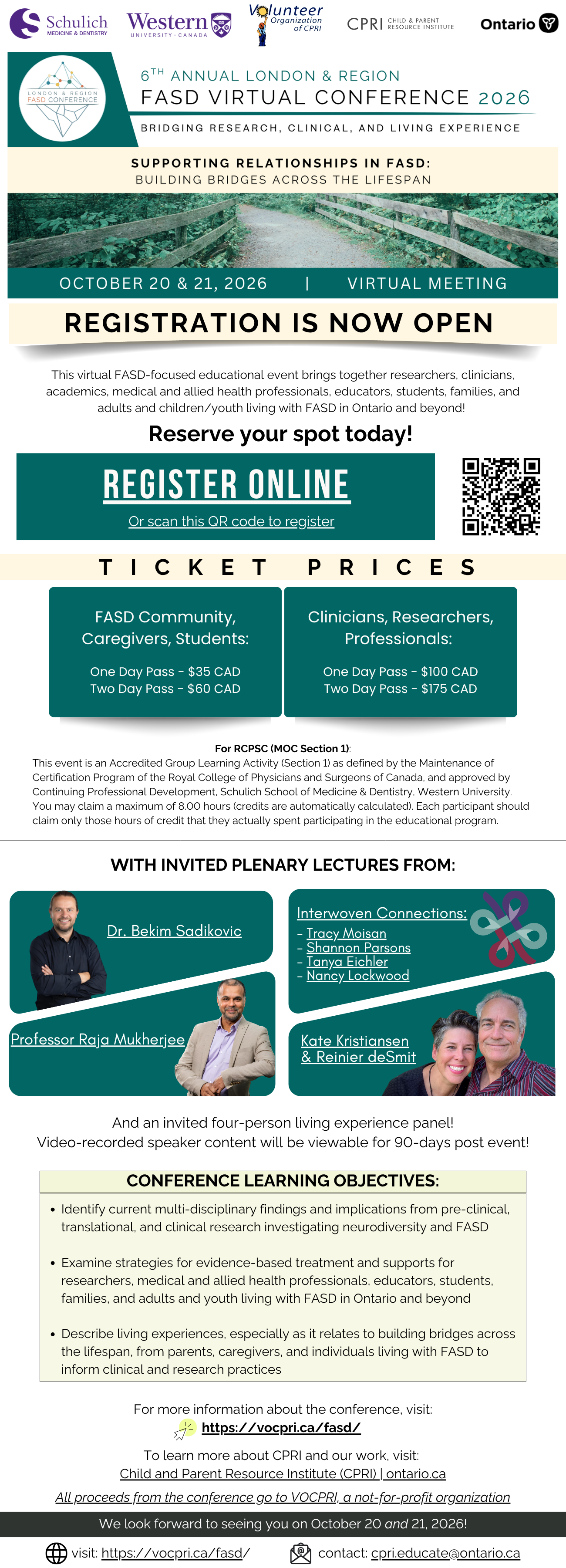
6th annual London & Region FASD Virtual Conference 2026 | Supporting Relationships in FASD: Building Bridges Across the LIfespan

This virtual conference is presented by the Child & Parent Resource Institute (CPRI), the Volunteer Organization of CPRI (VOCPRI), and the Government of Ontario.

Event flyer with registration link.
Click to view this image and event program as a PDF.

This virtual FASD-focused educational event brings together researchers, clinicians, academics, medical and allied health processionals, educators, students, families, and adults and children/youth living with FASD in Ontario and beyond. 

# Ticket prices: 

  • FASD Community, Caregivers, Students: 
    • One-day pass: $35
    • Two-day pass: $60
  • Clinicians, Researchers, Professionals: 
    • One-day pass: $100
    • Two-day pass: $175

# Participate in virtual learning with:

  • Current multi-disciplinary findings from pre-clinical, translational, and clinical research
  • Strategies for evidence-based treatment
  • Information about regional resources, supports, and services for individuals living with FASD and their families/caregivers
  • Compelling living-experience accounts
  • Customizable selections of breakout educational workshops
  • Opportunities to network with people passionate about understanding and advocating for individuals living with neurodiverse diagnoses, including FASD


This event is an Accredited Group Learning Activity (Section 1) as defined by the Maintenance of Certification Program of the Royal College of Physicians and Surgeons of Canada, and approved by Continuing Professional Development, Schulich School of Medicine & Dentistry, Western University. You may claim a maximum of 8.00 hours. 

To learn more, check out the event flyer and full program or visit the conference website. 


Details
Tuesday, October 20, 2026 - 08:00
October 20 & 21
Cost: 
$35-175
Internal/External: 
Event Type: 
Location
Online via Zoom

Primary Care Trials Training Program

This training is provided by the Canadian Primary Care Trials Network and the Department of Family & Community Medicine at the University of Toronto.

Are you an individual interested in getting involved in clinical research, but not sure where to start? The Canadian Primary Care Trials Network (CPCTN) invites you to apply for a new, hands-on training program designed to build your confidence and skills as a site investigator in primary care trials. 

Participants in this program will receive structured guidance from initial idea through to study proposal, including one-on-one mentorship and support from an experienced clinical trialist. They will gain practical skills in clinical trial design and conduct and build confidence to participate in or lead randomized controlled trials.  

Over four months, participants will connect with peers and mentors, participate in monthly virtual touchpoints, develop a brief study proposal to apply lessons learned.

This program runs from July - October 2026. 

# Application Instructions:

Submit your application by email to ranusha.ravindranathan@unityhealth.to  by June 5. Your application must include:

  • A one-page statement outlining your interest and how this program aligns with your career goals
  • A brief project idea or research question (can be preliminary)
  • Your name, contact information, and institutional affiliation

Read the program flyer to learn more.   

Details
Friday, June 5, 2026 - 17:00
Program runs July-October. Apply by June 5.
Location

Making Sustainability Part of Everyday Quality Improvement

This toolkit launch event is presented by CASCADES in partnership with Vancouver Coastal Health, Interior Health, and Health Quality BC.

The Sustainability-Embedded Quality Improvement (SE-QI) Toolkit is a practical resource that brings environmental sustainability into the core of quality. Co-developed through a leading collaboration between Vancouver Coastal Health (VCH), Interior Health (IH), Health Quality BC (HQBC), and CASCADES, the toolkit reflects shared expertise and real-world innovation across health systems working to deliver high-quality, low-carbon care. It supports teams to identify, measure, and report environmental impacts within new, current, or past projects, making sustainability actionable within existing QI efforts.

Tested and validated through a national pilot involving 14 healthcare organizations across six provinces in Canada, the SE-QI Toolkit has demonstrated strong usability, feasibility, and relevance in practice. The session will also introduce the SE-QI Spotlight, a growing pan-Canadian repository of real-world SE-QI examples designed to support shared learning, reduce duplication, and help teams see how sustainability can be embedded across diverse clinical and organizational contexts.

In this session, participants will be introduced to the updated Toolkit and Spotlight, hear early adoption experiences from across the country, and explore how to embed sustainability into their own improvement initiatives in a practical and meaningful way.

Details
Friday, June 26, 2026 - 13:00
1:00-2:00 pm
Cost: 
Free
Internal/External: 
Event Type: 
Location
Online via Zoom

Quels sont les liens entre pauvreté, crise climatique, santé des femmes et équité en santé? Et comment ces questions sont-elles présentées dans les médias? Examen des possibilités d’agir

This webinar se presente par le Centre de collaboration nationale des déterminants de la santé (CCNDS)

# Quels sont les liens entre pauvreté, crise climatique, santé des femmes et équité en santé? Et comment ces questions sont-elles présentées dans les médias? Examen des possibilités d’agir

Les organismes de santé du Canada reconnaissent de plus en plus la crise climatique comme étant une urgence sanitaire qui exacerbe les inégalités existantes, et appellent à plus d’action à plusieurs niveaux.  

Dans ce webinaire, l’Initiative canadienne sur la pauvreté, l’équité en santé et les changements climatiques (CPHECC) et le Centre de collaboration nationale des déterminants de la santé (CCNDS) examinent les questions souvent marginalisées dans le discours dominant sur les changements climatiques et la santé : les croisements entre pauvreté, crise climatique, santé des femmes et équité en santé.  

Un groupe d’intervenantes ayant divers points de vue parleront des systèmes qui négligent les femmes et feront part d’indications pertinentes tirées de l’expérience, de la recherche, des politiques et de la pratique. Ensemble, elles émettront une opinion critique sur la manière dont la presse écrite canadienne présente les questions des changements climatiques, de la pauvreté et de la santé des femmes, et établiront des possibilités d’agir grâce à la recherche, aux politiques et à la pratique.  

Dans le webinaire, les personnes participantes prendront part à ces sujets par sondage interactif.   

# Ce webinaire intéressera : 

  • Étudiants  
  • Éducateurs 
  • Professionnels 
  • Décideurs 
  • Responsables des politiques  
  • Chercheurs

# Objectifs du webinaire

  • sensibiliser davantage aux systèmes qui négligent les femmes et aux croisements entre pauvreté, crise climatique, santé des femmes et équité en santé;  
  • analyser comment les médias présentent les questions liées à la pauvreté, à la crise climatique et à la santé des femmes;  
  • établir des possibilités d’agir grâce à la recherche, aux politiques et à la pratique.  

# Conférenciers

  • Katie Hayes, PhD, Professeure adjointe, Université George Mason
  • Mariam Farooq, Analyste de recherche, Centre de toxicomanie et de santé mentale
  • Dr. Amber Fletcher, PhD, Professeure, Université de Regina
  • Leanne Lacap, Analyste de recherche, Centre de toxicomanie et de santé mentale
  • Chelsey Perry (elle/iel), Première Nation Nisga’a, Candidate au doctorat et gestionnaire de recherche, Indigenous Equity Lab
  • Cheyanne Ratnam
  • Sue Shikaze, Promotrice de la santé, Services d’urgence et environnements sains, Lakelands Public Health
  • Dre Siqi Xue, Psychiatre, Centre de toxicomanie et de santé mentale et Professeure adjointe, Université de Toronto

# Hôtes

  • Pemma Muzumdar (elle) Spécialiste du transfert des connaissances

# Ressources connexes

Details
Friday, June 12, 2026 - 12:00
12:00-1:30 pm
Cost: 
Free
Event Type: 
Location

What are the connections between poverty, the climate crisis, women’s health, and health equity? And how are these issues framed in the media? Exploring opportunities for action

This webinar is presented by the National Collaborating Centre for the Determinants of Health (NCCDH)

The NCCDH is partnering with the Canadian Poverty, Health Equity, and Climate Change (CPHECC) initiative from the Centre for Addiction and Mental Health (CAMH) to facilitate a webinar on the connections between poverty, the climate crisis, women’s health, and health equity.

# What are the connections between poverty, the climate crisis, women’s health, and health equity? And how are these issues framed in the media? Exploring opportunities for action

In this webinar, the Canadian Poverty, Health Equity, and Climate Change initiative (CPHECC) and the National Collaborating Centre for Determinants of Health (NCCDH) will explore issues that are often marginalized in the dominant climate change and health discourse: the intersections between poverty, the climate crisis, women’s health, and health equity.  

A group of speakers with diverse perspectives will discuss the systems that fail women, and share relevant insights from experience, research, policy, and practice. 

# This webinar will be of interest to:

  • Students  
  • Educators 
  • Practitioners 
  • Decision makers 
  • Policy makers  
  • Researchers

# Webinar objectives

  • Increase awareness about the systems that fail women and the intersections between poverty, the climate crisis, women’s health, and health equity.  
  • Analyze how issues related to poverty, the climate crisis, and women’s health are framed in the media  
  • Highlight opportunities for action through research, policy and practice.

# Presenters

  • Katie Hayes, PhD, Adjunct Professor, George Mason University
  • Mariam Farooq, Research Analyst, Centre for Addiction and Mental Health
  • Dr. Amber Fletcher, Professor, Sociology, University of Regina
  • Leanne Lacap, Research Analyst, Centre for Addiction and Mental Health
  • Chelsey Perry (she/they), Nisga’a First Nation, PhD Candidate & Research Manager, UBC Indigenous Equity Lab
  • Cheyanne Ratnam, Assistant Project Manager, Spotlight: Child Welfare and Co-founder, Ontario Children's Advancement Coalition
  • Sue Shikaze, Health Promoter, Emergency Services and Healthy Environments, Lakelands Public Health
  • Dr. Siqi Xue, Psychiatrist, Centre for Addiction and Mental Health and Assistant Professor, University of Toronto

# Hosts

  • Pemma Muzumdar (she/her), Pemma Muzumdar (she/her), Knowledge Translation Specialist
Details
Friday, June 12, 2026 - 12:00
12:00-1:30 pm
Cost: 
Free
Internal/External: 
Event Type: 
Location