On International Social Prescribing Day, a prescription to cure loneliness: Celebrating a holistic approach to addressing isolation and increasing belonging
Thursday, March 10, 2022
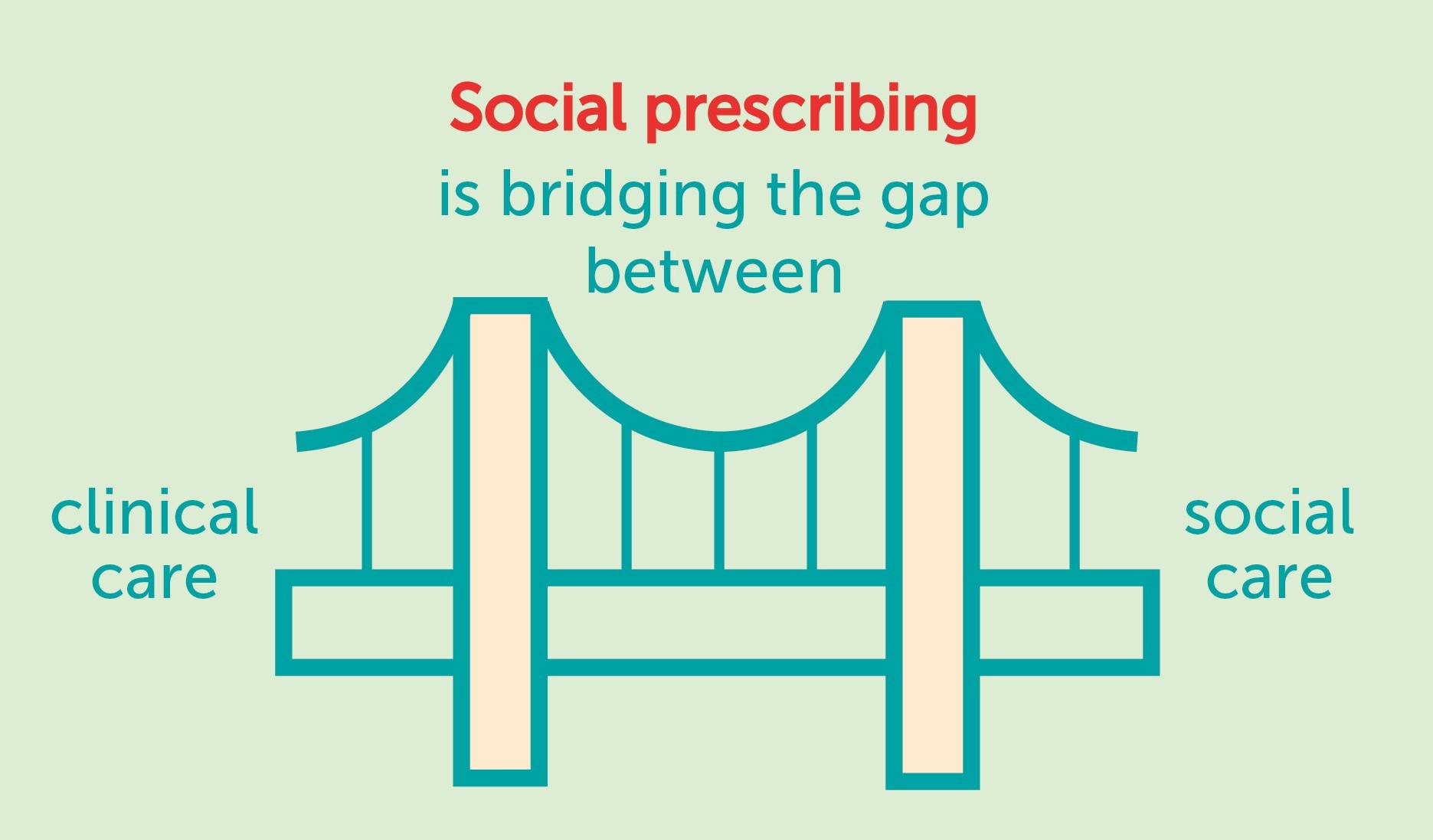
bridge

While most of us have experienced some degree of social isolation over the past couple of years due to the steps taken to slow the spread of COVID-19, for many older adults, these feelings existed long before the pandemic began in March 2020.

To sustainably address social isolation, especially among marginalized populations, the Alliance for Healthier Communities and its members -- community health organizations across Ontario – are working to bridge the gap between clinical and social care through an intervention called social prescribing.

Social Prescribing? What’s that?

First coined as a term in the United Kingdom in the late 1990s, social prescribing is a holistic approach to healthcare. The practice uses the trusted process of receiving a prescription from a health provider to connect people to activities and opportunities for social engagement. Importantly, social prescribing removes barriers for clients to take advantage of local, non-clinical services that help them to develop their interests, goals and gifts while connecting with their communities.

Related Story: Social Prescribing Community Quilt Shares More Stories of Connection

Social prescribing allows health providers to formally refer patients to community-based programs – which could be anything from an art class or dance lesson to an introduction to a local bereavement network – and then also provides a structure within which to follow up and track patients’ progress at meeting their own health goals.

“By integrating social support and care across the health system, we can help people safely reconnect to their communities and reverse some of the health impacts of the pandemic,” says Jennifer Rayner, Director of Research and Evaluation at the Alliance for Healthier Communities. “Social prescribing has the potential to be a game-changer for increasing people’s belonging, and could be a key tool for health and social care providers throughout Canada.”

According to research from the Nova Scotia Centre on Aging and Department of Family Studies and Gerontology Mount Saint Vincent University, approximately 30 per cent of older adults living in Canada – meaning millions of people from coast to coast – are at risk of becoming socially isolated. This is a problem that is widespread and systemic in nature, and that’s why a systems-based solution like social prescribing is needed.

Building on Promising Early Results

If we choose not to address social isolation at the systemic level, we will experience the long-term effects on our health and social systems in other ways. According to the World Health Organization (WHO), the effect of social isolation on mortality is comparable to that of other well-established risk factors such as smoking, obesity, and physical inactivity.

Results from the Alliance for Healthier Communities’ research pilot Rx: Community – Social Prescribing, a first-in-Canada social prescribing research project that ran from 2018 to 2020, are very promising. Participating clients reported their sense of loneliness decreased by 49 per cent. They also reported an increase of 19 per cent in social involvement and a 12 per cent increase in mental health.

Bringing Social Prescribing to Isolated Seniors

One participant in the Links2Wellbeing: Social Prescribing project through the Alliance for Healthier Communities and the Older Adults Centres’ Association of Ontario (OACAO), Linda, initially noted mobility issues and mental health concerns due to social isolation following her retirement. During the pandemic, she felt increasingly disconnected.

With some encouragement from family and information from her doctor, Linda was given a social prescription that referred her to community-based programs in Windsor where she lives, offered through the Life After Fifty Seniors Active Living Centre, a member of OACAO.

The opportunity to take part in community-based activities reinvigorated Linda’s sense of purpose. Now, she is a thriving member of the community who regularly knits baby hats and dishcloths for charity events. She also regularly encourages her friends experiencing social isolation to get connected as well.

“Social prescribing makes a big difference for patients during the pandemic who live alone, [are] unable to participate in social activities, and home-bound patients, especially with their isolation and loneliness. A social prescription to group activities gives them something to look forward to,” says Nicole, a nurse who has seen first-hand the positive impacts social prescribing on isolated seniors in her rural community.

Across Canada, social prescribing is gaining momentum among healthcare providers, community partners, researchers, funders, policymakers and health planners.

Together with the United Way B.C. and the Older Adult Centres Association of Ontario, and other key stakeholders the Alliance for Healthier Communities is convening a community of practice for professionals in academia, the arts, health care and more. This community of practice will help deepen understanding of social prescribing, and ways of implementing social prescribing initiatives. It will also provide this growing movement towards social prescribing with a way to learn from one another, raise awareness and develop provincial and national strategies.

“We are confident about the impact this holistic approach to healthcare will have for seniors and our health and social systems overall,” says Sarah Hobbs, CEO of the Alliance for Healthier Communities. “Social prescribing can be an important piece of the systemic solution to address social isolation, loneliness and to promote health equity through increased connectedness and belonging.”

Find out more about social prescribing at allianceon.org/Social-Prescribing.



Alliance members relentless in efforts towards vaccine equity

Friday, February 11, 2022
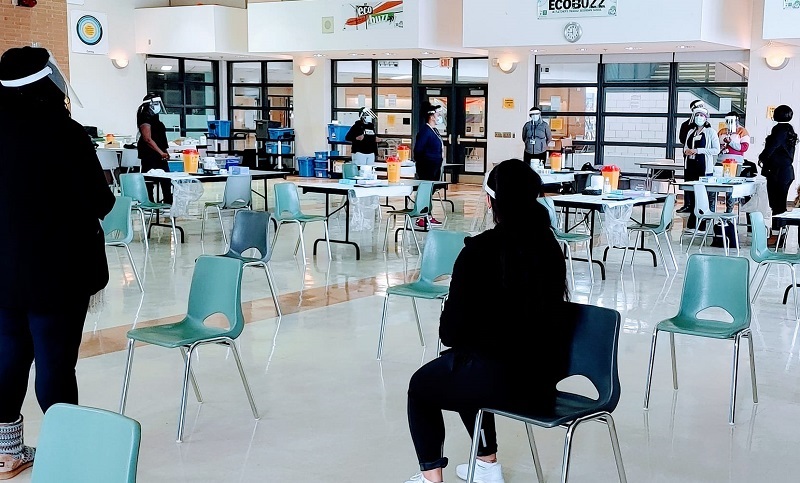
Photo of community vaccine clinic in Mississauga run by LAMP CHC

[Tailored clinics, like the one pictured above in Mississauga coordinated by LAMP CHC, are helping to raise vaccination rates among marginalized populations across Ontario, and are being led by community health organizations with strong trusted relationships with their communities and partners.]

Relentless.

In facing the Omicron variant of COVID-19, it’s possibly the best word to describe Alliance members’ efforts to support, care for, and inform their communities and increase access to life-saving vaccines.

Clinics for Black communities, South Asian communities, Francophones, Indigenous people, newcomers, uninsured people, children and parents, and others. Outreach to seniors, youth and people with distrust of the health system. Working for and with community members to build trust. Meeting people in their community, where they’re at, with empathy, respect and adaptive and evolving supports.

“We're just trying to do whatever we can to support the work of the Ontario Health Team and our community,” said Kim Fraser, Executive Director at Davenport Perth Neighbourhood and Community Health Centre in the west end of downtown Toronto. “Since Omicron flared up, we opened more spaces in our clinic, and we've added additional times.”

Fraser goes on to describe the whole community and organizational effort that’s gone into ensuring that the Portuguese and Spanish-speaking, as well as Afro-Caribbean populations, can easily access vaccines and vaccination information. The centre and its staff have also worked closely with community partners to reach seniors and youth, including with first and second doses, but also third dose booster shots essential to protecting seniors and others at higher risk due to COVID-19 infection.

“We had clinics where the staff could speak Portuguese and Spanish and it really helped some folks whose English is minimal. It was great for them to be able to access a clinic in their first language and their language of choice.”

Fraser went on to note that the close-knit community relationships – between staff and community members, between community members themselves, and between the CHC and its local partners – has made all the difference. In terms of being able to reach people who most need the shot with the right information and access to clinics, and in the experiences that people have when they come and get the shot.

“Our organization is both a neighborhood centre and a community health centre. We have found that people across all of our programs, including the community services side, have been really instrumental in running these clinics. Our community development and health promotion coordinator runs a lot of the clinics and is just great at organizing it and running it,” Fraser added.

“The Toronto Western Family Health Team have been the vaccinators, and we worked with them. We've been really fortunate to get a lot of volunteers who've helped, and they've come to most of our clinics. They're quite experienced at helping us do these clinics. And we’ve heard from people coming to the clinics that they’re run very smoothly. One man told me today his clinic was really well-run.”

By addressing barriers, building trust and increasing access to vaccines, including third dose boosters, community health organizations all across Ontario are helping to keep people and communities safe during a critical phase of the pandemic. By focusing on health equity in designing vaccination clinics and information campaigns, Alliance members are helping bring an end to the Omicron wave faster, and reducing impacts on their colleagues in other parts of the health system. And of course, this is all happening while community health organizations provide ongoing primary care and social supports tailored to the challenges marginalized people face. You can learn more about specifics from the Alliance’s recent webinar, Vax to the Future, via the recordings and slides for the event.

Here are some other recent examples from across the province of vaccine equity in action!

Community engagement via local community ambassadors, Flemingdon Health Centre

Making appointments easily available in Ottawa, Somerset West CHC

Clinics and information made accessible through language, Unison Health and Community Services

Working with partners in rural Ontario and leading the way to get shots into arms, West Elgin CHC

Weekend appointments, email and phone bookings, providing safe, accessible vaccine clinics for the Black community in Toronto, TAIBU CHC

Working with acute care and other partners in Windsor to reach more people with boosters, Windsor Essex CHC

Pop-up clinics for Black, African, and Caribbean communities in Mississauga, LAMP CHC

Boosting children’s vaccine campaign among racialized communities in Toronto with tailored community approaches, Black Creek CHC

An Indigenous Vaccination Hub, with information, wrap-around care and access to vaccines without an appointment, Wabano Centre for Aboriginal Health

COVID-19 and children’s vaccination specific townhall and information session for South Asian communities, South Riverdale CHC

Pop-up clinic in Midland, ON, offering walk-ins as well for vaccinations, including boosters, CSC CHIGAMIK CHC

Working with partners, across organizations and health sectors, to reach newcomers with vaccines across Toronto, Access Alliance Multicultural Health and Community Services

Nimble approaches in Scarborough, providing options such as community clinics and pop-up clinics to boost access, Scarborough Centre for Healthy Communities

Drop-in access to vaccines for First Nations, Inuit, Métis people in downtown Toronto, Anishnawbe Health Toronto

CHCs working together and with their partners in Hamilton to reach Francophone and other populations with vaccine clinics, CSC Hamilton Niagara, Compass CHC

South Asian-focused clinic in Ajax, Carea CHC

Walk-in clinics in Toronto to make things more accessible for those unable to book ahead, Four Villages CHC

Debunking vaccine and other COVID-19 myths with tailored information and materials, Wellfort/Bramalea CHC

Nurse Practitioner-Led Clinics providing both accurate vaccine information, and access to appointments for shots, Health Zone NPLC and Sudbury NPLC

Clinics accessible for all in Ottawa, with questions answered, Centretown CHC

If you’re seeking more information or would like to schedule an interview with a community health leader from an organization above, please contact:

Jason Rehel, media relations: 416-817-9518 or jason.rehel@allianceon.org

Paid Sick Days NOW: Read and share our letter in support of legislation to ensure paid sick leave for ALL workers

Tuesday, November 23, 2021

We've advocated alongside our members, the 600,000+ people they serve across Ontario, and our health and social services partners for many years on this issue.

When someone is sick, they should not have to choose between their job, including ensuring they can earn a living, pay rent or the mortgage, and their own health or the health of their family members. This is a fundamental prerequisite for ensuring healthier communities across Ontario.

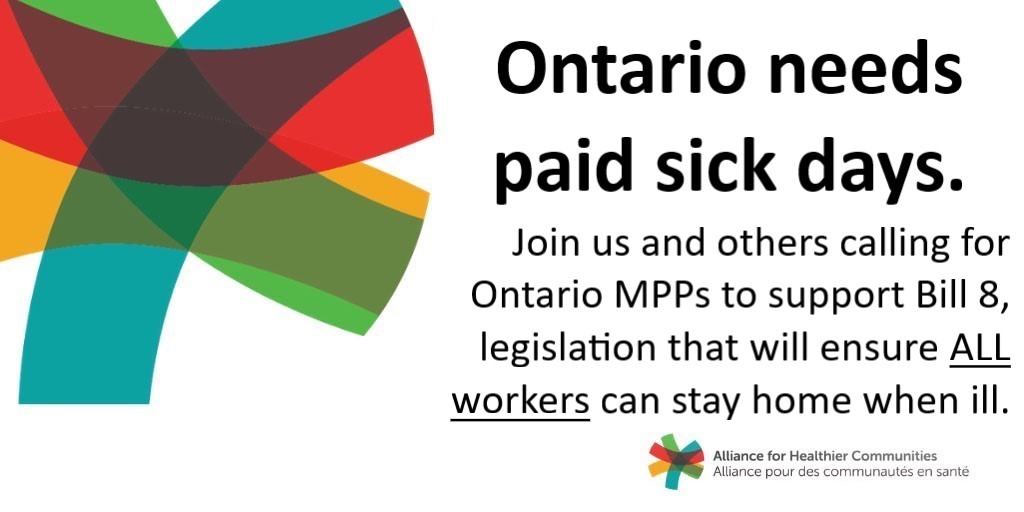
Here's our letter in support of Bill 8, which would ensure paid sick leave for ALL workers in Ontario, through amendments to the Employment Standards Act.

The time is now. Share our letter and your support for Paid Sick Days widely, and especially with your local MPP and other leaders.

November 23, 2021

We write today to endorse Bill 8, Stay Home If You Are Sick Act, 2021, currently being considered in the Ontario legislature. Through amendments to the Employment Standards Act, 2000, Bill 8 would guarantee all workers in Ontario access to 10 days of paid leave in a calendar year, for personal illness, injury or medical emergency, the death, illness, injury or medical emergency of a close family member.

Ontario needs paid sick days for all workers. To truly work for workers, the laws of Ontario need to guarantee that everyone’s rights are respected in all work relationships and all work environments.

The right of a person to stay home from a job to care for their health, or the health and wellbeing of a loved one -- in order to help ensure a faster and full recovery from illness -- is an essential component of any healthy society. But the right to stay home when sick isn’t one that everyone holds equally.

Those with full-time positions with benefits tend to have access to paid sick days. That means they can stay home when sick without the stress of missing essential income, or the fear of losing a job or shifts where they work. People without these benefits tend to be precariously employed, employed via short-term contracts, part-time work, and the “gig economy.” These workers are denied the legal protection in Ontario to exercise their rights; these workers are disproportionately racialized, precariously housed, and work for lower incomes, all of which makes them even more marginalized and at risk of poorer health, including mental health. During the COVID-19 pandemic, we’ve seen starkly that the lack of paid sick days increased workers’ risk of serious illness and death, and the risks to family members they live with.

The benefits of paid sick leave, on the other hand, are well understood across the health and policy sectors in Canada and beyond. Among the OECD and the Ontario COVID-19 Science Advisory Table alike, the evidence is clear that paid sick days are an essential public health measure. But the benefits of paid sick days for public health and the wellbeing of marginalized workers isn’t just a COVID-19 issue – it’s an issue of health equity every time someone has to choose between their health, their family’s health and being able to earn a living in Ontario. That’s why we’ve seen physicians, health policy experts, and economists alike arguing that the right to minimum number of paid sick days every year is an issue of health justice, of human rights, and of economic competitiveness. As they say: “We are all better off when people don’t go to work sick.”

If Ontario doesn’t want to left behind places like Australia, New Zealand, Sweden, Germany, or closer to home, British Columbia, we need to understand that the right to paid sick days for all workers isn’t an issue pitting business concerns and affordability on one side, and workers’ health on the other. This is a false dichotomy. Paid sick days legislation is what is right for workers, businesses, and the economy, because it would support a more sustainable, resilient, and competitive province, with healthier communities, workers and families.

So the time is now. We need action NOW on paid sick days, both to prevent further tragic consequences of the pandemic, and to build our province back stronger and better than ever before.  \

On behalf of our 109 community health member organizations, which include inter-professional health, mental health and social service teams, and which serve 600,000+ people across the province, we endorse legislated paid sick days under Bill 8.

Sincerely,

Sarah Hobbs                                                   

Chief Executive Officer

Alliance for Healthier Communities