L’environnement de l’information au Canada est-il sain? Agir contre la mésinformation.

Cet évenément est présenteé pa rl’Association médicale canadienne et le Canadian Club de Toronto 

Avec la participation de : David Coletto (chef de la direction, Abacus Data), Dre Joss Reimer (présidente, Association médicale canadienne), Dre Theresa Tam (administratrice en chef de la santé publique du Canada), Craig Silverman (journaliste spécialisé dans le reportage national au média d’enquête indépendant ProPublica et expert en matière de mésinformation), Angela Pacienza (directrice de la rédaction, The Globe and Mail) et Elamin Abdelmahmoud (animateur de l’émission COMMOTION sur les ondes de la CBC).

Au cours des dernières années, on assiste à une métamorphose spectaculaire de la manière dont l’information parvient aux Canadiennes et aux Canadiens. Qu’il s’agisse des médias traditionnels, des médias sociaux ou des nouvelles sources en ligne, la façon dont la population consomme les faits et comprend le pays a radicalement changé. En peu de temps, nous sommes passés d’un petit nombre de sources de vérité centralisées à un écosystème extrêmement fragmenté, souvent divisé en chambres d’écho alimentées par des préjugés, des préférences et des algorithmes opaques, propices à la polarisation. Dans cet environnement dynamique, les leaders de tous les secteurs doivent déterminer les meilleurs moyens de répondre aux besoins des Canadiennes et des Canadiens et leur transmettre les informations qui leur importent le plus.

Les enjeux sont particulièrement élevés dans le secteur de la santé, où la mésinformation peut avoir des conséquences vitales. Pour faire la lumière sur cette question cruciale, l’Association médicale canadienne (AMC) a demandé à la société Abacus Data de faire le point sur l’état actuel de l’environnement de l’information au Canada. Le sondage de suivi annuel de l’AMC sur la santé et les médias, qui s’appuie sur des données de sondage originales, jette un éclairage nouveau sur la propagation de la mésinformation sur la santé, ses causes et les stratégies à mettre en œuvre pour y remédier. Joignez-vous au Canadian Club de Toronto le 21 janvier prochain pour la présentation des résultats du sondage de 2025 et de nouvelles données dans le cadre d’une étude de cas éloquente, à l’intersection de la santé et des médias. Cette conversation permettra non seulement de mettre en lumière les défis actuels, mais aussi d’explorer les possibilités de changements majeurs.

David Coletto, chef de la direction d’Abacus Data, présentera les résultats de ce travail, puis un groupe d’experts discutera de la suite des choses. Ce groupe réunira les personnes suivantes :

  • Dre Joss Reimer, présidente de l’Association médicale canadienne
  • Dre Theresa Tam, administratrice en chef de la santé publique du Canada
  • Craig Silverman, journaliste spécialisé dans le reportage national au média d’enquête indépendant ProPublica et expert en matière de mésinformation
  • Angela Pacienza, directrice de la rédaction du Globe and Mail
  • Elamin Abdelmahmoud, modérateur de la conversation et animateur de l’émission COMMOTION à la radio de la CBC

Cet événement est disponible en virtuel, en anglais, avec interprétation simultanée en français​. La diffusion en direct pour les personnes invitées en mode virtuel commence à 12 h 30 (HE)

 

Details
Tuesday, January 21, 2025 - 12:00
12:30 - 1:30 pm
Cost: 
Gratuit
Location
Online

Panel Discussion: How Healthy is Canada’s Information Environment? Action in the Face of Misinformation

This event is hosted by the Canadian Medical Association and the Canadian Club Toronto

Canada has experienced stunning change over the past several years in the way Canadians receive information. Across the spectrum of traditional news, social media, and emerging online sources, the way Canadians consume facts and understand this country has shifted in a seismic way. In a short time, we’ve moved from a few single points of truth to a wildly fragmented ecosystem, often split into echo chambers driven by bias and preference, fueled by opaque algorithms, and plagued by polarization. This dynamic environment is challenging leaders across industries on how to respond and best reach Canadians with the information they care about most.

The stakes are particularly high in the health sector, where misinformation can have life-or-death consequences. To shed light on this critical issue, the Canadian Medical Association (CMA) has commissioned Abacus Data to explore the current state of Canada’s information environment. Their annual CMA Health & Media Tracking Survey with original polling data offers insights into the spread of health misinformation, its drivers, and actionable strategies to address it. Join Canadian Club Toronto on January 21 for the release of the 2025 survey results and new polling data, offering a compelling case study at the intersection of health and media. This conversation will not only unpack the current challenges but also explore the opportunities for meaningful change.

Abacus Data CEO David Coletto will present the results of this work, followed by a panel of experts who will discuss what needs to happen next.

This expert panel features:

  • Dr. Joss Reimer – President, Canadian Medical Association
  • Dr. Theresa Tam – Canada’s Chief Public Health Officer
  • Craig Silverman – ProPublica National Reporter & Misinformation expert
  • Angela Pacienza – Executive Editor, The Globe and Mail
  • Moderated by Elamin Abdelmahmoud, Host of CBC Radio’s COMMOTION

The in-person event, which starts at 11:30 am, is sold out. For virtual attendees, please note that the live stream will begin at approximately  12:30pm ET & the link will be provided closer to the event date.


Details
Tuesday, January 21, 2025 - 12:00
12:30 - 1:30 pm
Cost: 
Free
Location
Online

Black History Month World Café

Annonce pour l'évenément comme reseignements sur la date, contenu, et lien d'enregistation

Cet évenément sera presenté par co-CREATH.

Célébrez le Mois de l'histoire des Noirs avec nous virtuellement lors de notre événement annuel World Café. Préparez-vous à en apprendre davantage de notre équipe de recherche et découvrez comment nos projets ont un impact sur la vie des Afro-Canadiens, des Caribéens et des Noirs.

Details
Friday, February 28, 2025 - 12:30
12:30 - 1:30 pm
Cost: 
Gratuit
Event Type: 
Location
Sur ligne

Black History Month World Café

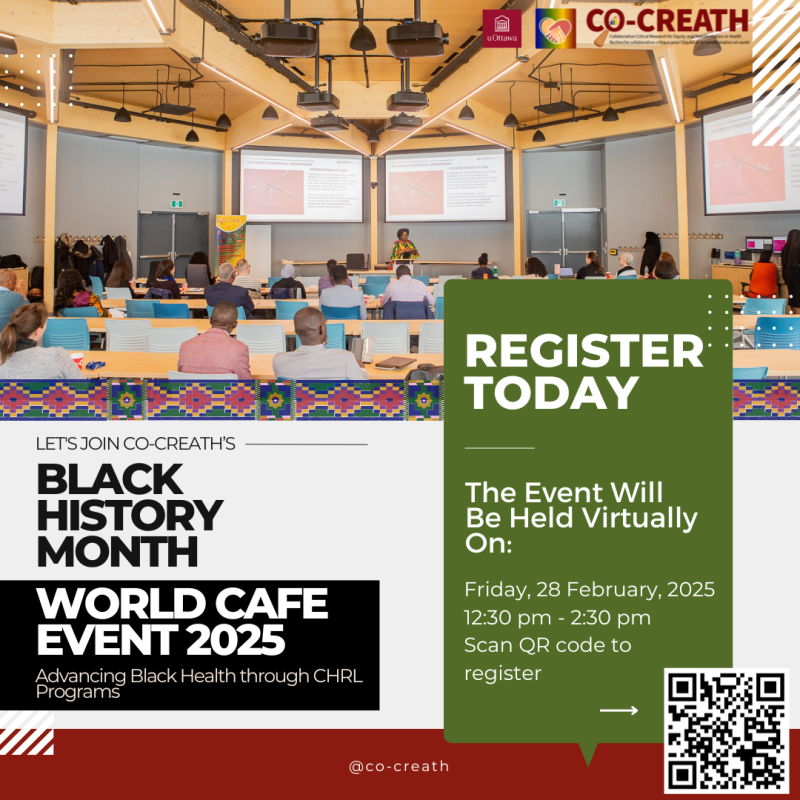
Flyer with an image of people attending a lecture. Text provides details of the event time and date.

This event is presented by Co-CREATH

CO-CREATH's annual Black History Month World Café Event is a virtual gathering to celebrate Black History Month and hear from their research team about how their projects are impacting the lives of African, Caribbean, and Black Canadians. It's also an opportunity to learn about the outcomes of their Critical Health and Racial Literacy program and what comes next.

#  

Details
Friday, February 28, 2025 - 12:30
12:30 - 1:30 pm
Cost: 
Free
Internal/External: 
Event Type: 
Location
Online

Building Social Connections: Designing multi-unit housing for social well-being

This webinar is presented by the National Collaborating Centre for Environmental Health. 

Join Happy Cities for an engaging discussion on designing housing that fosters well-being and social connection. As urban areas across Canada push for denser, faster housing development, it is critical to ensure these spaces support community connection, sustainability, and inclusion.

Happy Cities, a leading urban planning consultancy, has partnered with Hey Neighbour Collective and Simon Fraser University researchers to co-create innovative policies with five municipalities and one First Nation. Drawing on a decade of research in public health, psychology, and behavioural economics, this collaboration has culminated in a new toolkit offering evidence-based strategies for designing sociable multi-unit housing.

This session will explore how the design of multi-unit housing impacts neighbourly interactions and resident well-being. We’ll share actionable principles and insights to advocate for inclusive, connected communities.

As we face growing challenges like housing affordability, social isolation, and climate change, strengthening social connections is key to creating resilient, sustainable communities. Explore the toolkit here.

Details
Wednesday, January 15, 2025 - 15:00
3:00 - 4:00 pm
Cost: 
Free
Internal/External: 
Event Type: 
Location
Online

2S/LGBTQQIA+ Communities: Chronic Health & Administrative Health Data

This webinar is presented by Health Data Research Network Canada  (HDRN) as part of their Big IDEAs aout Health Data Speaker Series.

# About the Presentation:

There are increasing opportunities to leverage administrative health data to better understand the experiences of communities who face inequities, including 2S/LGBTQQIA+ communities. But how do 2S/LGBTQQIA+ people feel about these kinds of health data and their linkage to community-based research? For community-based researchers, what can administrative health data tell us about how 2S/LGBTQQIA+ people “show up” in the data? In this session, Anu Radha Verma and Dr. Nathan Lachowsky will discuss the feasibility and acceptability of administrative health data linkage amongst 2S/LGBTQQIA+ communities, the possibility of understanding chronic diseases and their management in our communities, and possibilities for the future.

PLEASE NOTE: This presentation is in English. The webinar will be recorded and posted on hdrn.ca.

# About the Speakers:

Anu Radha Verma (she/her) is an Associate Director of Research at the Community-Based Research Centre (CBRC). Her work at CBRC is focused on chronic health, conversion practices, anti-racism and gender-based violence. Anu Radha has lived and worked in both so-called Canada and India, and she focuses on social justice issues relating to the environment, health, gender and sexuality, poverty, youth, migration and disability. She is a queer, diasporic woman of colour with complex connections to ‘South Asia’, a mad-identified survivor, and she navigates chronic fatigue while living on the Treaty and Traditional Territory of the Mississauga’s of the Credit.

Dr. Nathan Lachowsky (he/him/his) is a settler researcher and uninvited guest on the traditional territory of the Lekwungen peoples. He is an Associate Professor in the School of Public Health and Social Policy at the University of Victoria, a Michael Smith Foundation for Health Research Scholar, and he serves as Research Director for CBRC. Championing interdisciplinary and community-based approaches, Dr. Lachowsky has conducted HIV and sexual health research with sexual and gender minoritized men, including Indigenous Two-Spirit and ethnoracial minority men across Canada and Aotearoa New Zealand.

# About the Series:

The Big IDEAs About Health Data Speaker Series features a variety of experts discussing how data can be used to advance health equity. It aspires to create a space for conversation about whether and how data can be used to advance equity in Canada; specific uses of and guidelines for the use of disaggregated data (sex and gender, race and ethnicity, disability, income, housing, language etc.); and advancements in data research practices and methods that embed inclusion, diversity, equity and accessibility in algorithms, distributed analytics, community involvement and equity assessment tools. Watch and share past webinar recordings

Details
Thursday, January 23, 2025 - 13:00
1:00-2:00 pm
Cost: 
Free
Internal/External: 
Event Type: 
Location

Co-Designing Integrated and Equitable Supports for Newcomers & Refugees

This webinar is presented by the National Newcomers Navigation Network (N4)

The settlement experiences of newcomers to Canada are shaped by broader social, systemic, and structural forces that can be better understood using an intersectional lens. However, intersectionality is often seen as too theoretical to operationalize within frontline settlement service delivery. Join us for a webinar with members from the “Beyond Technology, Beyond Healthcare” project, as they share lessons learned from a series of multistakeholder dialogues that can transform approaches in ensuring responsive and equitable service delivery for newcomers to Canada. 

# Speakers:

Dr. Ibukun Abejirinde, Scientist, Institute for Better Health, Trillium Health Partners

Isabelle Choon-Kon-Yune, Research Assistant, Women’s College Hospital Institute for Health System Solutions and Virtual Care

Dr. Nancy Clark, Associate Professor, Qualitative Health Researcher, University of Victoria


Details
Wednesday, February 12, 2025 - 13:00
1:00 - 2:00 pm
Cost: 
Free
Internal/External: 
Event Type: 
Location
Online

Community Engagement: From Debate to Dialogue

This virtual workshop is presented by the Tamarack Institute.

Community engagement is a pathway to building equity. We need to engage authentically while centring the voices of people who are closest to the issues we're working to solve. We need to work together.

Diverse perspectives are important for solution-making and finding ways to break the divide are necessary at local scales to find ways of moving forward. We have to create opportunities for dialogue – for understanding. 

# Learning Objectives

Participants will:

  • Learn techniques to help them navigate polarization in real time when facilitating engagement; create shared realities (or shared language) between those holding different perspectives; and increase the chances of healthy dialogue
  • Consider how to build relationships and reduce barriers to engagement
  • Frame polarized situations to create the conditions to move from debate to dialogue
  • Increase their knowledge of consensus-based and dialogue practices
Details
Thursday, March 6, 2025 - 13:00
1:00 - 4:00 pm
Cost: 
$225-275
Internal/External: 
Event Type: 
Location
Online

Webinaire de lancement du programme des PAQc 2025-26

Ce webinaire est organisé par Santé Ontario.

Les PAQ collaboratifs (PAQc) visent à soutenir les efforts d’amélioration de la qualité au sein des des Équipes Santé Ontario (ESO). Les indicateurs recommandés par Santé Ontario pour les PAQc sont axés sur l’amélioration de la santé de la population par la gestion des maladies chroniques et l’intégration des systèmes. Les ESO, toutes comme les agences individuelles, transmettent leurs PAQc par l’intermédiaire du Navigateur de PAQ. Les indicateurs des PAQc de cette année sont décrits dans cette lettre. Ce webinaire marque le lancement officiel du programme des PAQc 2025-26 et des ressources connexes. 

Ce webinaire sera présenté en Anglais.

# Objectifs du webinaire :

  • Passer en revue les points saillants de l’analyse des PAQc 2024-25; 
  • Expliquer le programme des PAQc 2025-26, y compris les mises à jour du programme pour 2025-26;
  • Présenter des idées de changement fondées sur des données probantes en provenance des experts en la matière afin de faire progresser l’impact clinique; 
  • Décrire les ressources offertes pour les PAQc 2025-26. 

# Qui devrait participer?

Les responsables des PAQc des ESO, les membres des équipes de projet des ESO et les personnes-ressources des organisations qui travaillent sur des initiatives d’amélioration de la qualité avec, ou au sein, des ESO sont invités à participer à ce webinaire.

Details
Wednesday, January 15, 2025 - 11:00
11h00 à 12h00
Cost: 
Gratuit
Location
Sur ligne

Séances d’information sur le programme des PAQc 2025-26

Ces séances virtuelles sont organisées par Santé Ontario.

Les PAQ collaboratifs (PAQc) visent à soutenir les efforts d’amélioration de la qualité au sein des ESO. Les indicateurs recommandés par Santé Ontario pour les PAQc sont axés sur l’amélioration de la santé de la population par la gestion des maladies chroniques et l’intégration des systèmes. Les ESO, tout comme les établissements individuels, transmettent leurs PAQc par l’intermédiaire du navigateur de PAQ

Ces séances sont offerts en anglais.

# Sommaire

Les indicateurs des PAQc de cette année sont décrits dans cette lettre. Après le webinaire de lancement du 15 janvier, Santé Ontario organisera une série de séances d’information hebdomadaires. Celles-ci vous permettriez de poser des questions au sujet du le programme des PAQc et d’en savoir plus concernant les ressources offertes. 

#  Qui devrait participer?

Les responsables des plans d’amélioration de la qualité collaboratifs des équipes Santé Ontario (ESO), les membres des équipes de projet des ESO et les personnes-ressources des organisations qui travaillent sur des initiatives d’amélioration de la qualité avec ou au sein des ESO sont invités à participer à ces séances.


Details
Thursday, January 16, 2025 - 10:00
Wednesday, January 22, 2025 - 13:00
Thursday, January 30, 2025 - 13:00
Friday, February 7, 2025 - 13:00
6, 22, 30 janvier et 7 fevrier, heures varieux
Cost: 
Gratuit
Event Type: 
Location