Gender Affirming Care Must Be Accessible to All. Without it, Lives Are at Risk
Date: 
Tuesday, November 18, 2025

Everyone has the right to gender affirming care, at any age. But for some people in Canada, including youth and 2SLGBTQ+ populations, that right is at risk right now, and so people’s health is at risk as well. 

Everyone is entitled to culturally safe, person-centred care when receiving health care. This saves lives and helps people who face barriers to survive and thrive. This includes access to gender-affirming care, including transition support, for people who identify as transgender. Canada has high rates of bullying (77%) among sexually and gender diverse youth, and gender affirming care is essential to address the existing poorer mental health among this population. High rates of bullying and poorer mental health also contribute to a rate of suicidal ideation in transgender youth that is five times higher than cisgender peers; their rate of suicide attempts are 7.6 times greater (Suicidality among sexual minority and transgender adolescents: a nationally representative population-based study of youth in Canada | CMAJ

In light of this, it is dispiriting to see two Canadian provinces – Alberta and British Columbia – moving to restrict gender affirming care for their youth. The policy changes of these two governments include denying people access to puberty blockers. These essential medicines delay the onset of hormonal changes and give trans and gender-questioning young people more time to consider and explore their options before they make permanent decisions about their bodies. It must be up to a physician or nurse practitioner and their patient to determine the appropriate course of treatment. Other forms of transition support under threat include the right of a young person to change their name or pronouns at school. Denying access to any of these forms of care furthers the risks faced by young people who are often already vulnerable.

The missing piece of so much of the current debate is that transition support is one part of the spectrum of broader, gender-affirming, person-centred care. There are other kinds of gender-affirming care, for other populations, that are commonplace and accepted without debate. These include breast augmentation or reductions, hormone replacement therapy during perimenopause and menopause, or interventions for people experiencing hair loss, low libido, or sexual dysfunction. These interventions are not subject to the same public debate because, unlike trans care, they are not tied to stigma, misinformation, or fear and hatred.

We commend Canada’s doctors and health system leaders who have raised the alarm about policies that restrict access to health care decisions that are between a primary care physician or nurse practitioner and their patient/client, and who have taken a strong stand in support of ensuring that gender-affirming care is accessible, safe and timely, particularly for youth and 2SLGBTQ+ people. These trained health professionals take very seriously their duty to care for Canada’s children and youth, and they are standing together in forceful opposition to attacks on gender-affirming care for transgender youth. In 2024, the Canadian Medical Association declared their opposition to policies that would restrict access to gender-affirming care; the Ontario Medical Association called for gender-affirming care to be prioritized, calling it “lifesaving;” and Ontario Health released quality standards specifically for Gender-Affirming Care for Gender-Diverse People

Across Ontario, local initiatives are putting these bold statements into action. Here are just four examples: 


Despite these excellent examples, it is not enough. In Ontario there continues to be long wait times for gender affirming care and the opposition to this care is prolific. We cannot allow misinformation, fear and stigma to drive the debate around evidence-based primary care for youth and 2SLGBTQ+ people, especially transgender people. Those who claim to rally “for kids” are in fact advocating for policy changes that we know – and evidence shows – will harm children and youth. Every person’s health care needs are best decided between them and their physician or nurse practitioner. 

As we move towards another Transgender Day of Remembrance on November 20, and followed by the 16 Days of Action Against Gender-based Violence, let’s remember, and remind people and policymakers alike: 

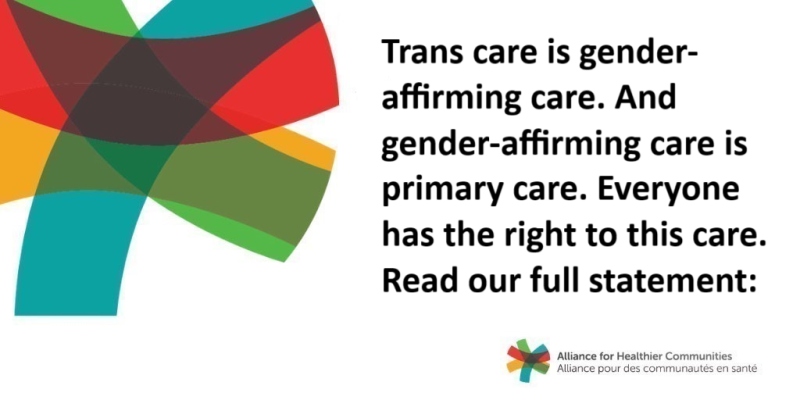
Trans care is gender-affirming care. And gender-affirming care is primary care. Everyone has the right to this care, and blocking access to it puts lives, including the lives of children, at risk.
 

Ontario Health Menopause Quality Standard Community of Practice Launch: Join the first learning session on November 18

This community of practice and launch webinar are hosted by Ontario Health. 

Ontario Health recently released the new Menopause: Care for Women and Gender-Diverse Peoplequality standard and is launching the Menopause Quality Standard Community of Practice (CoP) on November 18. Clinicians and health care teams are invited to register for the CoP’s first learning session, featuring Dr. Ardelle Piper, on Tuesday, November 18, from 12 p.m. to 1p.m. ET.  This 1-credit-per-hour Group Learning program has been certified by the College of Family Physicians of Canada and the Ontario Chapter for up to 1.0 Mainpro+Ⓡ credits. 

At this accredited learning session, attendees will:  

  • Gain a clear understanding of the new Menopause quality standard, its quality statements and accompanying resources, including the Menopause Implementation Toolkit, which will be debuted during the meeting
  • Learn how to use the quality standard to improve care for women and gender-diverse people experiencing perimenopause or menopause, particularly in primary care settings
  • Explore the historical context that has influenced menopause care and how clinicians can support a shift toward evidence-based care.  

 By registering through the link provided above, you will be enrolled in the complete learning series and receive timely notifications regarding future sessions.

Details
Tuesday, November 18, 2025 - 12:00
12-1 pm
Cost: 
Free
Internal/External: 
Event Type: 
Location
Online event

Hot Topic Webinar: ‘Peering into the System’ with Julia Reid

This webinar is presented by the Substance Use Health Network and the Reclaim Collective

Join us for a powerful conversation with  Julia Reid, a PhD candidate at the Lyle S. Hallman School of Social Work, Wilfrid Laurier University, whose research and clinical practice are transforming how peer work is understood, substance use, and mental health.

Julia brings together lived/living experience, clinical insight, and academic rigour to challenge biomedical dominance and highlight the invaluable expertise of people who’ve been psychiatrized, diagnosed, or criminalized as “addicts.”

Her upcoming talk will explore how Peer Specialists working in substance use health systems navigate exploitation, isolation, and co-optation within both abstinence-based and harm reduction environments — and what transformative, justice-oriented peer work can look like instead.

Julia’s approach, grounded in relational accountability, reciprocity, and community-based methodologies, reimagines how we build knowledge and support healing within substance use health and mental health care.


Details
Thursday, November 13, 2025 - 12:00
12-1 pm
Cost: 
Free
Internal/External: 
Event Type: 
Location
Online event

Partnering with People with Lived Experience to Enable Person-Centered Integrated Care

This webinar is presented by the International Foundation for Integrated Care (IFIC) Canada

Join us for a conversation on how people with lived experience are leading transformative change in healthcare and integrated care across Canada. This session will explore authentic partnership, shared power, and what it means to move from consultation to genuine co-leadership in system transformation.

This session is being co-designed with our panelists. A detailed description, discussion topics, and panelist bios will be available soon.

# Faciltators

Jodeme Goldhar | Co-Director, IFIC Canada

Prof. Walter Wodchis | Co-Director, IFIC Canada

Details
Wednesday, November 12, 2025 - 12:00
12:00-1:30pm
Cost: 
Free
Location
Online via Zoom

AI-Driven Misinformation Across Sectors: Addressing a Cross-Societal Challenge

This panel discussion is presented by the Canadian Science Policy Institute

Artificial Intelligence is reshaping how information is created, consumed, and trusted. While offering transformative potential in sectors like healthcare, education, finance, and public discourse, AI systems also introduce new vulnerabilities—particularly in the spread of misinformation and disinformation. From fabricated medical advice and AI-generated “deepfake” political content to financial scams and distorted educational tools, AI misinformation poses a growing threat to public trust and safety.

This panel brings together cross-sectoral experts to examine how AI-driven misinformation manifests in their respective domains, its consequences, and how policy, regulation, and technical interventions can help mitigate harm. The discussion will explore practical pathways for action, such as digital literacy, risk audits, content verification technologies, platform responsibility, and regulatory frameworks. Attendees will leave with a nuanced understanding of both the risks and the resilience strategies being explored in Canada and globally.

# Panelists

Dr. Plinio Morita | Associate Professor / Director, Ubiquitous Health Technology Lab, University of Waterloo

Dr. Nadia Naffi | Université Laval — Associate Professor of Educational Technology and expert on building human agency against AI-augmented disinformation and deepfakes

Dr. Jutta Treviranus | Director, Inclusive Design Research Centre, OCAD U, Expert on AI misinformation in the Education sector and schools

Michael Geist (Moderator) | Canada Research Chair in Internet & E-commerce Law, University of Ottawa

Dr. Fenwick McKelvey | Concordia University — Expert in political bots, information flows, and Canadian tech governance

#  
Details
Tuesday, November 11, 2025 - 12:00
12:00-1:30pm
Cost: 
Free
Internal/External: 
Event Type: 
Location
Online via Zoom

Better Care Starts Here: How to Embed Caregivers as Partners in Care

This webinar is presented by the Ontario Caregiver Organization

When care providers include caregivers as partners in care, communication improves, staff experience less stress, and care is enhanced. It's a win for everyone, but the process can feel overwhelming. 

How do you train caregivers or already-overwhelmed staff? What about getting buy-in from leadership or care recipient confidentiality? And how can you know something will actually work in your setting? 

That's where the Ontario Caregiver Organization's Essential Care Partner Support Hub comes in. 

# Webinar Overview

In this 30-minute info session with the Support Hub, you’ll hear stories from caregivers and frontline teams as well as the latest Ontario data to understand why caregiver inclusion matters. Plus, you’ll get simple, proven steps used by organizations to better engage, support, and collaborate with caregivers as part of the care team. You’ll walk away with:

✅ A clear understanding of caregivers and their impact on care delivery

✅ Practical ways to identify caregivers early and consistently across care settings 

✅ Tools to support better communication, reducing stress and confusion while supporting smoother transitions 

✅ Access to ready-to-use training templates for caregivers and staff 

✅ Real stories from caregivers and organizations already doing the work 

Join to find out why more than 300+ care teams across hospitals, long-term care, primary care, and home & community care have trusted us to help them better engage, support, and collaborate with care partners—and how we can help you achieve your goals, too.

This session is designed for: Clinicians, care navigators, leaders, managers, and teams advancing patient- and family-centred care. Free to attend. No prep required. 

NOTE:  This session won’t be recorded.

# About the Support Hub

Trusted by Ontario’s hospital, long-term care, primary care, and home and community care teams, The Support Hub provides: 

 Tools and templates that make care partner inclusion easier, whatever your setting

  • Real examples from organizations already leading the way
  • Simple, practical steps your team can take right now to improve transitions, reduce stress, and enhance care
  • Training resources for caregivers and staff
  • 1:1 support to embed person- and family-centered care across your organization 

 Join their info session on Nov 12 at 12 PM to learn more and connect with their team.

Details
Wednesday, November 12, 2025 - 12:00
12-1 pm
Cost: 
Free
Internal/External: 
Event Type: 
Location
Online event

Better Breathing Week 2026

This event is presented by the Lung Health Foundation.

Better Breathing Week 2026 marks the 43rd annual gathering of healthcare professionals, researchers, policymakers, and patient advocates dedicated to advancing lung health across Canada.  

This year’s program focuses on breaking down silos and uniting disciplines. Highlights include a dedicated series for primary care providers addressing limited access to spirometry, vaccine uptake, and severe asthma identification. 

Register to secure your spot for an incredible conference: Better Breathing Week Registration - Better Breathing Week 2026

See full list of individual prices here. Reach out to lraggente@lunghealth.ca for information about group discounts.

# Conference Dates

  • January 20–21, 2026 — Virtual
  • January 23–24, 2026 — In-person at the Hyatt Regency Toronto 

Join us virtually or in-person to be part of the conversation shaping the future of lung health in Canada. Some sessions are listed below; you can explore the full program here: Preliminary Program - Better Breathing Week 2026

# Curated Virtual Sessions

  • Motivating Change: A Primary Care Lens on Breathing, Behavior, and Better Health (with Peter Selby, MBBS, CCFP(AM), FCFP, MHSc, DFSAM on Jan. 20 at 9:00am EST, virtual)
  • Contemporary Approaches to Smoking and Vaping Cessation (with Hassan Mir, MD, FRCPC on Jan. 20 at 10:00am EST, virtual)
  • Advancing Respiratory Care in Rural and Remote Communities (with Birubi Biman, MD, FRCPC, Tracey Carr, BA, MSc, PhD, MA, and Andre Letendre on Jan. 20 at 11:00am, virtual)
  • Improving Outcomes Through Trauma-Informed Lung Cancer Care (with Tara Lohmann, MD, FRCPC, and Christine Fader, DSW, on Jan. 20 at 2:00pm, virtual)
  • Breaking Barriers: Tackling Lung Health Stigma in Practice (with Ambreen Sayani, MD, MS, PhD, Gary Bloch, MD, CCFP, FCFP, Vanessa Wright, DNP and Howard Freedman on Jan. 20 at 3:00pm EST, virtual)
  • Inhaler Technique 101: Practical Guidance for Healthcare Providers (with Alia Maratova, RRT, CRE, on Jan. 20 at 3:00pm EST, virtual)

# Curated In-Person Sessions

  • How to Start Patients on Airway Clearance Therapy? A Physiotherapist-Led Overview (with Kenneth Wu, PT, MBA, PhD, Prashna Singh, PT, CRE, and Diana Hatzoglou, PT, CRE on Jan. 23 at 1:15pm EST, in-person)
  • Collaborating for the Future: Innovation in Respiratory Care (with Shirley Quach, RRT, MHSc, PhD, Melis Erkan, and Sidra Anjum on Jan. 23 at 5:00pm EST, in-person)
  • From Oscillometry to Spirometry: Practical Insights in Pulmonary Function Testing (with Chung-Wai Show, PhD, MD, FRCPC, Donald Cockcroft, MD, FRCPC, and Sanja Stanojevic, PhD, on Jan. 24 at 1:15pm EST, in-person)

# Primary Care Series

We are also excited to welcome back our Primary Care Series on Wednesday January 21, from 1:00pm EST to 4:00pm EST:

  1. The Realities of Spirometry Testing in Primary Care: Addressing the Barriers (with Anthony D’Urzo, MD, MSc, BPHE, CCFP, FCFP)
  2. Identifying Suspected Severe Asthma and Prompt Referral in Primary Care (with Jason K. Lee, MD, FCPC, FAAAI)
  3. Strengthening Defenses: Advancing Immunization and Vaccine Uptake in Respiratory Disease (Christine Palmay, MD, CCFP, FCFP)

# CME Accreditation

Better Breathing 2026 has been officially certified and accredited for continuing education credits:

Credits for Family Medicine Specialists: This Certified Activity meets the certification criteria of the College of Family Physicians of Canada and has been certified by the Queen's University CPD Team for up to 27.5 Mainpro+ credits.

Credits for Royal College Specialists: This co-developed activity is an Accredited Group Learning Activity (Section 1) as defined by the Maintenance of Certification Program of The Royal College of Physicians and Surgeons of Canada, and approved and co-developed by the Queen's University CPD Team. You may claim a maximum of 27.5 hours (credits are automatically calculated).

Hours for All Health Professionals: This is a professional learning activity which provided up to 27.5 hours of Continuing Education


Details
Tuesday, January 20, 2026 - 09:00
Wednesday, January 21, 2026 - 09:00
Friday, January 23, 2026 - 09:00
Friday, January 24, 2025 - 00:00
January 20-21 (Virtual) and 23-24 (In Person)
Internal/External: 
Event Type: 
Location
Hybrid (Virtual and In-Person)
Hyatt Regency Toronto - 370 King St W
Toronto, ON M5V 1J9

Midwifery Connecting Primary Care and Hospital

This webinar is presented by the Alliance for Healthier Communities

The Midwifery and Toronto Community Health (MATCH) Program based at South Riverdale CHC has partnered with the Michael Garron Hospital’s Early Pregnancy Clinic (EPC) to improve the quality, safety, and accessibility of care for Early Pregnancy Loss. In less than two years, they have worked with obstetric colleagues to develop evidence-based protocols, have strengthened relationships between Midwifery and Obstetrics departments, provided education for primary care providers and community midwives, and developed patient handouts tailored to the community. They've also expanded clinic hours, established a hotline, created a pathway for uninsured patients to receive care from the hospital, and improved referral pathways between the community and the hospital. 

In this webinar, MATCH co-leads Shezeen Suleman and Jenna Bly, both Registered Midwives, will describe how this unique partnership came about and provide an overview of their innovative approach and the impact it's already had. Attendees will come away with a deepened appreciation for the potential of hospital-community collaboration, the importance of integrated midwifery care, and how these things can help reduce the need for people with early pregnancy loss seek care from emergency departments.

MATCH program logo
Details
Wednesday, February 11, 2026 - 12:00
12:00-1:00 pm
Cost: 
Free
Internal/External: 
Event Type: 
Location

Dialing Down Barriers: A Quality Improvement Journey to Strengthen Connection and Equity

This webinar is presented by Access Alliance Multicultural Health and Community Services

Event poster listing date, time, and webinar description
Event Poster - Click to Enlarge

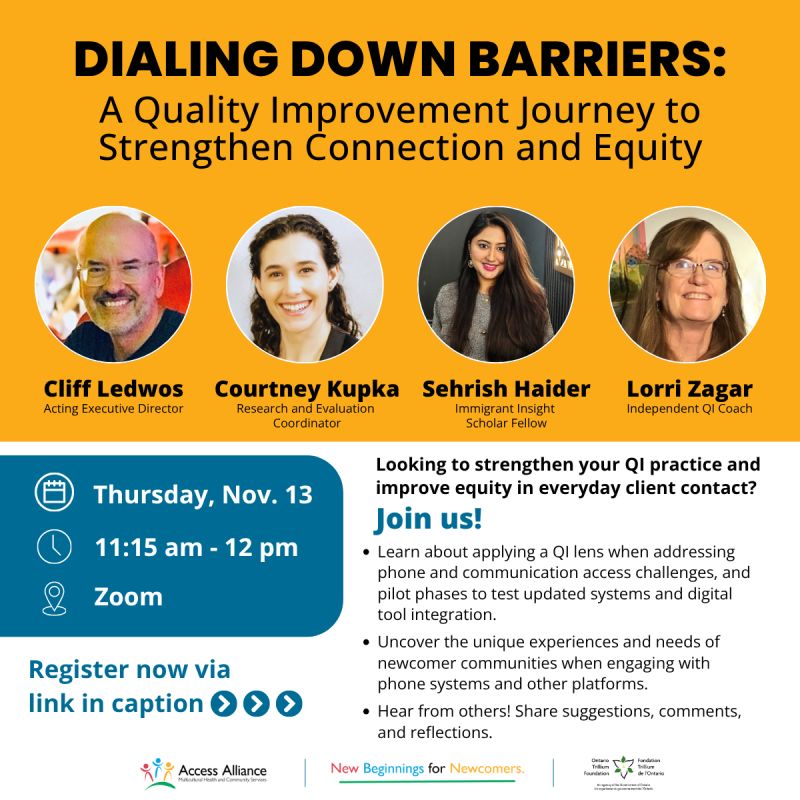
What’s the biggest barrier your clients face when trying to reach you by phone? Is it the system itself? Discover how Access Alliance is reshaping its phone system to cut wait times, improve language access, and embed equity into everyday client contact. Join us for 45-minutes of quality improvement (QI) methods, real-world data, and actionable next steps. We will share how QI leads, secretaries, and researchers came together with real-world data, plain-language scripts, and workflow analysis that make phone access an equity win for clients. Get practical ideas for integrating digital tools, tracking key indicators, and fostering cross-team collaboration to turn phone-related frustrations into reliable, inclusive client pathways. From "press zero" overloads to a strategic phone system redesign, hear about what we learned will boost client satisfaction and support community health goals.

# Session goals

  • Strengthen collaboration among QI, research, and operations staff across CHCs through shared learning and dialogue.
  • Help answer: “What’s the biggest barrier your clients face when trying to reach you by phone?”
  • Access Alliance reimagined its phone system to strengthen connection and equity for its clients. Understand how this fits into broader communications structures. 
  • Hearing from you! What have others done? 

# Learning outcomes 

  • Learn about applying a QI lens when addressing phone and communication access challenges, and pilot phases to test updated systems and digital tool integration.
  • Uncover the unique experiences and needs of newcomer communities when engaging with phone systems and other platforms.
  • Hear from others! Share suggestions, comments, and reflections. 

# Who should attend? 

CHC, primary care, and settlement QI leads, managers, secretaries, research staff, and frontline providers engaged in digital transformation and client information and service journeys in health and settlement.

# Speakers

  • Cliff Ledwos | Acting Executive Director, Access Alliance
  • Courtney Kupka | Research and Evaluation Coordinator, Access Alliance
  • Sehrish Haider | Immigrant Insight Scholar Fellow
  • Lorri Zagar | Independent QI Coach
Details
Thursday, November 13, 2025 - 11:15
11:15 am - 12 pm
Cost: 
Free
Internal/External: 
Event Type: 
Location
Online event

Health Security Unbound: Navigating Power, Surveillance, and Ethics

This event is presented by the Institute of Health Emergencies & Pandemics at the University of Toronto.

Join us for a compelling and timely webinar led by Joy Fitzgibbon, exploring the evolving landscape of health security in pandemic prevention and response. As global threats increasingly blur the lines between public health and national security, this session will delve into the security requirements that shape pandemic preparedness—and the tensions that arise when human rights intersect with military and intelligence interests.

Through a critical lens, Fitzgibbon will unpack:

  • The securitization of health in global pandemic strategies
  • Competing frameworks for managing bio-threats
  • Ethical dilemmas in surveillance, containment, and emergency powers
  • The role of intelligence agencies in pandemic forecasting and response
  • How to balance civil liberties with collective safety

 Whether you're a policymaker, public health professional, researcher, or concerned citizen, this webinar offers a thought-provoking look at the future of health security—and the choices we face in safeguarding both lives and freedoms.

Presenter:

Panelists:

Details
Monday, November 24, 2025 - 12:00
12-1 pm
Cost: 
Free
Internal/External: 
Event Type: 
Location