Better Quality Through Better Measurement

This 12-week learning program is presented by the Institute for Healthcare Improvement (IHI)

# Quality Improvement Relies on Quality Measurement

In this program, you will discover what quality measurement is and why it matters, how to set a clear and achievable aim, how to define a family of measures tightly linked to your aim, how to choose and collect the right data, and how to display and analyze your data in run and control charts to support improvement. You can bring your own improvement project or idea and apply course concepts, tools, and methods or choose from several case studies to use as you apply course learnings. You will benefit from online lessons, live webinars, case studies, coaching, and peer interaction.

# What You'll Learn

After completing this course, participants will be able to:

  • Describe the concepts and methods of measurement for improvement
  • Apply the steps/tools in the quality measurement journey to a system you are improving
  • Design a family of measures
  • Construct effective data collection plans that incorporate stratification and sampling methods
  • Design run and control charts to analyze data for improvement
  • Distinguish common and special cause variation in data

# Key Dates

This program consists of 6 online lessons and 6 all-learner calls.

  • September 24: Lesson 1 opens
  • October 7: Deadline to register
  • October 8: First all-learner call

Find the full agenda here.


# Who Should Attend

This online course is open to professionals familiar with quality improvement methods interested in taking a deeper look into measurement. This includes:

  • Quality Leaders and Managers
  • Chief Quality Officers
  • Patient Safety Officers/Executives
  • Data Analytics Staff


Details
Wednesday, October 7, 2026 - 17:00
Register by October 7
Cost: 
$995
Internal/External: 
Event Type: 
Location
Online Learning

Advancing Cultural Safety Together - HEC Learning Collaborative

This learning collaborative is presented by Healthcare Excellence Canada. 

# About the collaborative

Advancing Cultural Safety Together supports healthcare organizations to address systemic racism and advance culturally safe care.

Through coaching, shared learning including possible in-person and virtual events, and practical tools, teams will be supported to implement the Cultural Safety Pathway — a structured approach to creating meaningful and lasting change to address systemic racism and advance culturally safe care.

  • 80 teams from across Canada will be invited to join
  • The collaborative will run for two years starting in September 2026. Applications are open until July 31, 2026.
  • Participating teams will have an opportunity to build relationships, share, and learn from organizations and HEC coaches from across the country

# Why it matters

Racism experienced by First Nations, Inuit and Métis in healthcare is a critical patient safety issue. It leads to harm, mistrust, inequitable access to care and worse health outcomes. Across the country, healthcare organizations are increasingly recognizing the urgent need to address systemic racism and improve cultural safety.

Advancing Cultural Safety Together gives you a clear and supported way to address systemic racism and improve cultural safety. Your team can make meaningful progress in addressing systemic racism and advancing culturally safe care in your setting — leading to safer experiences, stronger trust and improved health and wellness of First Nations, Inuit and Métis patients, families and communities.

# By joining the collaborative, you will:

  • Identify clear, actionable steps to address systemic racism based on an organizational assessment
  • Strengthen relationships with First Nations, Inuit and Métis communities
  • Build capacity to provide culturally safe care

The result?

Improved relationships with First Nations, Inuit and Métis communities, leading to stronger trust and safer care experiences.

The collaborative and pathway content align with forthcoming indicators, reporting and standards. This includes the Health Standards Organization’s new First Nations, Inuit and Métis-led National Standard of Canada for Cultural Safety and Humility and the Canadian Institute for Health Information’s cultural safety and Indigenous-specific racism indicators.

Details
Friday, July 31, 2026 - 17:00
Apply by July 31. Collaborative starts in September.
Cost: 
Free
Internal/External: 
Event Type: 
Location
Online Learning

Advancing Health Equity action series

This learning program is presented by Healthcare Excellence Canada.

Join a six-month virtual action series designed to help you build practical skills, strengthen relationships and take action by addressing the factors that shape health equity in your setting.

This series supports you to put the HEC Health Equity Framework into practice through reflection, collaboration and real-world action.

You will explore how your role, decisions and everyday practices can contribute to safer more equitable care for everyone.

HEC is committed to building a future where everyone has access to safe, high-quality healthcare.

To support this commitment, HEC co-developed the Health Equity Framework, an action-oriented resource grounded in an understanding of how systems of oppression and discrimination affect care experiences and outcomes.

This action series is an opportunity to move the framework from concept into practice through virtual learning sessions, peer connection and supported action periods.

You will identify opportunities for change in your own setting and take meaningful steps toward more equitable care.

# What’s in it for you

# Build a shared understanding of health equity

Using the Health Equity Framework, you will deepen your understanding of how your role, team and systems shape experiences of care and contribute to safer, higher-quality healthcare.

# Apply a systems-oriented equity lens to your everyday work

You will explore a familiar aspect of your work through a new lens, identify an opportunity for change and take one practical, role-relevant action toward more equitable care.

# Strengthen relationships that sustain equity work

You will connect with peers and coaches who support reflection, learning and ongoing practice.

# Who should register

This series is open to anyone working in or alongside health and social care, including:

  • Leaders 
  • Point-of-care providers
  • Patient, family, caregiver and community partners

No prior experience with health equity work is required.

We ask that you register with a ‘learning buddy’ from your organization, team, network or community. We have learned from many across the country that learning and action for health equity can sometimes feel hard, uncomfortable and lonely. Learning alongside someone else can help strengthen reflection, accountability and action throughout the series.

If you are registering on your own, you will have the option to be paired with another participant.

# How the series works

The series includes:

You will be expected to:

Details
Friday, August 14, 2026 - 17:00
Register by August 14
Cost: 
Free
Internal/External: 
Event Type: 
Location
Online event

Understanding the Impact of Gender-Based Violence

This in-person learning series is presented by Women's Health in Women's Hands (WHIWH) Community Health Centre

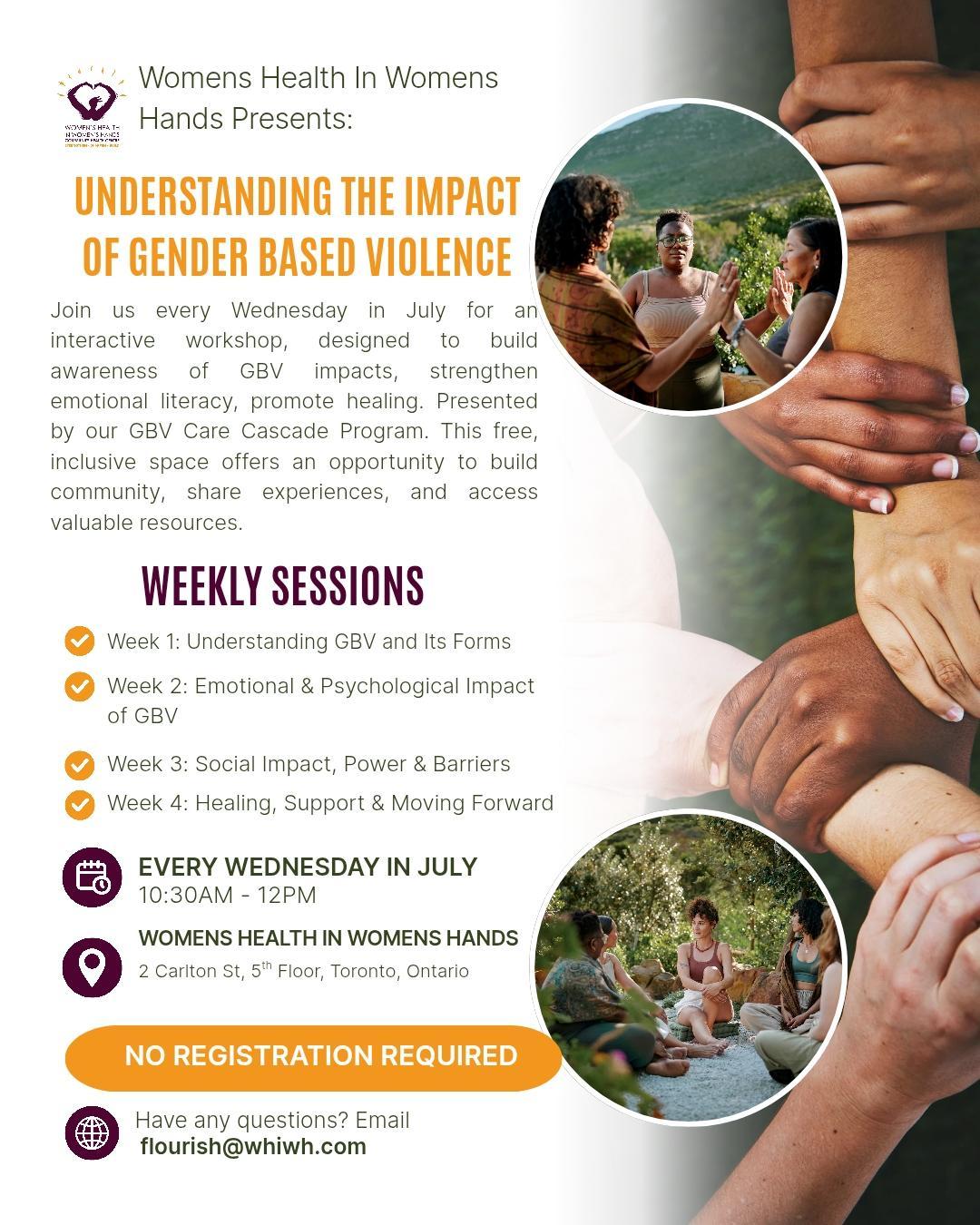
Event series poster. Text on this poster is repeated in the body of this post.

Join WHIWH every Wednesday in July (starting on July 8)  from10:30 am to 12:00 pm for an interactive workshop series, designed to build awareness of Gender-Based Violence (GBV) impacts, strengthen emotional literacy, promote healing. 

This event is presented by WHIWH's GBV Care Cascade Program. This free, inclusive space offers an opportunity to build community, share experiences, and access valuable resources. 

# Weekly Sessions

Participants are encouraged to join all four sessions. If you have any questions about the series, please contact flourish@WHIWH.com. 

  • July 8 | Understanding GBV and its forms
  • July 15 | Emotional & Psychological Impact of GBV
  • July 22 | Social Impact, Power & Barriers
  • July 29 | Healing, Support & Moving Forward

# RSVP By Email 

You do not need to register for these events Just send your name and contact information to flourish@WHIWH.com if you wish to attend. 

Details
Wednesday, July 8, 2026 - 10:30
Wednesday, July 15, 2026 - 10:30
Wednesday, July 22, 2026 - 10:30
Wednesday, July 29, 2026 - 10:30
Wednesdays, July 8-19, 10:30 am - 12:00 pm
Cost: 
Free
Internal/External: 
Event Type: 
Location
2 Carlton St.
5th Floor
Torotno, ON M5B 1J3

The Nine Pillars of Integrated Care: Discussion on Purpose

This event is presented by the International Foundation for Integrated Care (IFIC) as part of their Nine Pillars of Integrated Care 2026 Forum Series.

Shared purpose for integrated care matters because integrated care is, fundamentally, an attempt to get people to work together who otherwise wouldn't — across professional boundaries, organisational divides, the split between health and social care, and the gap between formal services and the people they serve. Without something that pulls in a common direction, each actor defaults to their own internal logic: at the risk of oversimplifying, the hospital to throughput, the GP to list size, the social worker to safeguarding thresholds, the commissioner to contract compliance. Shared purpose is what makes collective action possible in a system where no single authority can simply issue orders.

Join IFIC for an interactive Forum Discussion focused on the Shared purpose Pillar of the Nine Pillars of Integrated Care. This session brings together international expertise to explore what progress has been made, what tensions remain, and what practical shifts are needed to enable integrated, people centred care in different contexts.

# What the discussion will explore:

  • Whose purpose is it, really?
  • What are each of us willing to give up for it?
  • How would we know if our shared purpose was actually wrong?
Details
Wednesday, July 8, 2026 - 11:30
11:30 am - 12:30 pm
Cost: 
Free
Internal/External: 
Event Type: 
Location
Online via Zoom

ECHO Chronic Pain Open Session

This event is presented by ECHO@UHN

This is an open series, you do not need to be registered in the ECHO Chronic Pain program to attend any of these 4 sessions Starts Thursday June 25th 12:30PM - 2:00PM EST  (See open session dates and topics below)
  • Open to all health care providers
  • No cost to participate
  • Access to an interprofessional specialist team
  • Earn CPD Credits 
  • Present your cases for support from the ECHO community: email keren.sedmina@uhn.ca 

Once registered, you are welcome to attend any or all the sessions.

For questions or more information: please email - echo.ontario@uhn.ca,  download the flyer, or visit the ECHO@UHN website.   ECHO Ontario is funded by the Ontario Ministry of Health. Please feel free to share with other healthcare providers in Ontario  

# Series Schedule 

All Sessions are from 12:30PM - 2:00 PM EST

  • June 25    Clinical Interview & Sensory Exam
  • July 9    Back Pain & Spinal Stenosis Part 1
  • July 16    Back Pain & Spinal Stenosis Part 2
  • July 23    Aberrant Behaviors / Urine Drug Screening


Details
Thursday, June 25, 2026 - 12:30
Thursday, July 9, 2026 - 00:00
Tuesday, June 16, 2026 - 00:00
Tuesday, June 23, 2026 - 00:00
12:30-2:00 pm
Cost: 
Free
Internal/External: 
Event Type: 
Location
Online via Zoom

From Insight to Action: Equity Guiding Questions tool

This webinar series is presented by The Centre for Implementation as part of their Tools that Support Implementation Series. 

Many teams are looking for practical ways to use implementation tools to support their work, so instead of hosting a single session, TCI is launching a full event series dedicated to this topic. Each event will spotlight one TCI tool.  You’ll learn about its purpose, see how it works through a guided walkthrough, and hear real examples of how others have used it — giving you fresh ideas and practical inspiration to strengthen your own change efforts. You’ll also have the opportunity to join interactive activities, discussions, and a Q&A.

Equity Guiding Questions tool offers meaningful questions for self-reflection or team discussions to help you consider equity at every stage of the implementation process.

Details
Tuesday, September 15, 2026 - 12:00
12:00-1:00 pm
Cost: 
Free
Internal/External: 
Event Type: 
Location
Online event

From Insight to Action: Map2Adapt Tool

This webinar series is presented by The Centre for Implementation as part of their Tools that Support Implementation Series. 

Many teams are looking for practical ways to use implementation tools to support their work, so instead of hosting a single session, TCI is launching a full event series dedicated to this topic. Each event will spotlight one TCI tool.  You’ll learn about its purpose, see how it works through a guided walkthrough, and hear real examples of how others have used it — giving you fresh ideas and practical inspiration to strengthen your own change efforts. You’ll also have the opportunity to join interactive activities, discussions, and a Q&A.

Map2Adapt helps you and your team plan for adaptations by providing tangible activities, discussion questions, and decision points.


Details
Tuesday, July 21, 2026 - 12:00
12:00-1:00 pm
Cost: 
Free
Internal/External: 
Event Type: 
Location
Online Event

Déclaration de l’Alliance portant sur le Mois national de l’histoire autochtone et la Journée nationale des peuples autochtones

Date: 
Monday, June 22, 2026

Juin est le Mois national de l’histoire autochtone au Canada, et le 21 juin marquait la Journée nationale des peuples autochtones. Ce mois thématique nous invite collectivement à honorer les cultures et les traditions riches et uniques des Premières Nations, des Inuits et des Métis, qui habitent ce territoire depuis des temps immémoriaux - des milliers d’années avant qu’il soit désigné sous le nom de « Canada ». Célébrée au solstice d’été, la Journée des peuples autochtones nous rappelle de façon éloquente le profond attachement des populations autochtones envers cette terre, ainsi que leur connaissance intime de ses cycles. Pour l’Alliance, à titre d’organisme dirigé par des personnes allochtones, ces moments sont l’occasion de réfléchir à notre part de responsabilité dans l’histoire de la colonisation de l’Ontario et aux pratiques coloniales qui subsistent. Cette période de l’année nous appelle non seulement à honorer les populations autochtones, mais également à mener une réflexion approfondie sur nos obligations issues des traités, ainsi que sur le rôle que nous avons à jouer dans les processus de réconciliation et de décolonisation.

Au début du mois, nous avons tenu notre congrès annuel sous le thème « Aiguillage et accès pour tous : L’équité en santé au centre de l’expansion des soins de santé primaires en Ontario ». Nous avons eu le privilège d’accueillir une aînée tout au long de l’événement et de l’assemblée générale annuelle qui le précédait. Durant ces trois journées passées à nos côtés, la Grand-mère Renée Thomas-Hill, du clan de l’Ours de la Nation Cayuga, rattachée au territoire des Six Nations de la rivière Grand, nous a transmis ses enseignements, tout en nous conviant à une réflexion empreinte de bienveillance et de gratitude. Cette transmission de savoirs s’inscrit dans notre cheminement continu visant à tisser des liens, à approfondir notre connaissance des cultures autochtones et à consolider notre rôle d’organisation partenaire et alliée sur la voie de la réconciliation.   

Le congrès a par ailleurs été marqué par la présentation de David A. Robertson, qui compte parmi les plumes et les voix autochtones les plus saluées au Canada. Son allocution s’est appuyée sur la force du récit pour donner vie à son plus récent ouvrage, « 52 Ways to Reconcile: How to Walk with Indigenous Peoples on the Path to Healing ». Par ses propos, le conférencier a illustré comment la tradition orale permet aux personnes de tisser des liens, de guérir et de forger un esprit de communauté. En soulignant les répercussions des politiques coloniales historiques et actuelles sur les populations autochtones, il a rappelé à l’auditoire que la réconciliation s’inscrit dans un mouvement collectif au sein duquel chaque personne a un rôle à jouer. Une telle démarche commande de désapprendre pour mieux réapprendre, de déconstruire les fondations du passé et de bâtir, de façon concertée, une nouvelle réalité. La séance s’est conclue par un appel à la mobilisation : poser des gestes porteurs de sens à l’échelle tant personnelle que professionnelle.

Nous prenons ce mot d’ordre très au sérieux. Dans notre cheminement vers la réconciliation et la décolonisation, nous devons accorder une place centrale aux voix, au leadership et aux communautés autochtones. Nous y parvenons en forgeant des partenariats avec le Conseil autochtone des soins de santé primaires, avec les organismes autochtones de soins de santé primaires membres de l’Alliance, ainsi qu’avec d’autres entités dirigées par des personnes autochtones.

Ces démarches exigent en outre de défendre et de promouvoir le principe de la santé des Autochtones entre les mains des Autochtones, qui réitère l’importance de la gouvernance et de l’autodétermination de ces populations en matière de santé. Pour les organismes allochtones, cet engagement suppose de soutenir le droit des populations autochtones d’assurer la direction et la gouvernance des réseaux de la santé, d’établir les priorités et d’administrer les services ainsi que les ressources qui les concernent. Il importe également de bien cerner les périmètres d’intervention : bien que les entités allochtones aient la responsabilité d’offrir des services aussi sécurisants sur le plan culturel que possible, elles doivent s’abstenir de mettre sur pied des programmes exclusifs, de gérer des fonds spécifiquement alloués aux Autochtones ou de s’approprier des pratiques liées à la guérison traditionnelle, aux cérémonies ou à d’autres rôles connexes. Ce mandat revient de plein droit aux organismes dirigés par des personnes autochtones, aux aînés, aux gardiens du savoir, aux guérisseurs traditionnels, ainsi qu’à toute autre personne détentrice de savoirs autochtones. Les organisations désireuses de mieux saisir leur rôle dans l’application du principe de la santé des Autochtones aux mains des Autochtones et d’accroître leur capacité à offrir des soins culturellement sécurisants à la clientèle autochtone sont invitées à suivre la formation Anishinaabe Mino'ayaawin (« Les gens en bonne santé »). Offerte par le Conseil autochtone des soins de santé primaires (IPHCC), cette formation sur la sécurité culturelle s’accompagne de nombreuses ressources où puiser de judicieux conseils et des pistes de réflexion.

Le processus de réconciliation et de décolonisation se déploie bien au-delà du mois de juin. Ce cheminement continu et concerté exige l’engagement de chaque personne. Alors que s’achève l’édition de cette année du Mois national de l’histoire autochtone, gardons à l’esprit l’appel à la mobilisation de David A. Robertson : poser, chaque jour et tout au long de l’année, des gestes porteurs de sens à l’échelle tant personnelle que professionnelle.

Alliance Statement on National Indigenous History Month and Indigenous Peoples Day

Date: 
Monday, June 22, 2026

June is National Indigenous History Month in Canada, and June 21 was National Indigenous Peoples Day. Indigenous History Month is an invitation for all of us to honour the rich and unique cultures, traditions and cultures of First Nations, Inuit and Métis Peoples who have lived on this land since time immemorial – thousands of years before it was called “Canada.” Indigenous Peoples Day, celebrated every Summer Solstice, is a powerful reminder of Indigenous peoples’ deeply rooted connections to this land and their profound knowledge of its rhythms. For the Alliance, as a settler-led organization, these moments are an opportunity to reflect on our part in Ontario’s history of colonialization and ongoing colonial practices. They call us not only to honour Indigenous peoples but also to deeply consider our treaty obligations and our role in reconciliation and decolonization.   

Earlier this month, we held our annual conference, Attachment for Everyone: Centring Health Equity in Ontario’s Primary Health Care Expansion. We were joined by an elder for the entire duration of the conference and the Annual General Meeting that preceded it. In the three days she spent with us, Grandmother Renée Thomas-Hill of the Cayuga Nation Bear Clan, from the Six Nations of the Grand River Territory, shared her teachings and brought us into a space of reflection, caring and gratitude. Learning from her is one of the many steps we’ll take in our ongoing journey to build connections, deepen our knowledge of Indigenous cultures, and become better allies and partners in reconciliation. 

The conference also featured a keynote address by David A. Robertson, one of Canada’s most celebrated Indigenous authors and storytellers. His address tapped into the power of storytelling to bring to life his latest book, 52 Ways to Reconcile: How to Walk with Indigenous Peoples on the Path to Healing. Through his words, he showed us how story can help people to connect, heal, and build community. As he spoke of the impacts of past and present colonial policies on Indigenous Peoples, Robertson reminded us all that reconciliation is a shared movement and that everyone has a role to play in it. It requires unlearning and relearning, tearing down old foundations and building something new together. He concluded with a call to action: Do something that matters in your personal and professional lives.  

We take that call seriously. In the journey of reconciliation and decolonization, we must bring to the forefront Indigenous voices, leadership and communities. We do this through partnerships with the Indigenous Primary Health Care Council (IPHCC), Indigenous Primary Health Care Organizations (IPHCOs) that are members of the Alliance, and other Indigenous-led organizations.  

This work also calls for upholding and advancing the principle of Indigenous Health in Indigenous Hands, which reaffirms Indigenous governance and self-determination in health. For non-Indigenous organizations, this means supporting Indigenous rights to lead and govern the health systems, priorities, services, and resources that affect them. It also means understanding a crucial boundary: Non-Indigenous organizations must make their own services as culturally safe as possible, but they should not create Indigenous-specific programs, control Indigenous-specific funding; or take on traditional healing, ceremonies, or related roles. This work belongs with Indigenous-led organizations, Elders, Knowledge Keepers, Traditional Healers, and other Indigenous knowledge holders. Organizations looking to better understand their role in upholding Indigenous Health in Indigenous Hands and build their capacity to serve Indigenous clients in a culturally safe way are urged to take the Anishinaabe Mino’ayaawin (“People in Good Health”) Indigenous Cultural Safety training offered by the Indigenous Primary Health Care Council and to draw insights and guidance from the many resources available from the IPHCC. 

The work of reconciliation and decolonization extends beyond the month of June. It is an ongoing, shared journey that requires everyone’s involvement. As we wrap up this year’s National Indigenous History Month, let’s remember David A. Robertson’s call to action and do something that matters in our personal and professional lives every day, year-round.