The Alliance calls for a #SafeSeptember

Date: 
Wednesday, August 26, 2020

At the Alliance for Healthier Communities, we are at the forefront of community-driven approaches for health equity in Ontario. Our Community Health Centres and other front line organizations are led by and work on behalf of Black, Indigenous, racialized and low income communities whose exclusion on the basis of occupation, geography, race or poverty has forced upon many of them the highest rates and risks of COVID-19 in the province.

We have questions about a #SafeSeptember.

This week, parents and caregivers in many of these communities will be asked again whether they plan to enrol their children in person or online. But for most this is not a real choice. Without decent work, paid sick days, adequate spaces and supports for online learning, appropriate class sizes, province-wide mask policies for all grade levels, safe ventilation and sanitation facilities or clear guidance on the policies for school-related exposures or symptoms, it is an impossible choice.

We are pleased to see the federal government commit $2 billion toward safer school reopening across the country. Here are our questions for Premier Doug Ford, Education Minister Stephen Lecce, Health Minister Christine Elliott and Chief Medical Officer of Health David Williams about how they plan to spend it in the communities we serve in Ontario; the communities who need it most:

  • Will you mandate smaller class sizes to reduce COVID-19 transmission risk?
  • Will you invest in school boards that have mortgaged their future by being forced to spend current reserves on COVID-19-related facilities, staffing and space?
  • Will you increase provincially-mandated paid sick days to allow parents and caregivers to meet required periods of isolation when their children are symptomatic or exposed to COVID-19?
  • Will you empower educators and communities to ensure equitable remote learning strategies such as access to spaces, supports and connections for online learners including children at home during limited periods of COVID-19-exposure or symptom-related isolation?
  • Will you commit to clear policies and clear communications, and enrol trusted local peers to communicate in appropriate ways?
  • Are you prepared to further postpone school openings until comprehensive strategies are in place?

Backgrounder

Black Creek CHC and its partners lead community response to COVID-19 in northwest Toronto

Thursday, July 23, 2020
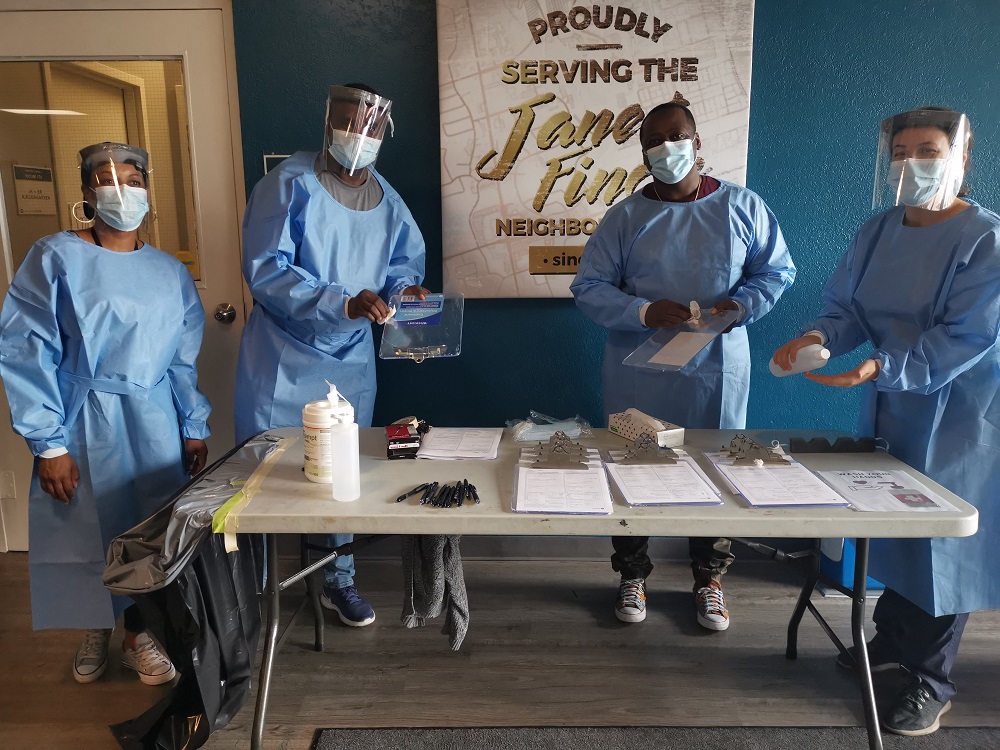
Staff at a community mobile testing site in northwest Toronto in mid-July 2020, after months of advocacy for a more community-focused approach to COVID-19.

[Community health staff pose in the lobby of one of the COVID-19 mobile testing sites that opened July 18, 2020 in the northwest of Toronto to help make services and supports more accessible for people facing higher risk during the pandemic due to marginalization.]

For months, leaders and staff at community health centres in the northwest and other areas of Toronto have advocated tirelessly for a coordinated community response to COVID-19 in support of marginalized people at higher risk of infection due to socioeconomic and other factors, such as the accessibility of testing.

This week, we celebrate the work of Black Creek Community Health Centre and its staff and partners, as mobile testing officially began in the northwest of Toronto on Saturday July 18, as reported by CBC News. This comes after months of advocacy, including in the media, as seen here in April, May and June.

We spoke briefly this week with Cheryl Prescod, Executive Director at Black Creek CHC, about what the community’s reaction was on Saturday to the arrival of mobile testing and a more community-centred model of COVID-19 response writ large, and what it took to get key factors affecting infection rates addressed at the community level.

What has the community’s reaction been to Black Creek CHC and others being able to deliver mobile testing and community-based contact tracing in areas seeing much higher rates of COVID-19?

People are feeling that they’re (finally) being listened to. But they are also still wondering why it took as long as it did. It’s so important that communities are meaningfully involved and have their voices heard in any plan and response to COVID-19, partly because gaining and keeping trust is so important, but also because the community has innovative ideas, strengths and contributions to make to keeping everyone safe during the pandemic. We've tried to amplify those voices, and now they're being heard and reflected in the response.

How are community members now being directly involved in managing and deploying the community response?

There are community outreach volunteers (who are paid honouraria), who are making a big difference in reaching “hard to reach” residents who remain skeptical about the testing. Through these volunteers, we’re able to reach people who speak many different languages and we see people’s cultures represented in outreach strategy, which is important for ensuring trusted relationships, openness with information, etc.

How else are people feeling generally about being able to get the test in their communities, vs. needing to get to a centralized or hospital assessment centre?

It’s big for people, because it means they can get tested, and they can walk to the place to get their test and not worry about taking public transit. And we’re finding that people are much more comfortable coming to a community space they’re familiar with already, vs. an assessment centre or hospital setting where they might have fear of contracting the virus.

What was a key step in making the mobile testing and a more community-focused response happen?

We started by listening closely to community agency partners involved in immediate COVID-19 responses, and hearing the things they found needed to be addressed, and the barriers people were facing. We were also hearing stories from staff doing meal deliveries who were validating those concerns. We also knew from other work that underlying issues in the community would impact infection rates: the types of jobs people have requiring them to interact with the public and others; dwelling conditions where crowding was likely, and newcomers not connected to services, to name a few examples.

Who were some of the key partners in getting things done locally in the northwest of Toronto?

We’ve worked with Emery-Keelesdale Nurse Practitioner Clinic; Toronto Medics; Home and Community Care, Central and Central West LHIN, and of course Ontario Health and Toronto Public Health. We also had support on the political side from Ward 7 Municipal Councillor Anthony Perruzza, who took these issues to the Board of Health and provincial MPP Tom Rakocevic (Humber River-Black Creek) who spoke up in the Ontario legislature about concerns in northwest Toronto. And once we got started with planning the mobile-testing and community outreach, there have been many local partners helping us on the ground, including faith-based organizations who’ve helped with offering spaces for things.

A staff member waits to screen people coming to a COVID-19 mobile testing site in northwest Toronto in July 2020.

 [Community volunteers who are being paid honouraria play an important role in getting information, services and support to hard-to-reach and often isolated people, and getting them to mobile testing sites like the one being staffed here in a northwest Toronto community space, where they can also be connected to other supports.]