Research Spotlight Webinar: What happens when care gets taken away? Preliminary findings from SCS closure studies

This webinar is presented by the Substance Use Health Network.

This timely webinar shares preliminary findings from studies examining what SCS closures are already doing on the ground. Researchers from The Margins Lab (MAP Centre for Urban Health Solutions, Unity Health Toronto), alongside CRISM Ontario Node partners, explore the impacts on service delivery, frontline staff, and people who rely on these services—and what this means for policy, care, and access moving forward.

# Speakers: 

  • Farihah Ali (CRISM-ON, CAMH), 
  • Uzma Ahmed (MAP Centre for Urban Health Solutions)
  • Zoe Dodd (MAP Centre for Urban Health Solutions)
  • Gillian Kolla (Memorial University)
Details
Thursday, April 23, 2026 - 12:00
12-1 pm
Cost: 
Free
Internal/External: 
Event Type: 
Location

Projet de recherche sur l’équité vaccinale dirigée par la communauté: séance d’information

Cette vidéoconférence sera presentée par Dr. Peter Centre. 

# À propos du Bridge Research Consortium

Le Bridge Research Consortium (BRC) réunit une diversité d’expertises et de perspectives afin de renforcer la confiance du public et de favoriser un accès équitable aux nouveaux vaccins et aux autres thérapies immunitaires, contribuant ainsi à la préparation du Canada face aux futures urgences sanitaires. Cette séance d’information présentera un nouveau projet de recherche national sur l’équité vaccinale dirigée par la communauté.

# Pourquoi participer?

  • Soyez les premiers informés: découvrez en primeur ce nouveau projet de recherche national

  • Passez de l’analyse à l’action: voyez comment les résultats seront transformés en ressources concrètes

  • Faites entendre votre voix: partagez vos expériences et découvrez comment vous impliquer

  • Créez des liens: échangez avec des acteurs du domaine de la santé communautaire et de l’équité

# Conférencière en vedette : Dre Sophie Webb

La Dre Sophie Webb est chercheuse postdoctorale au Bridge Research Consortium de l’Université Simon Fraser. Ses travaux portent sur les dimensions éthiques et politiques de la gouvernance en santé publique, notamment l’équité en santé, la réponse aux pandémies et l’utilisation des indicateurs dans l’élaboration des politiques. Elle détient un doctorat en sociologie de l’Université de Californie à San Diego.

Cette vidéoconférence se déroulera en anglais sur Zoom, avec une traduction simultanée en français.

Details
Thursday, May 21, 2026 - 14:00
14h00 à 15h00
Cost: 
Gratuit
Event Type: 
Location

Community-Led Vaccine Equity Research Project: Information Session

This video call is presented by the Dr. Peter Centre. 

# About the Bridge Research Consortium

The Bridge Research Consortium brings together experts with diverse skills and perspectives to help build public trust and make sure everyone has fair access to new vaccines and immune‑based treatments. This work helps Canada be better prepared for future health emergencies. This information session will introduce a new national research project on community-led vaccine equity.

# Why Join

  • Be the first to know: Get an inside look at this new national research project
  • Turn insights into action: See how findings will become practical, real-world resources
  • Have your voice heard: Share your experiences and find out how you can get involved
  • Build connections: Engage with others working across community health and equity

Dr. Sophie Webb is a Postdoctoral Fellow with the Bridge Research Consortium at Simon Fraser University. Her research examines the ethical and political dimensions of public health governance, with a focus on health equity, pandemic response, and the use of metrics in policymaking. She holds a PhD in Sociology from the University of California, San Diego.

This video call will be conducted in English, with simultaneous French interpretation provided.

Details
Thursday, May 21, 2026 - 14:00
2-3 pm
Cost: 
Free
Internal/External: 
Event Type: 
Location

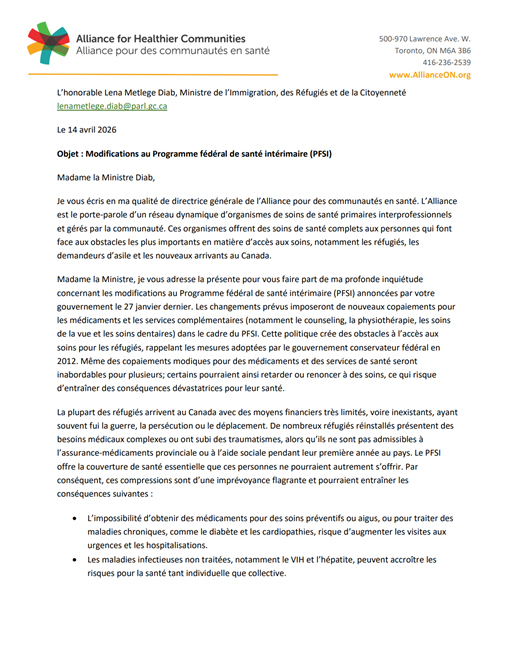
Le gouvernement fédéral doit revenir sur les coupes budgétaires dans les services de santé aux réfugiés : lisez notre lettre ouverte au ministre de l’Immigration

Date: 
Tuesday, April 14, 2026

L’honorable Lena Metlege Diab, Ministre de l’Immigration, des Réfugiés et de la Citoyenneté  

Le 14 avril 2026

Objet : Modifications au Programme fédéral de santé intérimaire (PFSI)

Madame la Ministre Diab,

Je vous écris en ma qualité de directrice générale de l’Alliance pour des communautés en santé. L’Alliance est le porte-parole d’un réseau dynamique d’organismes de soins de santé primaires interprofessionnels et gérés par la communauté. Ces organismes offrent des soins de santé complets aux personnes qui font face aux obstacles les plus importants en matière d’accès aux soins, notamment les réfugiés, les demandeurs d’asile et les nouveaux arrivants au Canada. 

Madame la Ministre, je vous adresse la présente pour vous faire part de ma profonde inquiétude concernant les modifications au Programme fédéral de santé intérimaire (PFSI) annoncées par votre gouvernement le 27 janvier dernier. Les changements prévus imposeront de nouveaux copaiements pour les médicaments et les services complémentaires (notamment le counseling, la physiothérapie, les soins de la vue et les soins dentaires) dans le cadre du PFSI. Cette politique crée des obstacles à l’accès aux soins pour les réfugiés, rappelant les mesures adoptées par le gouvernement conservateur fédéral en 2012. Même des copaiements modiques pour des médicaments et des services de santé seront inabordables pour plusieurs; certains pourraient ainsi retarder ou renoncer à des soins, ce qui risque d’entraîner des conséquences dévastatrices pour leur santé. 

La plupart des réfugiés arrivent au Canada avec des moyens financiers très limités, voire inexistants, ayant souvent fui la guerre, la persécution ou le déplacement. De nombreux réfugiés réinstallés présentent des besoins médicaux complexes ou ont subi des traumatismes, alors qu’ils ne sont pas admissibles à l’assurance-médicaments provinciale ou à l’aide sociale pendant leur première année au pays. Le PFSI offre la couverture de santé essentielle que ces personnes ne pourraient autrement s’offrir. Par conséquent, ces compressions sont d’une imprévoyance flagrante et pourraient entraîner les conséquences suivantes :

  • L’impossibilité d’obtenir des médicaments pour des soins préventifs ou aigus, ou pour traiter des maladies chroniques, comme le diabète et les cardiopathies, risque d’augmenter les visites aux urgences et les hospitalisations.
  • Les maladies infectieuses non traitées, notamment le VIH et l’hépatite, peuvent accroître les risques pour la santé tant individuelle que collective.
  • Les entraves à la couverture des soins de la vue et des lunettes ou des appareils d’aide à la mobilité peuvent nuire à la capacité d’étudier et de travailler.
  • Des infections dentaires non traitées pourraient entraîner des complications menant à des visites aux urgences et à des hospitalisations.
  • Un accès limité aux services de santé mentale peut ralentir l’intégration à la société canadienne et nuire à la capacité de contribution des nouveaux arrivants.
  • Les difficultés d’accès à la contraception et aux traitements prénataux posent des risques importants pour la santé des femmes.

Madame la Ministre, nous demandons à votre gouvernement, ainsi qu’au premier ministre, de revenir sur la décision d’imposer ces copaiements. Ceux-ci ne feront qu’alourdir le fardeau de réfugiés déjà vulnérables et, en fin de compte, augmenteront les coûts pour l’ensemble du système. Alors que d’autres pays choisissent de punir les réfugiés pour des crises dont ils ne sont pas responsables, le Canada doit rester fidèle aux valeurs de puissance moyenne que le premier ministre Carney prône souvent sur la scène internationale. Le Canada doit demeurer une terre d’accueil pour ceux qui, dans le monde, cherchent un refuge; or, cette hospitalité repose sur des politiques comme le PFSI.

En 2012, il a fallu quatre ans et un changement de gouvernement pour garantir que les réfugiés et les demandeurs d’asile puissent accéder aux soins requis afin d’éviter que leurs problèmes de santé ne s’aggravent. Il a fallu quatre ans et un changement de gouvernement pour que soit entendue la voix des médecins et des professionnels paramédicaux, regroupant 20 associations de santé et des gouvernements provinciaux de tous les horizons politiques. Il a fallu une décision de la Cour fédérale jugeant que les compressions au PFSI constituaient une violation de la Charte canadienne des droits et libertés.

Prenons la bonne décision. Annulez cette mesure. Montrons au monde l’identité profonde du Canada : un pays qui garde ses portes ouvertes à quiconque est dans le besoin, même quand d’autres les ferment.

Je vous prie d’agréer, Madame la Ministre, l’expression de mes sentiments distingués.

Sarah Hobbs  

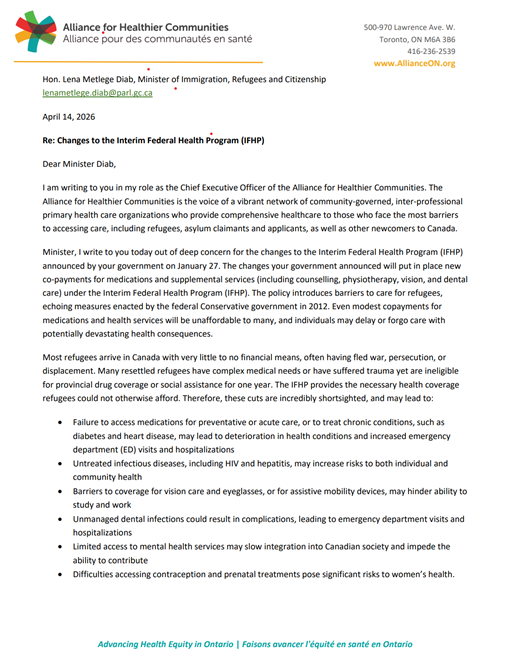
Federal government must reverse cuts to refugee health: Alliance's Open Letter to Minister of Immigration on Changes to Interim Federal Health Program (IFHP)

Date: 
Tuesday, April 14, 2026

Hon. Lena Metlege Diab, Minister of Immigration, Refugees and Citizenship

April 14, 2026

Re: Changes to the Interim Federal Health Program (IFHP)


Dear Minister Diab,

I am writing to you in my role as the Chief Executive Officer of the Alliance for Healthier Communities. The Alliance for Healthier Communities is the voice of a vibrant network of community-governed, inter-professional primary health care organizations who provide comprehensive healthcare to those who face the most barriers to accessing care, including refugees, asylum claimants and applicants, as well as other newcomers to Canada.

Minister, I write to you today out of deep concern for the changes to the Interim Federal Health Program (IFHP) announced by your government on January 27. The changes your government announced will put in place new co-payments for medications and supplemental services (including counselling, physiotherapy, vision, and dental care) under the Interim Federal Health Program (IFHP). The policy introduces barriers to care for refugees, echoing measures enacted by the federal Conservative government in 2012. Even modest copayments for medications and health services will be unaffordable to many, and individuals may delay or forgo care with potentially devastating health consequences. 

Most refugees arrive in Canada with very little to no financial means, often having fled war, persecution, or displacement. Many resettled refugees have complex medical needs or have suffered trauma yet are ineligible for provincial drug coverage or social assistance for one year. The IFHP provides the necessary health coverage refugees could not otherwise afford. Therefore, these cuts are incredibly shortsighted, and may lead to:

  • Failure to access medications for preventative or acute care, or to treat chronic conditions, such as diabetes and heart disease, may lead to deterioration in health conditions and increased emergency department (ED) visits and hospitalizations
  • Untreated infectious diseases, including HIV and hepatitis, may increase risks to both individual and community health
  • Barriers to coverage for vision care and eyeglasses, or for assistive mobility devices, may hinder ability to study and work
  • Unmanaged dental infections could result in complications, leading to emergency department visits and hospitalizations
  • Limited access to mental health services may slow integration into Canadian society and impede the ability to contribute
  • Difficulties accessing contraception and prenatal treatments pose significant risks to women’s health.

Minister, we call on your government, and the Prime Minister, to reverse the decision to introduce these co-payments, which will impose hardship on already vulnerable refugees and ultimately increase system costs. Other countries choose to punish refugees for crises not of their making, but Canada must hold to the middle power values Prime Minister Carney speaks of often on the world stage. Canada must remain a refuge to those in the world who need a place to go, and that door hinges on policies like the IFHP.

Back in 2012, it took four years, and a change in government, to ensure that refugees and asylum claimants could access the care they needed, to prevent medical issues from worsening. It took four years and a change in government for the voices of doctors and allied providers that encompassed 20 national health associations and provincial governments from across the political spectrum to be heard. It took a federal court decision that deemed cuts to IFHP to be a violation of the Charter of Rights and Freedoms.

This time, let’s do the right thing. Reverse this decision. Ensure that the world knows who Canada is, and that when others close their doors, ours are open to anyone in need.

Sincerely,

Sarah Hobbs CEO, Alliance for Healthier Communities


Cc: Rt. Hon. Mark Carney, Prime Minister Hon. Marjorie Michel, Minister of Health Yasir Naqvi, MP Ottawa Centre Evan Solomon, MP Toronto Centre Aslam Rana, MP Hamilton Centre Chris Bittle, MP St. Catharines

Ensuring Equitable Integrated Long-Term Care for Rural and Vulnerable Communities

This webinar is presented by Laurel. 

People living in rural areas and those in vulnerable situations can face significant barriers to accessing integrated long-term care across Europe. Geographic distance, workforce shortages, limited digital infrastructure and wider social vulnerability can all reduce access to timely, coordinated and person-centred care.

This 75-minute Laurel webinar will explore how integrated long-term care systems can remain accessible and equitable for underserved communities. It will focus on the practical, organisational and policy challenges involved in delivering care in rural settings and ensuring that services respond effectively to people facing disadvantage or exclusion.

More than a discussion, this session will bring together European projects, policy perspectives and real-world examples to highlight promising approaches to reducing inequalities in care access, including innovative service models, digital solutions and community-based responses.

Join us to help shape more equitable integrated long-term care policy and practice across Europe.

# What You’ll Learn

  • How rural realities and social vulnerability affect access to integrated long-term care

  • Key challenges for professionals, communities and systems, including workforce shortages, distance and continuity of care

  • How innovative service models and digital tools can help improve access and reduce inequalities

  • Practical examples from European projects working in rural communities and with vulnerable populations

  • What policy actions are needed to support more equitable integrated long-term care across Europe

  • How the discussion will contribute to Laurel’s policy recommendations

# Who Should Attend

This session is for:

  • Health and social care professionals
  • Researchers working on integrated care, long-term care and health inequalities
  • Policymakers, service planners and system leaders
  • Community organisations and projects supporting rural and vulnerable populations
  • Anyone interested in more equitable access to integrated long-term care across Europe
Details
Tuesday, April 28, 2026 - 08:00
8:00-9:15 am
Cost: 
Free
Internal/External: 
Event Type: 
Location
Online Event

The Power of Primary Care Summit 2026: Leading the Attachment Era Together

This conference is presented by the Association of Family Health Teams of Ontario (AFHTO)  

# The Power of Primary Care Summit 2026: Leading the Attachment Era Together

This year’s conference is a working summit focused on advancing real solutions for integrated, team-based primary care.
 
Join leaders from across the system to:
Leadership is about influence, not title. If you’re driving change in primary care, this is for you.  
 

# Registration and Fees

Early bird rates, listed below, are open until August 16. 

  • AFHTO Members: $557 for full summit, $454 for single day
  • Non-members: $900 for full summit, $700 for single day


Details
Thursday, October 15, 2026 - 17:15
Friday, October 16, 2026 - 00:00
October 15-16
Cost: 
$454-900
Internal/External: 
Event Type: 
Location
Hilton Toronto/Markham Suite Conference Centre & Spa
8500 Warden Ave.
Markham, ON L6G 1A5

Nonprofit Driven Regional Connects: Peterborough

This series of regional gatherings is presented by the Ontario Nonprofit Network (ONN)

It’s time again for some real talk, in real life This is not your average “conference” - Nonprofit Driven Regional Connects are small gatherings with big impacts. These are opportunities for nonprofit peers to share space and ideas for our collective well-being, explore systemic solutions locally, learn more about ONN’s work, and break bread together. Our sector continues to be intentionally under-resourced and privatized, is experiencing growing legal attacks from the community for doing its critical work, and grapples with increased scrutiny and eroding public trust. To combat the current climate of deep polarization, we must invest in building relationships to help our sector and communities thrive. Regional gatherings, co-hosted in collaboration with local partners, are an ongoing exercise in movement-building, and actively shaping the future together. 💚

# What to expect:

  • Get practical data, information about policies and trends impacting nonprofits in London and across Ontario, and discuss how these are showing up in your work and communities.
  • Make connections over the issues that matter to you - engage in conversations and learn from local peers and team members from Pillar and ONN.
  • Enjoy breakfast and lunch with nonprofit colleagues.
  • After the event, all registrants will receive slides, notes, and links to resources.

# Other Regional Connects Sessions

  • London and area - June 4 - Registration is now open
  • Sault Ste. Marie-Algoma - Coming soon in October 
  • Halton region - Coming soon in November

We cannot address complex community needs alone - and we don’t have to. Join us at an event near you!

Details
Wednesday, October 21, 2026 - 09:30
9:30-3:00
Cost: 
$103.30-182.02
Location
Gathering Room in The Canadian Canoe Museum-Jiimaan Kinomaagewin
2077 Ashburnham Drive
Peterborough, ON K9L 1P8

Nonprofit Driven Regional Connects: London & Region

This series of regional gatherings is presented by the Ontario Nonprofit Network (ONN)

It’s time again for some real talk, in real life This is not your average “conference” - Nonprofit Driven Regional Connects are small gatherings with big impacts. These are opportunities for nonprofit peers to share space and ideas for our collective well-being, explore systemic solutions locally, learn more about ONN’s work, and break bread together. Our sector continues to be intentionally under-resourced and privatized, is experiencing growing legal attacks from the community for doing its critical work, and grapples with increased scrutiny and eroding public trust. To combat the current climate of deep polarization, we must invest in building relationships to help our sector and communities thrive. Regional gatherings, co-hosted in collaboration with local partners, are an ongoing exercise in movement-building, and actively shaping the future together. 💚

# What to expect:

  • Get practical data, information about policies and trends impacting nonprofits in London and across Ontario, and discuss how these are showing up in your work and communities.
  • Make connections over the issues that matter to you - engage in conversations and learn from local peers and team members from Pillar and ONN.
  • Enjoy breakfast and lunch with nonprofit colleagues.
  • After the event, all registrants will receive slides, notes, and links to resources.

# Other Regional Connects Sessions

  • Peterborough - October 21- Registration is now open
  • Sault Ste. Marie-Algoma - Coming soon in October 
  • Halton region - Coming soon in November

We cannot address complex community needs alone - and we don’t have to. Join us at an event near you!

Details
Thursday, June 4, 2026 - 09:30
9:30-3:30
Cost: 
$103.80-182.02
Internal/External: 
Event Type: 
Location
Innovation Works London (CommUNITY Living Room)
201 King Street
London, ON N6A 1C9

Basic Income Earth Network Congres 2026 | Basic Income and the Polycrisis: The Key to Unlocking the Puzzle

This conference is presented by the Basic Income Earth Network (BIEN) and Basic Income Ontario.

# Basic Income and the Polycrisis: The Key to Unlocking the Puzzle

*In Person and Virtual Conference

The BIEN Congress will officially open on August 20. All Congress participants are also invited to a half-day, pre-congress session the afternoon of August 19 focused on Canada. 

The 2026 Congress is being held as the early decades of the twenty-first century are defined by a polycrisis: the causal entanglement of multiple, overlapping crises. These pressures span interconnected systems, including the natural environment (climate disruption), the economy (inflation, unaffordability, widening income and wealth inequality, and persistent poverty), political institutions (erosion of public trust, democratic strain, and the rise of exclusionary populism and authoritarian governments), and the rights-based international order. Together, they expose the limits of fragmented welfare systems that respond to risks in isolation rather than as cumulative and systemic challenges. In this context, basic income is gaining renewed attention not only as an anti-poverty measure, but as a foundational policy for strengthening social inclusion and solidarity.

This Congress theme positions basic income as a unifying response to the polycrisis—one that cuts across policy silos and reconnects income security to broader questions of justice, sustainability, and democratic capacity. The theme invites critical examination of basic income as part of a renewed social contract capable of countering precarity, fragmentation, and exclusion in complex, interdependent systems.

# Registration fees 

# Tier 1: Organization and Academic Rate ($350 CAD)

  • This tier is designed for participants whose attendance is supported by organizations with significant resources and professional staff.
  • Who should select this tier: Representatives of governments, large non-profits, academic institutions, and corporations. This tier also applies to individuals attending independently who possess better-than-average economic means.

# Tier 2: Standard Rate ($200 CAD)

  • The standard rate supports the core costs of the Congress and is intended for those with moderate institutional or personal resources.
  • Who should select this tier: Staff from smaller non-profits with modest resources and few paid employees, as well as individuals with moderate personal incomes.

# Tier 3: Low-income Rate ($100 CAD)

  • BIEN is committed to inclusive dialogue. This reduced rate is intended to remove financial barriers to participation.
  • Who should select this tier: Individuals with limited financial resources for whom the standard rate would make participation unaffordable or cause undue hardship.

More information available on the conference website. 

Details
Wednesday, August 19, 2026 - 08:00
Thursday, August 20, 2026 - 00:00
Friday, August 21, 2026 - 00:00
Saturday, August 22, 2026 - 00:00
August 19-22
Cost: 
$100-350
Location
Hybrid: online and Toronto Metropolitan University
Toronto, ON