Palliative Care: Culturally Safer and Trauma Informed Care Across Diverse Populations

This event is presented by Northern Ontario School of Medicine (NOSM) University, Continuing Education and Professional Development as part of their Palliative Care education Series

Topic: Culturally Safer and Trauma Informed Care Across Diverse Populations

Speakers: Holly Prince

Date: Thursday, April 2, 2026 9:00 - 10:30 a.m. EST *Different Time Than Usual

Learning Objectives

At the end of this session participants will be able to:

  1. Define cultural humility
  2. Apply culturally safer care with humility

CME credits are available from the College of Family Physicians of Canada.
Details
Thursday, April 2, 2026 - 09:00
9:00-10:30 am
Cost: 
Free
Internal/External: 
Event Type: 
Location
Online event

ECHO Evening | Liver Diseases in Primary Care: Approach to Fatty Liver

This online learning activity is presented by ECHO UHN and funded by the Ontario Ministry of Health

This no-cost evening ECHO session is open to all healthcare professionals. It will consist of a didactic lecture by our interprofessional team and real de-identified patient case presentation.

CME credits are available for family physicians. Other members of the health care team are equally welcome to attend. 

# Present a case for this session: 

Have a question about one of your clients?  If you wish to present a patient case, please contact echo.ontario@uhn.ca


Details
Thursday, June 4, 2026 - 19:00
7:00-8:15
Cost: 
Free
Internal/External: 
Event Type: 
Location
Online (Zoom)

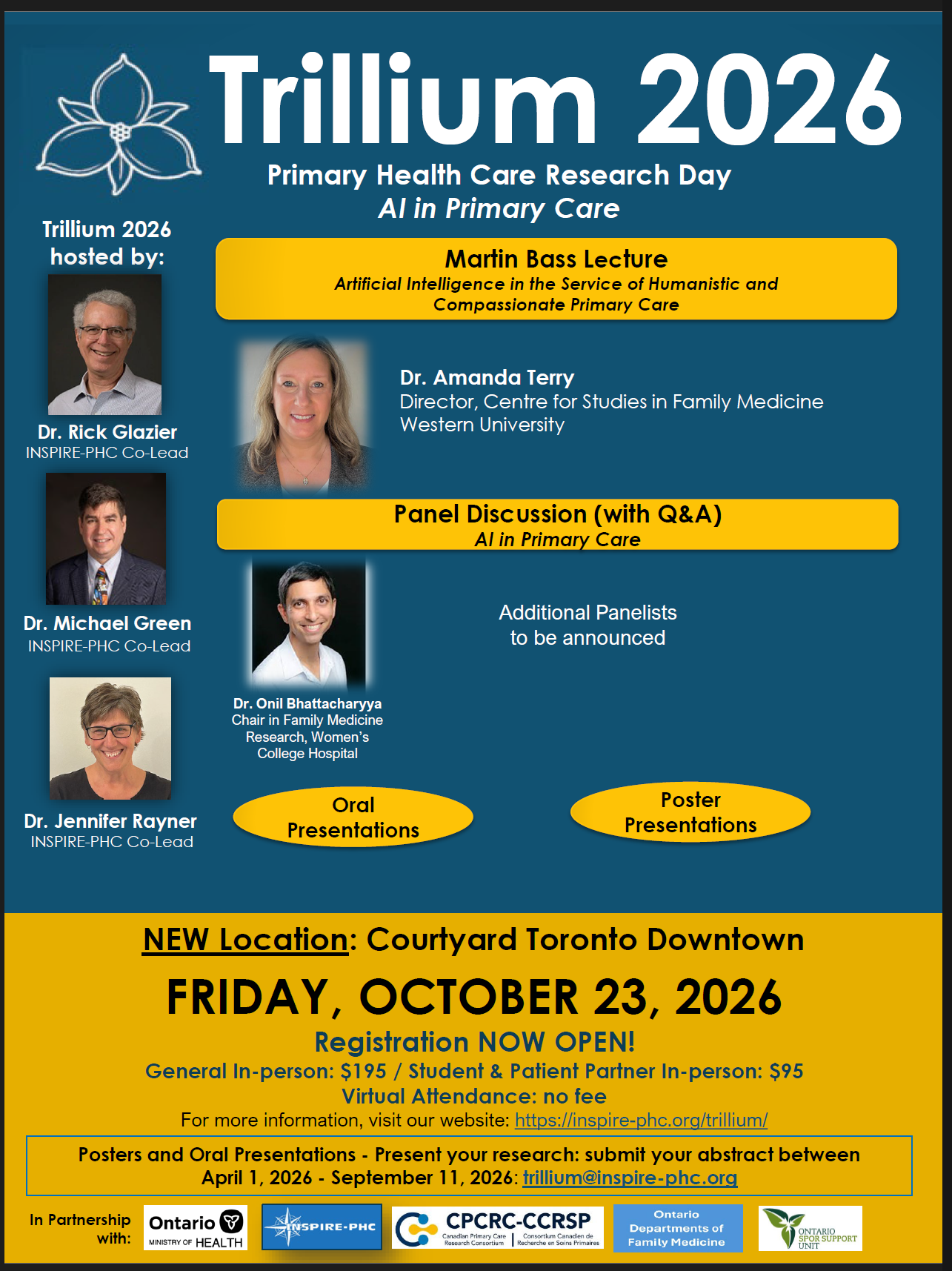
Trillium 2026 Primary Health Care Research Day

This in-person learning event is hosted by INSPIRE-PHC in partnership with the Canadian Primary Care Research Consortium (CPCRC) and CIHR-IHSPR.

Trillium 2026 Flyer - click to view as PDF
Click to view this image as a PDF

# Event Highlights

  • Martin Bass Lecture: Artificial Intelligence in the service of Humanistic and Compassionate Primary Care
    • Dr. Amanda Terry, Director, Centre for Studies in Family Medicine, Western University
  • Panel Discussion with Q&A: AI in Primary Care. 
    • Dr. Onil Bhattacharyya, Chair in Family Medicine Research, Women's College Hospital
    • Additional panelists to be announced
  • Oral presentations
  • Poster presentations

# Event hosts

  • Dr. Rick Glazier, INSPIRE-PHC Co-Lead

  • Dr. Michael Green INSPIRE-PHC Co-Lead

  • Dr. Jennifer Rayner, INSPIRE-PHC Co-Lead


Details
Friday, October 23, 2026 - 00:00
TBD
Cost: 
$95-195
Internal/External: 
Event Type: 
Location
Courtyard by Marriott Downtown Toronto
475 Yonge Street
Toronto, ON M4Y 1X7

What is distinctions-based health impact assessment

This webinar is hosted by the National Collaborating Centre for Indigenous Health. 

# Webinar description

Health impact assessment (HIA) provides a systematic process to identify and analyze the potential effects of a proposed development project on the health and well-being of a population. For Indigenous Peoples in Canada, standardized HIAs are not able to adequately measure potential health impacts as these processes do not consider the full range of cultural, social, spiritual and economic determinants of Indigenous well-being. Instead, distinctions-based HIA approaches are required that begin from place-based, community-specific and holistic environmental health frameworks. In this webinar, join Drs. Diana Lewis and Elana Nightingale for a discussion of distinctions-based health impact assessment: what it is, what it could look like in Canada, and how it could transform HIA into a process that reflects Indigenous Peoples’ diverse worldviews, knowledge systems and values. Drawing on more than a decade of Indigenous community-led health research experience, the presenters discuss what it means to meaningfully collaborate with Indigenous communities and develop impact assessment processes grounded in distinctions-based models of well-being.

# Learning objectives

  • Identify distinctions-based models of health and well-being and how they differ from mainstream health models.
  • Understand the implications of Indigenous community-specific models of health and well-being for HIA processes in Canada.

# Presenters

Dr. Diana Lewis is a member of Sipekne’katik First Nation and Associate Professor/ Canada Research Chair (Tier II) in Indigenous Environmental Health Governance in the Department of Geography, Environment and Geomatics, University of Guelph. She is also Director of the IndigenERA Lab and a Member of the Royal Society of Canada (2025). Her research focuses on promoting understanding of Indigenous worldviews in environmental decision-making and advocating for Indigenous-led approaches to give communities baseline health data and sovereignty over the data in environmental decision-making. She is currently working with Indigenous communities across Canada to develop an Indigenous-led environmental health risk assessment approach.

 Dr. Elana Nightingale is a Postdoctoral Scholar in the IndigenERA Lab at the University of Guelph where she works on Indigenous economic impact assessment. She holds a PhD in Geography from Western University, a MSc in Local Economic Development from the London School of Economics, and a BA in Economics from Carleton University. Elana aims to support community-led research as a means to advance health and social equity for First Nations, Inuit and Métis communities in Canada. Her research interests include the social determinants of Indigenous health, community economic development, community-based research methodologies and knowledge translation.

Details
Tuesday, March 31, 2026 - 14:00
2:00-3:30 pm
Cost: 
Free
Internal/External: 
Event Type: 
Location
Online (Zoom)

Building a Newcomer Health Plan in Ontario - the time is right

This learning event is hosted by Access Alliance Newcomer and Community Health, an Alliance-member CHC. 

It is time to design, validate, and evaluate an equity-focused Newcomer Health Plan (NHP) in Ontario. Join us for a community conversation to reimagine Ontario's health system for immigrants and refugees.

We envision a co-designed Newcomer Health Plan that will involve policy and program interventions, workforce (i.e. better inclusion of Internationally Educated Health Professionals) and service delivery models, and governance frameworks. It will strengthen prevention, health promotion, equity-focused outreach, and system navigation through improved access, cultural safety, accessible language, including translation, and coordinated pathways linking newcomers to health services and health-adjacent social supports. The plan will integrate trauma-informed, culturally tailored strategies and address governance and workforce barriers.

If we are successful, future newcomers arriving in Ontario will no longer face persistent barriers to healthcare access, such as language exclusion, fragmented navigation, limited culturally safe services, racism, and systemic discrimination. They will discover a welcoming and inclusive health system, built with them in mind.

# Who should attend:

You should attend if you work at the intersection of health, settlement, equity, and inclusion. This is a working session. You will be participating in active discussions to help shape ideas and discuss how best to co-create a Newcomer Health Plan with health, settlement, community, and newcomers themselves.  The goal is to embed the NHP into Ontario’s health system. System transformation; not new research, or a new program. What role might you or your organization play in moving this forward? What do you need to be able to contribute?

Find out more about our ideas and the full session agenda at https://accessalliance.ca/research-blog/a-newcomer-health-plan-for-ontario-the-time-is-right/#NHPevent and join us on April 29th!

Details
Wednesday, April 29, 2026 - 09:30
09:30 am - 12 pm
Cost: 
Free
Internal/External: 
Event Type: 
Location
Online (Zoom)

Big F***ing Deal: Compounding Effects of Stigma for People Living with HIV

This video call is hosted by the Dr. Peter Centre. It is funded by the Public Health Agency of Canada. 

This session will feature a presentation from Casey House as they share their new short film, Big F***ing Deal. Produced as a part of their Smash Stigma campaign, this short demonstrates how stigma intensifies and outcomes diverge when an HIV diagnosis intersects with challenges such as housing insecurity, substance use dependency, mental health challenges, and discrimination tied to identity. During the session, Casey House will discuss their Smash Stigma campaign and detail the intentions, production, and reception of their new short.

This video call will be conducted in English, with simultaneous French translation provided. 

Featured speaker: Lisa McDonald, Director, Communications and Public Policy, Casey House. 

# Why Join?

  • Gain insight into how healthcare organizations are addressing stigma to improve health outcomes for their clients.
  • Explore practical lessons in confronting socially constructed barriers to equitable health outcomes for people living with HIV from a communications perspective.
  • Reflect on the effects of being judged, misunderstood, or unsupported for clients seeking care for complex health issues, including HIV.
  • Engage in shared learning with peers navigating similar system-level challenges


Details
Tuesday, March 31, 2026 - 14:00
2:00-3:00 pm
Cost: 
Free
Internal/External: 
Event Type: 
Location
Online (Zoom)

What Happens When Care Gets Cut Off? A conversation on ethics, accountability, and the real impacts of policy decisions.

This webinar is presented by the Substance Use Health Network (SUHN) as part of their Research Spotlight series.

# MySafe Final Evaluation Report: Impacts of Program Closure

Join us for a critical and timely conversation on the independent evaluation of the MySafe biometric medication dispensing program - and what its closure reveals about the current direction of drug policy in Canada.

At its core, this is not just a story about one program. It raises urgent questions about what it means to pilot high-impact interventions for populations at extreme risk - and then withdraw them without continuity, safeguards, or accountability. As harm reduction services are scaled back or shut down across jurisdictions, the findings point to a growing gap between evidence, ethics, and policy.

# In this webinar, we will:

  • Share key findings from the evaluation

  • Examine the real-world impacts of program withdrawal on people’s lives

  • Situate MySafe within a broader landscape of shifting drug policy and restricted access to prescribed alternatives

  • Interrogate the ethical implications of short-term pilots without continuity-of-care protections

  • Discuss what accountability, responsibility, and evidence-informed policy should look like moving forward

For healthcare and social service providers, researchers, policy-makers, and people with lived and living experience, this session offers space to grapple with a difficult but necessary question: what do we owe people when we introduce - and then remove - interventions that shape their survival?

# About MySafe

MySafe was a low-barrier, person-centred model that provided secure, flexible access to prescribed alternatives through biometric dispensing machines, paired with wraparound supports. Participants described improved stability, autonomy, and engagement in care. In 2024, the program was abruptly defunded amid shifting political and regulatory pressures on prescribed alternatives, leaving many people without safe, reliable access to care.

This evaluation, based on in-depth interviews with former clients and service providers, documents not only what worked but what happened when it was taken away. Participants describe rapid destabilization, loss of autonomy, and forced transitions into more restrictive or inaccessible systems of care. These are not abstract policy shifts; they are decisions with immediate, material consequences for people’s health, safety, and survival.

# Speakers

  • Tara Taylor, SpenceCreo Founation

  • Isabelle Boisvert, Changemark

  • Kaitlin Calligiari, Changemark  

Details
Thursday, March 26, 2026 - 12:00
12-1 pm
Cost: 
Free
Internal/External: 
Location

 Menopause Quality Standard Community of Practice Learning Session

This learning session is hosted by Ontario Health as an activity of their Menopause Quality Standard Community of Practice 

Ontario Health's Menopause Quality Standard focuses on the identification, assessment, and management of symptoms at any stage of menopause and in all health care settings for people living in Ontario. Released in October 2025, it is Canada's first-ever quality standard dedicated to menopause care. The Community of Practice (CoP) was established to support it implementation in all settings, with a particular focus on primary care. 

At this interactive session, clinicians and health care teams will:   

  • Hear from fellow clinicians about what they are doing – and learning – as they improve menopause care in clinical practice. 
  • Learn about the Academic Detailing service from the Centre for Effective Practice. 
  • Get updates on the Community of Practice and plans for future learning sessions and supports.

This session is open to all clinicians and healthcare teams.

Note: Registering for this session will also grant you access to the learning session in June 2026.  While CoP membership is not required to attend, joining the CoP is encouraged for those who want to stay connected and continue learning.

 Dr. Lara Rosenberg and Nureen Ladha from the North York Family Health Team will share how their team is working to improve menopause care in their organization. 

  • Dr. Rosenberg is the Medical Director at the North York Family Health Team, where she practices comprehensive family medicine. She also serves as the Program Director for the Low-Risk Obstetrical PGY3 Program at the University of Toronto. 
  • Nureen Ladha is an RN and CEO/Executive Director at the North York Family Health Team. 

Silvana Ferrara from the Centre for Effective Practice will introduce the Academic Detailing service and how it supports clinicians with practical, one-on-one learning.  

  • Silvana Ferrara is a pharmacist with 25+ years of experience in community and long-term care. Since 2018, she has been an academic detailer with the Centre for Effective Practice, delivering one-on-one educational visits for primary care clinicians. She holds a pharmacy degree from the University of Toronto. 


Details
Tuesday, April 7, 2026 - 12:00
12-1 pm
Cost: 
Free
Internal/External: 
Event Type: 
Location
Online (Zoom)

Audit & Feedback (A&F) and Antibiotics.

This webinar is presented by the Audit & Feedback MetaLab at Women's College Hospital  This session is the second of an ongoing webinar series designed to bring together researchers and health system partners to review evidence, share real-world Canadian examples, and collaboratively identify future research and implementation priorities.

# Webinar Overview

Antimicrobial resistance (AMR) is an urgent and growing health threat, fueled in part by the overuse and inappropriate prescribing of antibiotics. Audit and feedback approaches, particularly those that include peer comparison, have been shown to improve prescribing practices among clinicians. Ensuring these approaches are designed and implemented with equity in mind is important for supporting appropriate antibiotic use across diverse health care settings.

In this interactive, 60-minute webinar, Dr. Noah Ivers will open with key findings from his audit and feedback Cochrane review. Dr. Kevin Schwartz will then discuss the evidence base for antibiotic prescribing feedback and highlight the CANBuild-AMR project, which aims to scale and optimize audit and feedback programs across Canada to improve antibiotic use. Jonathan Lam will provide a brief overview of Canada’s Drug Agency (CDA-AMC) and lead a facilitated discussion exploring opportunities to spread and scale effective audit and feedback initiatives, equity considerations in implementation, and future directions for research and practice.


Details
Friday, March 27, 2026 - 12:00
12-1 pm
Cost: 
Free
Internal/External: 
Event Type: 
Location
Online

Public Health & Collaborative Governance in Extreme Heat Response

This webinar is presented by the Dala Lana School of Public Health in partnership with the Collaborative Centre for Climate, Health & Sustainable Care and the North American Observatory on Health Systems and Policies

# Description

This presentation will share results from a CIHR-funded project exploring the governance of heat responses in Canada, with two parts: first, a scoping review of the academic and grey literature to characterize the roles of public health authorities in climate action, with a focus on extreme heat in three provinces (British Columbia, Ontario, and Quebec); and, second, a qualitative comparative case study with interviews with key stakeholders to identify and assess governance mechanisms supporting collaborative action on extreme heat in three cities (Vancouver, Toronto, and Montreal). Implications for public health authorities and their role in climate action, and broader climate resilience, will be discussed.

# Speaker

Sara Allin is an Associate Professor of Health Policy at the Institute of Health Policy, Management and Evaluation, Dalla Lana School of Public Health, University of Toronto, and Director of the North American Observatory on Health Systems and Policies (NAO). Her research focuses on comparative health systems, health system resilience, and health equity. At the NAO, she leads research to inform evidence-based policy, including rapid reviews for decision-makers and in-depth studies of health system structures and reforms in Canada and other high-income countries.

Details
Wednesday, April 1, 2026 - 12:00
12-1 pm (virtual) or 12-2 pm (in-person)
Cost: 
Free
Internal/External: 
Event Type: 
Location