We need Ontario's provincial leaders to support communities to slow COVID-19 spread
Monday, October 5, 2020
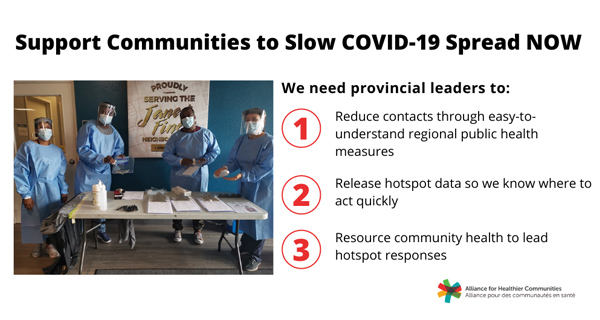
Text graphic with picture of staff at community testing site in Toronto Jane/Finch neighbourhood, that reads: Support Communities to Slow COVID-19 Spread NOW   We need provincial leaders to:   1. Reduce contacts through easy-to-understand regional public health measures 2. Release hotspot data we know where to act quickly 3. Resource community health to lead hotspot responses

We're asking everyone to join our call to the Ontario government and public health leaders: Community models work to control outbreaks. Black Creek Community Health Centre, Rexdale Community Health Centre and others have led a community-based response. We need Ontario's leaders to invest more in community now to slow COVID-19.

We need Ontario's leaders to:

1. Reduce contacts – clear regional public health measures to limit spread are needed now.

We need to act now to contain COVID-19 and prevent further harm before the second wave spirals out of control. Provincial government and public health leaders must act now to put in place population-wide protections such as limits on public gatherings, limits on businesses, appropriate messaging on social circles, mandating use of masks, and physical distancing measures.

2. Release neighbourhood hotspot data now – we can’t target messages, interventions, supports, and testing if we don’t know where to act.

Ontario needs to be more transparent with COVID-19 data and helping the public to understand what’s really going on in our province, but also in their individual communities. We need to know who COVID-19 is impacting and how it is spreading in our communities. Without this information, our healthcare and public health systems cannot intervene quickly in the right places. The province must transparently report on how COVID-19 is impacting our communities now so that we can target community-led interventions to slow the spread.

3. Resource communities now – community health centres and providers are the experts, and ensure that BIPOC and marginalized communities they serve are represented at decision making tables

We need funding now to take control of this spiralling situation where we live. A one-size-fits-all approach isn’t working in Ontario. Some communities (and areas within communities) are harder hit and the people who live in them face more barriers in accessing care. Ontario needs solutions that are responsive to what is happening on the ground. We need provincial leaders to work with community-led organizations on the ground to roll out testing strategies in hot spots. Fund community-led and mobile testing now to reach communities that are being left behind. We also need the province to ensure that the right people are sitting at decision making tables and ensure the voices of the most impacted aren’t left behind.

Take Action: Support Communities to Slow COVID-19 Spread NOW

Contact your local MPP today and join our call to the Ontario government and public health leaders: Community models work to control outbreaks. Black Creek Community Health Centre, Rexdale Community Health Centre and others have led a community-based response. We need Ontario's leaders to invest more in community now to slow COVID-19.

A template letter is provided below. Use the “Find my MPP” function on the Legislative Assembly of Ontario website to find your MPP’s contact information.


Dear MPP <insert name of your local representative here>

I am writing to you today because our community urgently needs your help. With the risk rising every day that COVID-19 cases will spiral out of control, thousands of people’s lives and families are in danger. Marginalized communities, many with high numbers of racialized people, people living on low-incomes, and people who work front-facing jobs and take public transit, are at far higher risk of COVID-19 impacts than others, and need more than blame-and-shame messages to protect themselves. They need community-led interventions, and they need your support to ensure those interventions happen.

I’m calling on you to hold Ontario government leaders accountable. Ontario urgently needs a strategy for slowing the spread of COVID-19 in marginalized neighbourhoods and keeping people safe. That means I need you to call for support of community models for testing and infection/outbreak control. Community-led comprehensive primary health care organizations, such as Black Creek Community Health Centre and Rexdale Community Health Centre, have already demonstrated this approach successfully.

I need you to raise your voice and demand action from the Ontario government NOW on: Reducing contacts, Releasing neighbourhood data, Resourcing communities:

1. Reduce contacts and opportunities for transmission -- Ontario needs clear regional public health measures to limit spread are needed now.

We need urgent action from government and Ontario Public Health to contain COVID-19 and prevent further harm before the second wave spirals out of control. Provincial government and public health leaders must act now to put in place population-wide protections such as limits on public gatherings, limits on businesses, appropriate and consistent messaging on social circles and gatherings, mandating use of masks, and physical distancing measures.

2. Release neighbourhood hotspot data now – We can’t target messages, interventions, supports, and testing if we don’t know where to act.

Ontario needs to be more transparent with COVID-19 data and helping the public to understand what’s really going on in our province, but also in people’s individual communities. We need to know who COVID-19 is impacting and how it is spreading in our communities. Without this detailed, transparent information, our healthcare and public health systems cannot intervene quickly in the right places. The province must transparently report on how COVID-19 is impacting our communities now so that we can target community-led interventions.

3. Resource communities now – community health centres and providers are the experts. We need funding now to take control of this spiralling situation where we live, and  we need to ensure that BIPOC and marginalized communities they serve are represented at decision making tables

A one-size-fits-all approach isn’t working in Ontario. Some communities (and areas within communities) are harder hit and the people who live in them face more barriers to accessing care. Ontario needs solutions that are responsive to what is happening on the ground. We need provincial leaders to work with community-led organizations to roll out testing strategies in hot spots. Fund community-led and mobile testing now to reach communities being left behind. We also need the province to ensure that the right people are sitting at decision making tables and ensure the voices of the most impacted aren’t left behind.

Thank you for your urgent help, leadership and being a true voice for this community.

<Your name>
#CHWW2020: Connecting families and children in Ottawa with supports during the COVID-19 pandemic

Monday, October 5, 2020
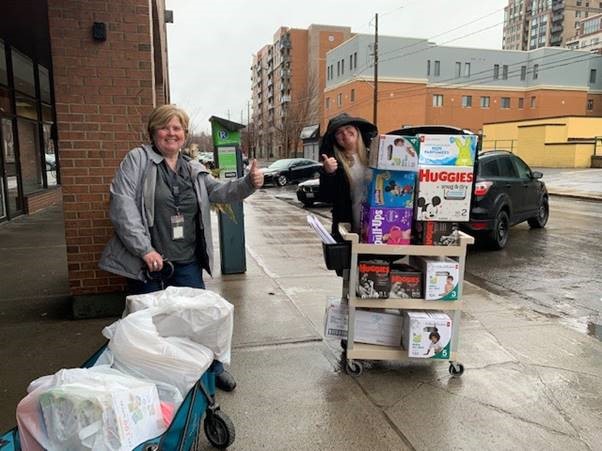
Centretown CHC: Jennifer and Vanessa loading up supplies to bring to families living in a shelter

[Jennifer and Vanessa loading up supplies to bring to families living in a shelter. Photo supplied]

Submitted by the Centretown CHC Early Years Team

Throughout Community Health and Wellbeing Week 2020, we will bring your stories of #PowerInCommunity from across the province. Today, Vanessa Graham and Emily Doolan from the Centretown CHC Early Years team in Ottawa write about the supports they've adapted to serve children and families during the pandemic.

The Early Years and EarlyON team at Centretown Community Health Centre in Ottawa is committed to providing families and children with daily support and services. As a team, we work collaboratively with other teams at the centre to ensure families have access to what they need to navigate community resources or any challenging circumstances during the COVID-19 pandemic. Families are living through a time of uncertainty, overwhelm, stress and isolation all while trying to keep their children well and happy. The team has provided families with information about early childhood development, parenting support and education, outreach services and service navigation. The following highlights how the team has successfully responded to helping families and children during the developing global pandemic.

The Early Years and EarlyON team was actively engaged in supporting CCHC’s pandemic plan. The team diligently assessed where the needs were in the community and began right away to offer their support. Emergency baby supplies were made easily accessible for families to obtain on a monthly basis. These supplies included diapers, wipes, breastfeeding supplies and clothing. In addition, Early Learning Activity Kits were put together with the focus to support at home learning for families. As summer arrived, Physical Activity Kits were created in order to promote outdoor physical activity for families all while practicing social distancing measures. Deliveries were made for families who were faced with barriers on accessing emergency supplies during the early stages of the pandemic. For continuous family connection, the team completed wellness calls to provide virtual support and navigation for services across Ottawa.

[Emily and Vanessa welcoming clients at the self-serve baby weight station]

The services that were deemed essential for community members with young children were adapted and implemented. Breastfeeding support, as well as, pre and postnatal support was continued by telephone to ensure new and expecting mothers had the necessary expertise readily available for them. The Welcome Baby Prenatal Nutrition Program continued providing support to the participants, which included a delivery of a monthly healthy snack pack and a weekly phone call to each participant. With an increased demand for baby weight services, the team offered a weekly self-serve baby weight station at the centre. To meet the needs of the community, the Early Years and EarlyOn programs and services are being offered by telephone support, virtual programming or in person. 

During this evolving time, the Early Years and EarlyOn team continues to utilize their adaptability skills in order to provide quality services to meet the unique needs of families. The team has connected with over 100 families and continues to build relationships with community members in hopes to provide a sense of security and comfort for all families. The ultimate goal for the Early Years and EarlyOn team is to foster healthy and happy children and families.

[Isabelle and Emily packing healthy snacks, activity kits and supplies. Photos supplied]

Alliance accepts Excellence in Diversity and Inclusion Award from the Canadian College of Health Leaders

Thursday, September 17, 2020

On Wednesday, September 16, in a virtual awards ceremony, the Canadian College of Health Leaders (CCHL) presented the Alliance for Healthier Communities with its Excellence in Diversity and Inclusion Award. Alliance CEO Adrianna Tetley, who will retire next month, accepted the award via pre-recorded speech. You can watch the ceremony on this video (Alliance award presentation begins at 30:30).

"With the challenges faced by marginalized communities during COVID-19, recognition of the Alliance’s work on health equity is especially meaningful to us. From advocacy for Black communities and other marginalized populations, migrant farm workers and people who use drugs to taking the lead on a Digital Equity strategy for virtual care, the Alliance and its members continue to find ways to ensure health equity is prioritized during the crisis," said Tetley in accepting the honour presented by Jennifer Gilson of Sodexo Canada, who sponsored the Diversity and Inclusion award.

The award -- given to recognize a forward-thinking healthcare organization that has demonstrated leadership in creating and promoting diversity and inclusion to improve the environment for its employees, and to better service their customers/patients, and the community -- is shared by the Alliance and its 100+ members across the province.

The Alliance's nomination package highlighted recent efforts to diversify representation on the Alliance's Board, identifying four priority populations, hiring more diverse staff, mandating anti-oppression and Indigenous Cultural Safety training for all staff, among other internal steps. It also talked about the work Alliance staff do with members, such as the drafting, endorsement and updating of the Health Equity Charter and the Models of Health and Wellbeing and Wholistic Health and Wellbeing, guides and training for inclusive leadership training, and other health equity work that supports member organizations to better serve people who face barriers. 

As everyone in the Alliance membership, staff, and broader community health sector knows, there will be much more work ahead, particularly with inequities laid bare and worsened by the pandemic, but also through opportunities that arise as well all advocate for a healthy and just recovery that works for everyone.

"As we plan for post-COVID recovery, this is a historic opportunity to build a more just and equitable society," said Tetley in her acceptance. "It will require a commitment from all of us to creating more inclusive and diverse organizations and addressing systemic racism in health, education, justice, and governance."

As the leadership of the Alliance for Healthier Communities shifts in early October to incoming CEO Sarah Hobbs, she also echoed Tetley's calls for the Alliance, its members, and the broader sector to stay true and be leaders on their commitments to health equity.

"It is wonderful to see the Alliance recognized on a national stage for our work and the collective work of our members to move health equity forward in Ontario. It’s a sign of the important strides we’ve made so far,” Hobbs said.

“But we are also well aware that there is much more work to be done, including for us as an organization. That’s why we will continue to regularly examine and develop our own internal practices to address anti-Black racism and anti-Indigenous racism. It’s also why we’re looking forward to an important milestone for the Alliance and its members this fall as we refresh and endorse a new version of our Health Equity Charter, a foundational document for the Alliance and its members, as we continue on our journey to addressing health equity barriers for everyone living in Ontario.”

Here's the program and details of all the CCHL winners this year. The Alliance's entry is on page 15.

Alliance members in the news: September 10

Thursday, September 10, 2020
Alliance members in the news text graphic with picture of newspapers.

Alliance member organizations continue to prepare for a fall flu season and planning for increased cases of COVID-19, while also getting health promotion, community development and other programs up and running for the fall season. Amid all of that activity, members' work continues to be noticed by local media, and as we head into this year's Community Health and Wellbeing Week (just three weeks away!), we wanted to take a moment to highlight some of the stories we've seen over the last few weeks.

COVID-19 has certainly shone a powerful spotlight on the ways in which leaders at Alliance member centres are working hard to ensure communities across Ontario are well supported during the pandemic. But this kind of leadership also has a long history in the sector. It's that sort of enduring leadership that the Brockville and District Chamber of Commerce recognized earlier this week; Dr. Andrew Jordan, lead physician at Leeds and Grenville Community Family Health Team for the last 14 years, was named Brockville's Citizen of the Year earlier this week. Dr. Jordan, who grew up in the area, has been involved across different areas in the health sector for decades, and also in the non-profit sector, such as with the YMCA and United Way to support a healthier community. Read the full story.

Toronto celebrated the opening of a new Community Food Centre in its East York neighbourhood this week. The project is a collaboration between partners Community Food Centres Canada and South Riverdale Community Health Centre, and will be the 12th Community Food Centre to open across Canada. The project came to be in part because of the work staff at South Riverdale CHC did to identify that food security was a key issue affecting the health and wellbeing of the community it serves, especially for isolated seniors and people living with disabilities. 

John Jordan, Executive Director of Lanark Renfrew Health and Community Services (of which Whitewater Bromley CHC is a part) announced in late August that the CHC would be receiving funding for a new primary care team -- including a physician, nurse practitioner, nurse and administrative staff -- to help serve the Cobden-Eganville corridor better. Read the full story.

Elsewhere, members marked International Overdose Awareness Day on August 31, with leaders gathering outside of the Consumption and Treatment Services (CTS) location at NorWest CHC in Thunder Bay to call attention to the rising number of deaths to overdose during COVID-19. Part of the problem is that fewer people are able to access the CTS locations due to COVID-19. Melissa Kwiatkowksi, primary health director at the Guelph CHC, pointed out that as the poisoned supply of drugs has worsened, fewer people on average are accessing the CHC's CTS services, which is driving the increase in overdoses and overdose deaths. The Alliance continues to advocate to all levels of government, including this letter to provincial leaders sent last week, to support safer supply programs across the province in order to save lives.

Last but far from least, we'll continue to bring you stories from across Ontario of how members are supporting their communities to step up and help others' during COVID-19:

In West Elgin, the CHC is supporting youth to sew reusable masks for people who don't have ready access to cloth face coverings.

And in Ottawa, Sandy Hill CHC worked with a local muralist to help reduce the social isolation of several families with a project that involved them in the creation of a new piece of urban public artwork. The following is a great interview with the muralist, Claudia Salguero, a Colombian-Canadian professional artist. Salguero worked with 32 families on the project, and her remarks on the ripple effects that art and communal projects like this one can have on people's health is a true recipe for health and wellbeing from the grassroots up. Read the full interview.

We will return in a few weeks with more stories of Alliance members in the media. Got a story from your community that we missed? Email us at jason.rehel@allianceon.org.

The Alliance calls for a #SafeSeptember

Date: 
Wednesday, August 26, 2020

At the Alliance for Healthier Communities, we are at the forefront of community-driven approaches for health equity in Ontario. Our Community Health Centres and other front line organizations are led by and work on behalf of Black, Indigenous, racialized and low income communities whose exclusion on the basis of occupation, geography, race or poverty has forced upon many of them the highest rates and risks of COVID-19 in the province.

We have questions about a #SafeSeptember.

This week, parents and caregivers in many of these communities will be asked again whether they plan to enrol their children in person or online. But for most this is not a real choice. Without decent work, paid sick days, adequate spaces and supports for online learning, appropriate class sizes, province-wide mask policies for all grade levels, safe ventilation and sanitation facilities or clear guidance on the policies for school-related exposures or symptoms, it is an impossible choice.

We are pleased to see the federal government commit $2 billion toward safer school reopening across the country. Here are our questions for Premier Doug Ford, Education Minister Stephen Lecce, Health Minister Christine Elliott and Chief Medical Officer of Health David Williams about how they plan to spend it in the communities we serve in Ontario; the communities who need it most:

  • Will you mandate smaller class sizes to reduce COVID-19 transmission risk?
  • Will you invest in school boards that have mortgaged their future by being forced to spend current reserves on COVID-19-related facilities, staffing and space?
  • Will you increase provincially-mandated paid sick days to allow parents and caregivers to meet required periods of isolation when their children are symptomatic or exposed to COVID-19?
  • Will you empower educators and communities to ensure equitable remote learning strategies such as access to spaces, supports and connections for online learners including children at home during limited periods of COVID-19-exposure or symptom-related isolation?
  • Will you commit to clear policies and clear communications, and enrol trusted local peers to communicate in appropriate ways?
  • Are you prepared to further postpone school openings until comprehensive strategies are in place?

Backgrounder