Help fight loneliness and social isolation with social prescribing and make a Human Connection on October 20

Thursday, October 12, 2023

View Release

Help fight loneliness and social isolation with social prescribing and make a Human Connection on October 20

[Toronto, ON - October 12, 2023] – Community members are invited to join a day of ‘Social Prescribing for Human Connection’ events across Ontario to support community engagement and combat the issue of social isolation.

‘Social Prescribing for Human Connection’ events are open to all, with a special emphasis on people seeking to enhance their wellbeing and connect with others.  Social Prescribing is a holistic approach that connects people with non-clinical programs and services to support their health and wellbeing.  During Community Health and Wellbeing Week, the Alliance for Healthier Communities and its members are hosting events that offer opportunities for people to come together and cultivate connections to enrich their lives.

“We hope to initiate a positive ripple effect that strengthens community ties,” said Sarah Hobbs, CEO of the Alliance. "Human connection lies at the heart of wellbeing, and is the work that our sector has always supported. We strongly believe in the power of community, and we are dedicated to fostering healthier, more connected communities."

‘Social Prescribing for Human Connection’ events will provide a chance for participating healthcare workers, community members and advocates from across Ontario to experience social prescribing in person on Friday, October 20. Some examples of Human Connection events include:

  • Sault Museum for Art4Wellness -- Mindful Making, a free art drop-in experience tailored for adults and older youth.
  • Social Prescribing for Youth Wellness Hub Initiative at Access Alliance's event, "Social Prescribing for Youth Wellness Hub: Project Launch" centering on non-medical interventions dedicated to the wellbeing and mental health of youth within vulnerable newcomer communities.

Explore the full listing of social prescribing events at: https://www.allianceon.org/Social-Prescribing-Human-Connection. These events will follow the annual Social Prescribing virtual conference showcasing fresh ideas and innovations for social prescribing and featuring two international keynote speakers. 

Social Prescribing has been shown to enhance our healthcare system by reducing costs and improving both the clinician and patient experience. In 2018, the Alliance Rx Community social prescribing pilot project showed participants reduced their stress and anxiety, increased their sense of self-confidence and purpose, and decreased the number of repeat visits. In 2023, the Alliance its members and partners have three ongoing social prescribing projects to improve health, mental health and well-being focused on Black communities, older adults and post-pandemic mental health. For more information on the Human Connection events or Alliance’s social prescribing projects, visit https://www.allianceon.org/Social-Prescribing.

For media inquiries, interviews with event organizers and further information, please contact:

Sofia Ramirez, sofia.ramirez@allianceon.org, 416-236-6788


About The Alliance for Healthier Communities

The Alliance for Healthier Communities is the voice of a vibrant network of community-governed primary health care organizations that serve diverse communities across the province. These organizations share a commitment to advancing health equity through the delivery of comprehensive primary health care. To learn more about the Alliance and our Social Prescribing Initiatives or join the community of practice, visit: https://www.allianceon.org/ or https://www.allianceon.org/Social-Prescribing.

Rethinking Patient Safety Webinar

#Canadian Patient Safety Week 2023 takes place October 23-27

What does patient safety mean to you? How is the presence of safety different from the absence or harm? If we avoid harm, are we safe or just lucky? These are some of the questions that Healthcare Excellence Canada is exploring during Canadian Patient Safety Week (CPHW) 2023 as they champion a new approach to patient safety that fosters a curious mindset.

Historically, patient safety efforts have focused mostly on measuring and responding to harm. However, safety is much more than the absence of harm. Instead, patient safety includes looking at the whole system: its past, present and future in all its complexity. Everyone who delivers, supports, organizes and funds healthcare has a duty toward patient safety. Plus, everyone who seeks or receives healthcare should be offered the skills and the opportunity to contribute to their own safety. They also should be made aware of the degree of risk they face and how they can influence their own safety outcomes. Whether they realize it or not, everyone involved in giving or receiving care contributes to patient safety. 

In the past, focus has been mostly on physical harms – especially those that are easier to measure, such as falls and healthcare-acquired infections. But the person who experienced harm is often best positioned to define it and describe its impact on their life. Examples of other forms of harm that are often overlooked include under- and over-treatment, wrong treatment, delayed or incorrect diagnosis, dehumanization, and psychological harm.

Widespread societal inequities, power imbalances and systemic oppression can contribute to healthcare harm. These include racism, ableism, ageism, sexual and gender discrimination, religious and class discrimination, and body size and mental health discrimination. Additionally, the economic, social, educational, and environmental inequities faced by various groups and individuals can lead to healthcare harm. For example, ongoing colonial impacts and racism experienced by First Nations, Inuit and Métis in healthcare continue to be harmful. Cultural safety is essential to patient safety. Bottom line, all forms of harm matter. We must open our eyes, minds and hearts to this broader concept of harm. We also must embrace a shared commitment among patients, care providers, leaders and other key players to reduce harm, manage risk and create safety in healthcar

Change is possible. Even small changes can have a big impact when it comes to safer care. Small things like asking questions, engaging in safety discussions, and taking action proactively.

You can start by signing up for their webinar and taking advantage of new CPSW 2023 resources and Rethinking Patient Safety: A Discussion Guide

#Join an interactive online discussion

Healthcare Excellence Canada's Canadian Patient Safety Week 2023 webinar will be a lively interactive discussion where a panel of patient safety experts shares insights on what safety means to them, how to establish safe conditions that go beyond preventing harm, and the roles that everyone involved in delivering or receiving care play. The goal is to help promote a curious mindset and identify effective approaches to safer care.

Hosted by Rachel Gilbert, Senior Program Lead, Innovations and Strategic Development, Healthcare Excellence Canada, the panel will include advisors and contributors to “Rethinking Patient Safety”:

  • Denise McCuaig, Executive Director, Healthcare Transformation and Capacity Building, Healthcare Excellence Canada
  • Wendy Nicklin, Adjunct Associate Professor, Queen's University Faculty of Health Sciences, School of Nursing; Co‑Chair Patients for Patient Safety Canada
  • G. Ross Baker, Professor Emeritus, Institute of Health Policy, Management and Evaluation, University of Toronto
  • Maaike Asselbergs, Patient Partner, Patients for Patient Safety Canada; Lived Experience Partner and Co‑author


Details
Tuesday, October 24, 2023 - 12:00
12-1 pm
Cost: 
Free
Internal/External: 
Event Type: 
Location
Online

Overcoming organizational challenges to advance equity

The National Collaborating Centre for the Determinants of Health is launching their fourth and final COVID-19 Conversation Series, Shifting worldviews: Stories about advancing equity and justicein October 2023. 

Story 2: Overcoming organizational challenges to advance equity

In this session, we will hear from organizations who have collaborated in Belleville, Ontario to create and sustain a drop-in centre. We will hear about insights from these partnerships and relationships, and ways in which these organizations have been able to overcome barriers like uncertainty, fear and risk aversion.    

For more information and to register:  https://nccdh.ca/workshops-events/entry/fourth-covid-19-conversation-series 

Details
Tuesday, October 31, 2023 - 12:00
12-1 pm
Cost: 
Free
Internal/External: 
Event Type: 
Location
Online

Prioritizing reconciliation, collectives, trust, and humanity

The National Collaborating Centre for the Determinants of Health is launching their fourth and final COVID-19 Conversation Series, Shifting worldviews: Stories about advancing equity and justicein October 2023. 

Story 1: Prioritizing reconciliation, collectives, trust and humanity 

In this session, Street Culture Project in Regina, Saskatchewan will share stories and reflections on reconciliation, the power of collectives, trust and humanity. Drawing on their work with youth, we will hear and reflect on a variety of themes, focused on building culture, acknowledging the harms of colonialism, and creating spaces where everyone is welcome.    

For more information and to register:  https://nccdh.ca/workshops-events/entry/fourth-covid-19-conversation-series 

Details
Tuesday, October 17, 2023 - 12:00
12-1pm
Cost: 
Free
Internal/External: 
Event Type: 
Location
Online

Adapting Environments for Sensory Loss

Shine a light on accessibility challenges:

Explore adaptations to create spaces that are functional, user friendly and inclusive for individuals with sensory loss.

#This interactive workshop will address:

  • Review the impact of sensory loss related to accessibility 
  • Increasing awareness of accessibility needs and barriers in the home and community for individuals experiencing sensory loss 
  • Introducing ideas on adapting environments to meet their unique needs including DIY tips and solutions.

Please register before Nov 12, 2023 at 11:30 pm. For further info, contact mcs@deafblindontario.com or call 1-855-340-3267 x 273.

Presented by DeafBlind Ontario Services

Details
Monday, November 13, 2023 - 13:00
1-4 pm
Cost: 
$50
Internal/External: 
Event Type: 
Location
Webinar

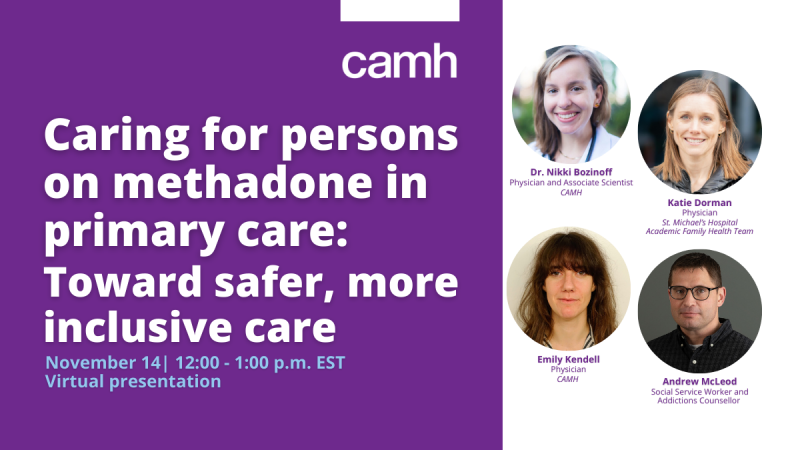
Caring for persons on methadone in primary care: Toward safer, more inclusive care

Social media card for event with CAMH colours and logo, event title, speakers names and headshots, and date/time.

In the setting of an escalating overdose crisis, efforts to help family physicians feel comfortable providing comprehensive care to patients prescribed methadone are urgently needed. This interactive virtual workshop will include case presentations and facilitated participant discussion.

#Presenters

  • Dr. Nikki Bozinoff, Physician and Associate Scientist, CAMH
  • Katie Dorman, Physician, St. Michael's Hospital Academic Family Health Team
  • Emily Kendel, Physician, CAMH
  • Andrew McLeod, Social Worker and Addictions Counsellor

This webinar is being presented by the CAMH Opioid Internal Network (COIN) Community of Interest, which is supported by the Evidence Exchange Network (EENet) within the Knowledge Mobilization portfolio of CAMH’s Provincial System Support Program.


Details
Tuesday, November 14, 2023 - 12:00
12:00-1:00 pm
Cost: 
FREE
Internal/External: 
Event Type: 
Location
Online

11th Canadian Conference on Dementia

#About the 11th Canadian Conference on Dementia

The 11th Canadian Conference on Dementia brings together a group of national and international scholars to share clinically relevant, cutting-edge developments in dementia research. The biennial conference is organized by the Canadian Colloquium on Dementia and the University Health Network. This year's theme is Better and Earlier Detection of Dementia in a Changing Landscape. The keynotes, plenaries, parallel sessions, and workshops will focus on multiple aspects of dementia diagnosis and management in the Canadian context, with a focus on diversity and change in dementia care and research. Specifically, sessions will address screening, diagnostic confirmation, delivery of diagnoses, cultural aspects of dementia, approaches to screening, leveraging caregiver and care partner input, supporting and integrating primary care, health system issues in early detection, novel therapeutics, and the role of biomarkers. Best practices and clinical pearls will be explored, including the presentation of three new sets of Canadian guidelines.

#Conference Objectives

  • Review a broad and culturally-informed approach to dementia diagnosis and management
  • Explore the changing dementia landscape as it pertains to clinical care and research
  • Discuss health care system issues relevant to incorporating novel diagnostics and therapeutics
Details
Thursday, November 2, 2023 - 12:00
November 2-4
Location
Sheraton Centre Toronto Hotel
123 Queen St. West
Toronto, ON M5H 2M9

Learn to Successfully Structure Orientation for Internationally Educated Health Professionals

In this webinar, speakers will describe the uniqueness of IEHP orientation, important topics that should be covered, and provide concrete, actionable recommendations that can be adapted to your organization.

#Learning Objectives

  • Gain knowledge on what subjects IEHPs benefit from learning during their orientation.
  • Discover how and why IEHP orientation should be unique from traditional orientation.
  • Apply concrete, useable orientation tips to your organization’s orientation policies.

#Presenters

Catherine Driscoll, International Educated Nurses (IEN) Coordinator, Horizon Health Network

Ndolo Njie-Mokonya, Supervise Practice Experience Program Coordinator, The Ottawa Hospital

Details
Wednesday, November 22, 2023 - 13:00
1:00-2:00 pm
Cost: 
Free
Internal/External: 
Event Type: 
Location
Online

Supporting Internationally Educated Nurses to Relaunch and Flourish in their Nursing Career in Canada

Join Meghan Wankel and Rola El Moubadder from CARE Centre for Internationally Educated Nurses to explore the importance of IENs in Canada and the credential assessment process for nursing licensure. Discover how CARE Centre provides support and eligibility requirements, while also delving into the challenges and opportunities of integrating into the Canadian healthcare system and strategies for a successful nursing career in Canada.

Learning Objectives

  • Why Canada needs IENs: An Environmental Scan
  • The credentialling assessment process for nurses seeking licensure in Canada
  • How CARE Centre support IENs to licensure and employment and Eligibility requirements
    • Pre-arrival across Canada: PASS Program
    • Post-arrival in Ontario: STARS Program
  • IENs’ Challenges and Opportunities Integrating into the Canadian Healthcare System
  • Strategies to help IENs Launch their Career and Flourish in Canada

#Presenters

Rola El Moubadder, Program Manager, CARE Centre for Internationally Educated Nurses

Meghan Wankel, Program Coordinator, CARE Centre for Internationally Educated Nurses


Details
Wednesday, October 18, 2023 - 13:00
1:00 - 2:00 pm
Cost: 
Free
Internal/External: 
Event Type: 
Location
Online

Notre déclaration: Tracer un parcours de la réflexion honnête à l’action urgente à l’occasion de la Journée nationale de la vérité et de la réconciliation

Date: 
Friday, September 29, 2023

La Journée nationale de la vérité et de la réconciliation, connue également sous le nom de « Journée du chandail orange », est un moment au Canada pour faire une pause, réfléchir et favoriser un dialogue ouvert et honnête sur les questions autochtones. C’est l’occasion de réfléchir au travail accompli, et à celui en cours et à venir pour la réconciliation entre les Canadiennes et Canadiens et les peuples autochtones. Il est important de souligner cette journée par des cérémonies communes, des discussions et le renouvellement des engagements. Mais nous ne pouvons pas et ne devons pas nous arrêter là!

Quelle est la vérité en ce qui concerne l’histoire coloniale du Canada? Une vérité commune est nécessaire pour établir une voie vers la réconciliation. La prise de conscience récente des atrocités dans les pensionnats autochtones, de la rafle des années soixante et des femmes et filles autochtones disparues et assassinées a été douloureuse, mais nécessaire. Nous devons poursuivre ces efforts en créant des espaces de guérison pour les communautés et les peuples autochtones. Nous faisons ceci en permettant aux Canadiennes et Canadiens de mieux comprendre les structures telles que les services policiers, les systèmes de services sociaux et de soins de santé, et les systèmes de gouvernance, qui perpétuent les principes coloniaux et la violence des traumatismes intergénérationnels.

En avançant sur le parcours de la vérité, nous pouvons discerner les actions nécessaires vers la réconciliation et un avenir différent pour les générations présentes et futures, autochtones et non autochtones. Seule la vérité peut nous guider vers les actions pour tracer un avenir différent. Et ces actions, celles nécessaires pour guérir de la violence coloniale et y mettre fin sont plus évidentes que jamais.

Le travail de réconciliation consiste à promouvoir l’autonomie et l’autodétermination des structures et des systèmes de la société autochtone. Il vise également à revitaliser et à réaffirmer les droits linguistiques, fonciers et de la personne des peuples autochtones au sein des structures juridiques existantes au Canada. Il est aussi nécessaire d’imaginer et de construire de nouvelles relations entre individus, entre des groupes et des organisations communautaires, et entre les gouvernements et les nations et peuples autochtones. Il est également important d’établir des alliances pour perturber et démanteler la culture, les lois et les politiques coloniales du Canada.

Les membres de l’Alliance ont pris plusieurs mesures au cours de l’année écoulée, notamment l’adoption d’une résolution mise à jour intitulée « La santé des Autochtones entre les mains des Autochtones » lors de l’assemblée générale annuelle de 2023. Cette résolution appelle à la création d’environnements plus sécuritaires pour les peuples autochtones en intégrant les recommandations de la ressource Ne’iikaanigaana « All My Relations ». Elle réaffirme également l’engagement de l’Alliance envers l’équité en santé et la réconciliation, en veillant à ce que tous les membres des conseils d’administration communautaires et le personnel des organisations de santé reçoivent une formation sur la sécurité culturelle autochtone.

Cette semaine, l’Alliance a signé un nouvel accord avec le Conseil autochtone des soins de santé primaires (Indigenous Primary Health Care Council—IPHCC) pour renforcer les liens entre leurs organisations et leurs membres, dont certains sont membres des deux organisations. Ce partenariat, le résultat d’une démarche intentionnelle menée par des leaders autochtones et non autochtones, vise à promouvoir l’autonomie et l’autodétermination autochtones en matière de soins de santé. Il s’agit d’une étape clé pour l’Alliance cette année, en collaboration avec l’IPHCC. Son but est de promouvoir la santé des Autochtones entre les mains des Autochtones et façonner nos organisations respectives afin de progresser dans la mise en œuvre des 94 appels à l’action de la Commission de vérité et de réconciliation du Canada. Nous cherchons notamment à défendre les droits et à établir des politiques solides pour appuyer la création de systèmes de santé dirigés par les Autochtones, permettant ainsi aux peuples autochtones d’atteindre le meilleur état de santé et de bien-être possible au Canada.

Le progrès n’est pas linéaire. Nous ne pouvons l’ignorer! Le racisme anti-autochtone persiste au sein du secteur des soins de santé, d’autres secteurs et de la société canadienne, ce qui pose d’importants défis. Les traumatismes intergénérationnels continuent à détériorer le tissu social. L’inaction des gouvernements, y compris le gouvernement fédéral, en ce qui concerne l’accès à l’eau potable dans de nombreuses communautés et les revendications territoriales, entrave notre progression collective vers la réconciliation.

Cependant, nous ne sommes pas impuissants et ne devons pas feindre l’ignorance. En reconnaissant la vérité et en agissant avec amour et compassion, et en ayant soif de justice, nous pouvons construire un avenir réconcilié. Il nous incombe, comme individus et dans nos organisations, de cheminer ensemble sur cette voie, même lorsque cela s’avère difficile. Nous vous souhaitons une journée enrichissante qui inspire des actions en faveur de la réconciliation.