A Community Health Centre hub run by the community, for the community
Wednesday, September 14, 2016

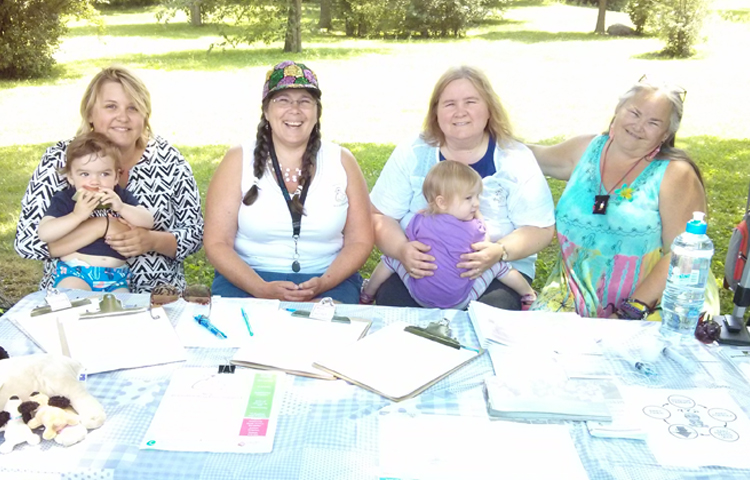
KCHC’s breastfeeding peer support group, started and run by new moms, meets for their summer celebration in a Kingston park.

by Jason Rehel, AOHC story producer and editor

In the speech from the throne on September 12, Premier Wynne reiterated her government’s commitment to community hubs, affirming they make it “easier to access health, social, education, cultural and recreational programs and services that nurture community life.” But creating hubs, and making sure they serve the community in the most effective way, is no easy matter. How can more Ontario communities get there?

Kingston Community Health Centres (KCHC) is a leader showing the way. Its 263 Weller Avenue location, a.k.a. the “Hub,” which opened in 2014, is now a busy hive of interprofessional care, social services, and community-driven programs. Now, nearly 100 Syrian refugees are being provided with housing, immigrant, education and parenting services under the same roof as primary health care. New user-driven programs include a breastfeeding peer support group. For people coping with multiple stresses, the Hub provides seamless wraparound support.

#HISTORY OF THE HUB

The vision for the Hub began in 2012 when it became clear that KCHC, and its seven access points, needed to improve the delivery of its many different services: dental care, programs that help low-income families raise healthy children, assistance for youth from deprived communities to complete high school successfully, settlement programs for new immigrants and refugees, as well as a variety of regional programs that promote better access for anyone facing barriers to good health.  

“We are the go-to organization whenever there are issues or social challenges in the community,” says Hersh Sehdev, executive director of Kingston Community Health Centres. “But back when our programs were spread across so many sites, we became concerned that we were not properly serving the needs of people already facing barriers. So we set out to build a ‘people place.’ ” The plan: put all programs under one roof, and develop strategies to provide integrated one-stop access to families with limited resources.

#THE COMMUNITY BOARD’S ROLE

Driving the development was KCHC’s board, comprised of community members with longstanding involvement in grassroots activism, across education, health and immigration issues.

“A community board makes the bottom line serve the community, rather than the other way around,” says Jim Brown, who’s served as a director on the board since 2011. “That’s the mindset, that’s the heart-setof everybodyat the table. It’s not about competing with other organizations, or letting anything get in the way of clear thinking about your community.”

Part of the board’s clear thinking was that KCHC should maintain its downtown and rural sites, Street Health Centre (SHC) and Napanee Area CHC (NACHC), in the preferred locations suitable to those communities. Both the SHC and NACHC sites are now in new buildings as well. But in the city’s north end, KCHC decided to build the Hub. When it came time to get the municipal government involved, it was the centres’ board that stepped up, Sehdev notes. Board members’ close ties and relationships in the community enabled them to demonstrate the value the Hub would hold for Kingston overall. Now that the Hub is up and running, KCHC’s board works to ensure that the services and programs offered address the most important factors affecting health in the community. This approach is backed up by research that supports community governance as a key factor that leads to a broader range of services, which are better oriented to a community’s specific needs.

#WHAT A REAL ‘PEOPLE PLACE’ LOOKS LIKE

Sehdev recalls a young woman coming out of immigrant services, shortly after the Hub opened. She asked about some pictures she saw on the wall, and it turned out the program she was asking about, Better Beginnings, was for parents to learn more about children’s programs and education. “The whole goal of creating the Hub – its design, how it was built, with the community and people at its centre, was to promote access across program boundaries, and to give people control and choice over their own care,” Sehdev says.

The KCHC hub’s physical design further reflects community-centredness: its central meeting area hives off into separate areas for primary care, newcomer, and various other social services. A community café acts as a hub within the Hub, a place where people learn about food and culture, and where newcomers to Canada now play a leading role.

“The immigrant community runs this program now. It’s become a place where people can practise their English and share their food ideas,” Sehdev adds.

#A NETWORK OF HUBS ACROSS ONTARIO

KCHC is one of 108 community-governed primary health care organizations across Ontario, many of which serve as community hubs, who put people and communities at the centre of governance, as well as services and program development.

“Because they are rooted in the community and are run by community members, Ontario’s community-governed primary health care organizations often evolve over time to create and run hubs,” says Leah Stephenson, director of special projects for the Association of Ontario Health Centres. “Community-governed hubs like those operated by KCHC enhance community vitality and people’s sense of belonging, because they’re community-centred, and they set out to build the pathways that link the wellbeing of every person with the wider wellbeing of the community as a whole. These incredible impacts are a glimpse of what is possible across Ontario when community-governed health providers very intentionally put people and communities first.”

Between September 26 and October 1, 108 AOHC member centres across Ontario will celebrate Community Health and Wellbeing Week. This year, special events will showcase how health providers put people and communities first in the delivery of services and programs. In the lead-up to Community Health and Wellbeing Week, AOHC centres are sharing principles and practices they apply every day to do this.
Joignez-vous à notre appel en ligne au ministre Hoskins : Passons de Priorité aux patients à Priorité aux personnes et aux communautés!

Friday, September 9, 2016
Community Health and Wellbeing Week

Quand la population participe à la prise de décisions au sujet des services de leur communauté reçoit, les résultats s’améliorent.

par Adrianna Tetley, chef de la direction de l’Association des centres de santé de l’Ontario

Bienvenue au nouveau blogue de l’Association des centres de santé de l’Ontario : « Le changement transformateur en action ». Nous commençons par demander : pourquoi le débat public sur le système de santé de l’Ontario est-il tellement concentré sur les médecins et combien ils sont payés pour fournir des services aux patients? Si vous pensez vous aussi qu’il faut changer la conversation, joignez-vous à notre blitz provincial dans les médias sociaux en faveur du changement.

Voici ce qui nous préoccupe : le mois dernier, les nouvelles étaient saturées de commentaires sur le fait que le gouvernement provincial et l’Association médicale de l’Ontario ne sont toujours pas parvenus à une entente sur la rémunération des médecins.

Notre association espère certainement cette impasse se résoudra bientôt. Les médecins sont un élément absolument essentiel de notre système de santé; plus de 400 médecins salariés travaillent dans les 108 centres membres de l’ACSO. Sans m’exprimer en leur nom, je suis persuadée qu’il y a des priorités bien plus importantes que la rémunération des médecins.

#Guérir notre culture toxique

Pour commencer, notre priorité doit être de garder la population en bonne santé – prévenir les maladies évitables et les visites évitables aux bureaux des médecins, dans les salles d’urgence et les lits d’hôpitaux. Pour mieux faire dans le domaine de la prévention des maladies,  nous devons nous attaquer à ce que Gabor Maté et d’autres appellent notre « culture toxique ».

La culture toxique est une maladie sociétale qui se manifeste sous de nombreux aspects nuisibles à la santé. Beaucoup trop de gens ont des problèmes de santé parce qu’ils ne peuvent pas se permettre de s’alimenter sainement ou d’avoir un logement salubre. Beaucoup trop de gens souffrent de maladies liées au stress parce qu’ils sont victimes de racisme ou d’autres formes d’exclusion sociale. Dans les régions rurales ou éloignées, et surtout dans les communautés autochtones, des milliers de personnes ne peuvent pas avoir accès à l’eau potable ou aux services les plus élémentaires de promotion de la santé et de prévention.

Les recherches montrent que 50 pour cent des résultats pour la santé de la population au Canada sont déclenchés par ces facteurs sociétaux toxiques. Donc encore une fois, je pose la question : pourquoi sommes-nous toujours en train de parler de ce qui se passe dans les cabinets des médecins et de la rémunération des médecins pour leurs services? Je pose la même question à propos des hôpitaux. Oui, les médecins et les hôpitaux jouent un rôle très important pour traiter les gens quand ils sont malades. Mais nous devons prévenir davantage, afin de traiter moins. Nous devons créer une culture de la santé et du bien-être qui empêche les maladies et les blessures évitables, une culture qui favorise le meilleur état de santé possible pour tout le monde, peu importe qui ils sont et où ils vivent, une culture que la première ministre Wynne a confié à ses collègues du Cabinet le mandat  d’offrir, mais qui ne s’est pas encore manifestée.

#Changer l’accent

Pour concrétiser cette vision, les gouvernements fédéral, provinciaux, régionaux et municipaux doivent éliminer la compartimentation et appliquer une approche axée sur la santé dans toutes les politiques. Et notre système de santé doit montrer la voie en appliquant des principes et pratiques centrés sur les personnes et les communautés qui répondent aux réalités toxiques nuisant à la santé des gens, que ce soit la pauvreté, la discrimination ou d’autres types de contraintes sociales, économiques ou environnementales.

Une approche centrée sur les personnes et les communautés signifie également rejeter la notion que les gens sont des individus isolés qu’il faut traiter comme des bénéficiaires de soins passifs et patients. Au contraire, ils ont besoin de participer activement à la prise de décisions au sujet du genre de services que leur communauté doit recevoir, et sur le mode de prestation de ces services. Les recherches montrent que lorsque c’est le cas, les résultats s’améliorent.

#Recadrer le débat et la prise de décisions

Ce changement semble ardu. Comment pouvons-nous y arriver? Le ministre Hoskins peut faire un pas important en recadrant tout simplement la conversation.

Un exemple en est son initiative « Priorité aux patients » et le projet de loi omnibus qui la soutient. Dans nos prochains blogues, nous vous présenterons les points positifs et les points négatifs de ce projet de loi, qui est maintenant à l’étude à Queen’s Park. Mais nous tenons tout d’abord à insister sur le fait que l’emploi du mot « patients » implique une attention continue sur les médecins et les hôpitaux, et que cette orientation ne produira pas la culture de la santé et du bien-être dont nous avons vraiment besoin. Nous proposons plutôt au ministre Hoskins de recadrer la transformation du système de santé autour du thème « Priorité aux personnes et aux communautés ».

Êtes-vous d’accord avec cette première étape? Ensuite, nous vous invitons à participer à notre appel en ligne en utilisant une application de médias sociaux appelée Thunderclap. Cet outil vous permet d’utiliser la plateforme de votre choix (Facebook, Twitter ou Tumblr) pour envoyer un message déterminé au ministre Hoskins.

Notre intention est que notre message « Priorité aux personnes et aux communautés » profite d’une large diffusion à l’occasion du lancement de la semaine santé communautaire et bien-être de notre association (du 26 septembre au 1er octobre).

À la veille et tout au long de la semaine, consultez ce blogue pour y découvrir des histoires sur la manière dont les centres de santé des quatre coins de la province appliquent déjà des pratiques qui accordent la priorité aux personnes et aux communautés.

  • Nous montrerons comment nos centres membres élaborent des services et des programmes qui s’attaquent à la « culture toxique » de l’Ontario.
  • Nous exposerons les avantages des centres de santé régis par la communauté, pour la communauté.
  • Nous démontrerons aussi l’importance du rôle que jouent les prestataires pour faire en sorte que les gens qu’ils servent sont actifs et non passifs et patients, et qu’ils participent à la prise de décisions sur la manière d’améliorer leur état de santé et leur système de santé.

Merci de vous joindre à la conversation alors que nous faisons la transition vers la Priorité aux personnes et aux communautés.

AOHC supports the fight for $15 and Fairness

Date: 
Thursday, December 17, 2015

Over 100 people from AOHC members centres were part of the 800 health care workers across the province that signed a statement calling for changes in the laws that regulate employment.  They are asking that all full time workers have at least seven paid sick days each year. At a Queen’s Park press conference on November 5th organized by AOHC, the statement was unveiled and Axelle Janzur, Executive Director of Access Alliance spoke about the ways that bad jobs are affecting people’s health. Later the petition was also personally presented to Minister Hoskins.

On November 19th representatives from Toronto CHCs joined other healthcare providers in public education actions. 

See the full Storify below: 

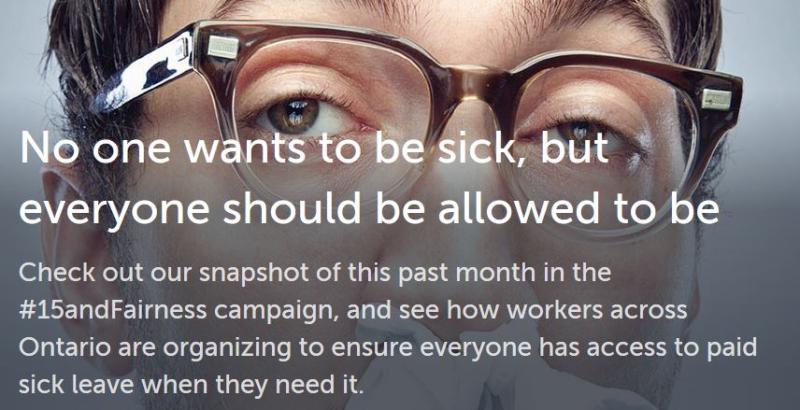
[<a href="//storify.com/AtkinsonCF/15andfairness-a-monthlong-snapshot-int0-a-growing-" target="_blank">View the story "No one wants to be sick, but everyone should be allowed to be" on Storify</a>]

As flu season begins, health care providers call for paid sick days for all Ontario workers

Date: 
Thursday, November 5, 2015

TORONTO, November 5, 2015 – Over700 health workers across the province have signed a statement that calls for change in the laws that regulate employment. They are asking that all full time workers have at least seven paid sick days each year - pro-rated for part time workers.

Speaking at a Queen’s Park press conference today, Dr. Andrew Pinto, from Health Providers Against Poverty and St Michael’s Hospital, stated: “Flu season is now starting. As a public health specialist I know that infectious diseases like influenza can spread in workplaces. We tell our patients to stay home when sick. But many of the people I see are in low wage, temp jobs without sick leave benefits and cannot afford to take a day off without pay. People should not have to choose between going to work while sick and losing income –or worse, losing their job.”

Currently, no worker in Ontario has a legislated right to a paid sick day. In addition, more than 1.6 million workers have no access to job protected emergency leave and could be fired for taking a sick day.

“We’re seeing a growing trend toward more precarious work in Ontario. Research at our Community Health Centre has documented how bad jobs are affecting people’s health and making them sick. But without job protection under the Employment Standards Act, people have no choice but to go to work sick,” said Axelle Janczur, Executive Director, Access Alliance Community Health Centre in Toronto.

She talked about the recent case of a client who had a serious illness.  The woman had vomited at her job in a bakery, but was unable to take any time off.  Ms. Janczur added “We see an increasing number of clients coming to our Health Centre in very critical health conditions just because they could not take time off to recover or visit our Centre earlier.”

Dr. Danyaal Raza, a family physician at Sumac Creek Health Centre, St. Michael’s Hospital in Toronto and an advisory board member at Upstream, concluded: “This is an issue of equity. All workers should have access to sufficiently paid, job-protected sick leave to help them recover from illness without losing income, and to reduce the risk of infecting others.”  Health care workers are also calling for changes so that employers not require medical notes as proof of illness.

“As health care providers we call on Premier Wynne and Labour Minister Flynn who are currently reviewing employment legislation to change the Employment Standards Act so that all workers in businesses, big and small, get at least seven paid sick days, pro-rated for part-time workers, with no requirement for a medical note,” said Dr Andrew Pinto.

Health Providers Against Poverty is a province wide alliance of health providers who are committed to addressing poverty as a health issue. The Association of Ontario Health Centres  (AOHC) is Ontario’s voice for community-governed primary health care representing 109 Community Health Centres, Aboriginal Health Access Centres, Nurse Practitioner- Led Clinics and Community Family Health Teams. Upstream is a not-for-profit organization that works with the growing body of evidence on social determinants to guide recommendations for health policy change.

Porte-parole français disponible

                                                                -30- For further information contact: Jacquie Maund, Association of Ontario Health Centres jacquie@aohc.org  Tel. 647-294-5724

Vaughan among first municipalities to measure quality of life using the Canadian Index of Wellbeing (CIW)

Vaughan Wellbeing Report
Date: 
Tuesday, November 3, 2015

TORONTO, November 3, 2015 – A report on quality of life in Vaughan, released today by a coalition of community stakeholders, reveals  the fast-growing municipality has many strengths to build on but must also address important issues to ensure sustainable growth and optimal wellbeing.

The Vaughan Community Wellbeing Coalition, convened by the Vaughan Community Health Centre, prepared the report using the Canadian Index of Wellbeing (CIW), a comprehensive measurement framework that tracks wellbeing with respect to eight quality of life domains.

The report is called Measuring What Matters and draws data from a wide range of sources.  It shows that in Vaughan the average income is higher than the provincial average and the majority of residents have a post-secondary education.  However, analysis of the data also reveals Vaughan has pockets of hidden poverty as people struggle with low wages and precarious employment. This is compounded by rising house prices and the need for more affordable rental units.

Read the full release on the Vaughan CHC website here>>