Des personnes âgées plantent le germe de l’appartenance à Kingston
Tuesday, December 20, 2016

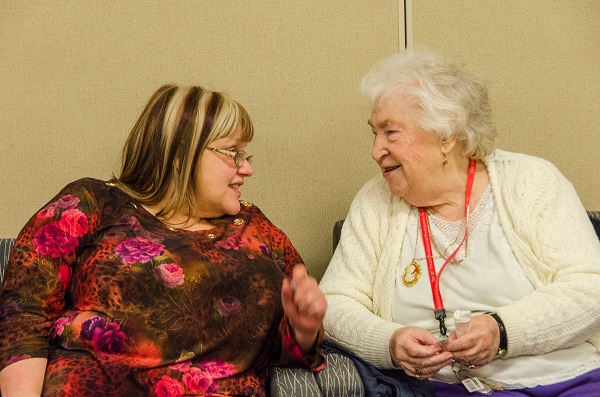
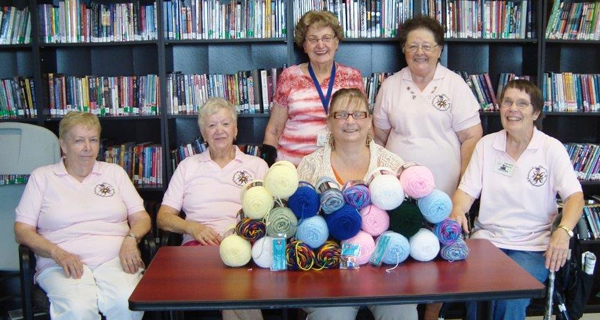
Les dames qui enseignent aux enfants à tricoter sont « emballées », dit Pat Lloyd. De plus, elles apportent des balles de laine dans des maisons de soins infirmiers pour recruter encore plus aînées. Photo avec la permission de Friendship Blooms/CSCK

Par Jason Rehel, auteur et éditeur du contenu, ACSO

Dans la première semaine de décembre, la Loi donnant la priorité aux patients est entrée en vigueur en Ontario. Aux termes de la Loi, « la promotion de l’équité en matière de santé ainsi que le développement et le déploiement de stratégies de promotion de la santé » s’ajoutent au mandat des 14 réseaux locaux d’intégration des services de santé de l’Ontario. Pour mieux imaginer ce mandat en action dans les soins primaires, nous vous présentons des témoignages sur les programmes de promotion de la santé et les initiatives de promotion de l’équité en santé des centres membres de l’ACSO un peu partout dans la province. Cette semaine, nous braquons les projecteurs sur une approche communautaire de la lutte contre l’isolement social à Kingston.

Pat Lloyd revient tout juste d’une séance de Tech Tutors, où des étudiants de l’université lui ont appris à utiliser Skype.

« J’ai un fils et petit-fils à Terre-Neuve, et un arrière-petit-fils qui a presque trois ans, que je n’ai jamais vu. Je voulais apprendre pour pouvoir le voir », dit-elle en souriant.

Pat Lloyd est membre de Friendship Blooms, un programme d’activités bénévoles dirigé par des personnes âgées aux Centres de santé communautaire de Kingston, où est née la série de formations d’un mois de Tech Tutors. Ce programme est un des nombreux volets de Friendship Blooms, dont la vision consiste à « favoriser l’amitié entre des membres de la collectivité de tout âge afin de promouvoir des modes de vie propices au bonheur et à la santé ». Les agents de développement communautaire appuient le programme Friendship Blooms des CSCK en offrant de la formation, de l’espace pour les activités et les réunions, des conseils d’experts et de modestes budgets pour la planification des programmes.

La lutte contre l’isolement social et la solitude est au cœur de l’action de Friendship Blooms qui donne aux gens l’occasion de tisser des liens grâce à d’enrichissantes activités bénévoles. Certains entendent parler du programme par le bouche-à-oreille. D’autres ont été aiguillés directement vers Friendship Blooms par un ergothérapeute, un diététiste ou un autre professionnel de la santé des CSCK. Pour les personnes qui ne peuvent se rendre au Centre, les bénévoles vont dans les maisons de soins infirmiers pour y distribuer laine à tricoter et bonne humeur et les relier à la communauté dans son ensemble, le tout avec une infolettre et des appels téléphoniques périodiques pour s’assurer que tout va bien.

Madame Verena Menec, professeure de sciences de la santé communautaire au Collège de médecine de l’Université du Manitoba, étudie la relation entre les relations interpersonnelles et la santé depuis plus de dix ans. Selon elle, les efforts pour lutter contre l’isolement social et la solitude sont indispensables.

« Ce sont des risques pour la santé, aussi graves que le manque d’activité physique, l’obésité ou le tabagisme, explique madame Menec. Dans le cas de la solitude, bon nombre de recherches démontrent que certains mécanismes de base – comme l’affaiblissement du système immunitaire, de la qualité du sommeil et l’augmentation des hormones du stress – peuvent être directement liés à des problèmes de santé. »

Pour les personnes âgées qui participent à Friendship Blooms, cependant, les avantages du programme vont bien au-delà de la protection contre la maladie et les maladies chroniques. Friendship Blooms leur offre un bienfait fondamental et essentiel : des relations d’amitié. L’alternative – se sentir coupé du monde, isolé et démotivé – est un sentiment que Pat Lloyd ne connaît que trop bien.

« J’étais seule à la maison avec mon mari. Mes enfants ont quitté la maison et je ne sortais pas beaucoup, dit-elle. À un moment donné, je me levais le matin et je restais assise dans mon fauteuil à regarder la télé ou à tricoter, et je commençais à être très déprimée. »

Ce qui s’est passé ensuite a tout changé pour elle : « J’ai rencontré une dame qui faisait partie de Penguins North End (un groupe social pour les personnes âgées situé aux CSCK), et je suis allée à quelques réunions avec elle. Puis, l’une des Penguins a entendu dire que je savais tricoter et elle m’a invitée à rejoindre Friendship Blooms. Maintenant, nous avons six dames qui tricotent, et douze enfants à qui nous apprenons à tricoter dans notre groupe. Nous avons beaucoup de plaisir à faire danser les aiguilles! »

Si on réfléchit à l’isolement social en général, la bonne nouvelle, c’est que les recherches démontrent que la création, le maintien et le renouvellement de relations solides peuvent améliorer la longévité et la santé. Mieux encore, les CSCK ne sont que l’un des 107 centres de soins primaires gérés par la communauté dans la province où le personnel collabore jour après jour avec les membres de la communauté pour créer un milieu riche en possibilités de s’impliquer, de nouer des amitiés et de changer les choses. [hyperlien vers la fiche d’information ici]

« Se sentir intégré à la société, avoir un endroit où on éprouve un sentiment d’appartenance et des gens avec qui le partager – ces facteurs favorisent directement une meilleure santé », déclare Gary Machan, responsable stratégique de la santé et du bien-être de l’Association des centres de santé de l’Ontario. « Lorsqu’on met en relation les services de soins primaires vers lesquels les gens se tournent quand ils sont malades et les programmes de promotion de la santé qui, comme Friendship Blooms contribuent à les garder en bonne santé, le niveau de soins ainsi obtenu permet de traiter les problèmes de santé chroniques et les facteurs de risque bien avant qu’une personne doive se diriger vers l’hôpital ou les soins de longue durée. »
Close-knit women's group supports a strong sense of belonging in Brantford

Saturday, December 24, 2016

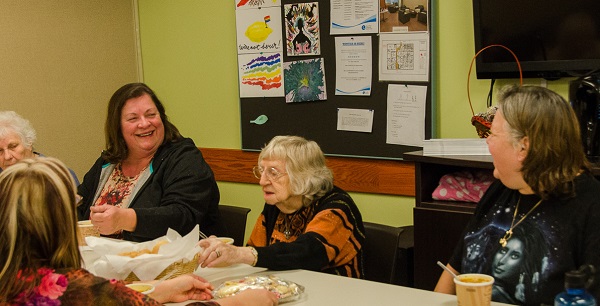
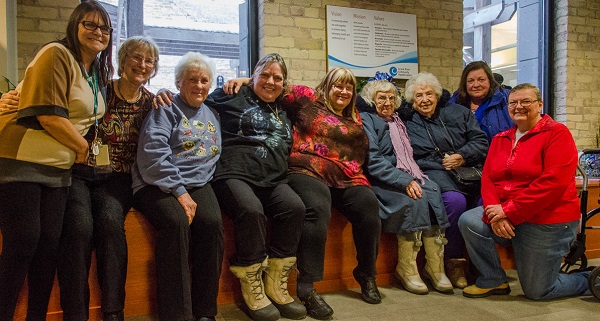
The women of Stitch 'N Chat gather to celebrate the holidays at Grand River Community Health Centre in Brantford. (Photo: Oleksandra Budna/AOHC)

By Jason Rehel, story producer and editor, AOHC

In the first week of December, the Patients First Act became law in Ontario. In the Act, “the promotion of health equity and development and implementation of health promotion strategies” is added to the mandate of Ontario’s 14 Local Health Integration Networks. To better imagine what this mandate could look like in action in primary health care, we’re bringing you stories from AOHC member centres across the province. Here we highlight a women’s group in Brantford that cultivates a sense of belonging among everyone who joins, and hear directly from the women themselves about why their program matters so much.

A few weeks ahead of Christmas in 2010, a group of women gathered for the first time, to share tea, knitting and sewing tips, and a bit of conversation. Six years later, the group is still going strong. Its official name has evolved to Stitch ’N Chat, but the purpose of the weekly gatherings is still the same: to welcome women from the community to a safe space for creating things and making friendships.

We found that many people who were being seen on the primary care side, perhaps for counselling because they were a bit sad or dealing with some depression, when we peeled away the layers, it was social isolation that was at the root of many cases,” says Gloria Ord, Community Health and Wellness worker at Grand River Community Health Centre (GRCHC) in downtown Brantford.

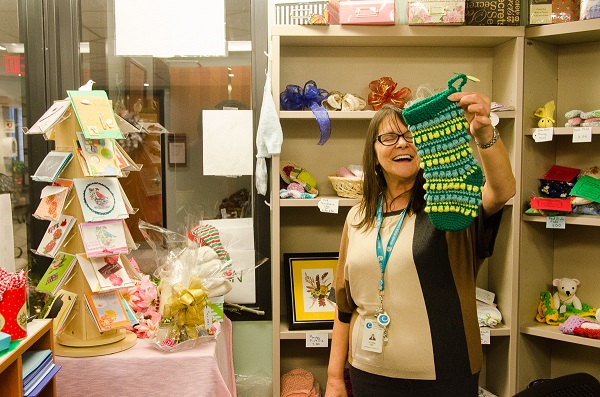
Ord helps facilitate the group, which includes about 20 women ranging in age from 30 to 93. She helps plan the small budgets that the group has for knitting, sewing, card-making and other crafting projects. Led by Shirley, a volunteer at GRCHC, the group also runs and stocks a small gift shop at the centre, where Stitch ’N Chat members’ unique creations find homes in the community. And yes, business has been brisk the last few weeks. (But no, they don’t have any homemade Minions left!)

Referrals to the social group are made through physicians, counsellors and others on the primary care side of the Community Health Centre, Ord says. Other mental health organizations in the Brantford area have also referred people in their care directly to Stitch ’N Chat. Often the women in the group themselves, vocal advocates for their weekly meet-ups, will draw in people they’ve identified as needing a friend, sometimes after learning about the loss of a spouse or a battle with illness.

Gloria Ord holds one of the Stitch 'N Chat group's creations in the volunteer-run gift shop at Grand River CHC. (All photos: Oleksandra Budna/AOHC)

Ord says she’s most proud that Stitch ’N Chat sustains itself, even when she’s not there. When she goes on summer vacation, projects are still planned, tea is poured, and the chatting continues. She’s a member of the group, and provides guidance, but Ord says the group leads itself, with the women taking strong roles in welcoming others, developing new craft projects, planning events, and helping each other.

To honour that strong sense of belonging, we spoke with several of the women of GRCHC’s Stitch ’N Chat group at their annual Christmas gathering this week. Below, you’ll find some of their reflections on why the program matters so much to them, their sense of wellbeing, and their health overall.

Mary: This program is not so much about stitching, it’s about being with other people. It’s about giving us an opportunity to get out of our closed tight circles and expand. When you’re going through health challenges, it’s harder to participate in things in the community, but this program makes sure we have that chance, and that we can come out of our shell. With the gift store, it’s also a chance to feel like we’re contributing back to the community, too.

Chatting never takes a back seat to knitting or sewing at Stitch 'N Chat, members of the weekly women's group say. Friendship and supporting each other is the main purpose, they add.

Donna: I just started coming in November. My husband died in March, so I’ve been trying to find ways to get out and get involved again. I had been my husband’s care-giver for 10 years. That made me kind of feel that I was distanced from everything. But I had been knitting all along anyway, and I had made a whole bunch of hats for charity, and they needed a home! And that’s when I came across this group. Gloria was looking for someone to teach sewing, and I had worked as a sewing teacher. So it all kind of happened at the perfect time for me. It’s just great being with everyone.

Gerry: I came in because of depression. I met Gloria and she made me feel so comfortable. People here tell me I’ve bloomed and blossomed since then. I get a lot out of this program because I’ve met real friends. They’re not just acquaintances. Our group is close-knit, but we invite people in and help them to feel comfortable. That’s the way we are.

Shirley: I started coming with my sister who was handicapped and looking for an excuse to get out of the house. That was about three years ago, and although she died, I’ve kept coming. Now I’m running the gift shop and so I’m here about four hours a day, and I make a lot of greeting cards. Since the middle of November, I think I’ve made about 200 cards.

Gerry: And she also shares her knowledge with us and teaches us to make our own cards!

Leslie: I joined the program after I was put off work because of my hip. My doctor’s office is at GRCHC, and I said to her, “You know, I think I’m a little down. I’m always at home and I’m not really doing anything.” So she sent me to Gloria. When I told her about my situation, she suggested that I join this group. I was shy at the beginning like Gerry, but everybody here gets along, accepts you for who you are, there’s no judgment whatsoever. I feel as if this group has been a real life-saver for me, and I feel really lucky.

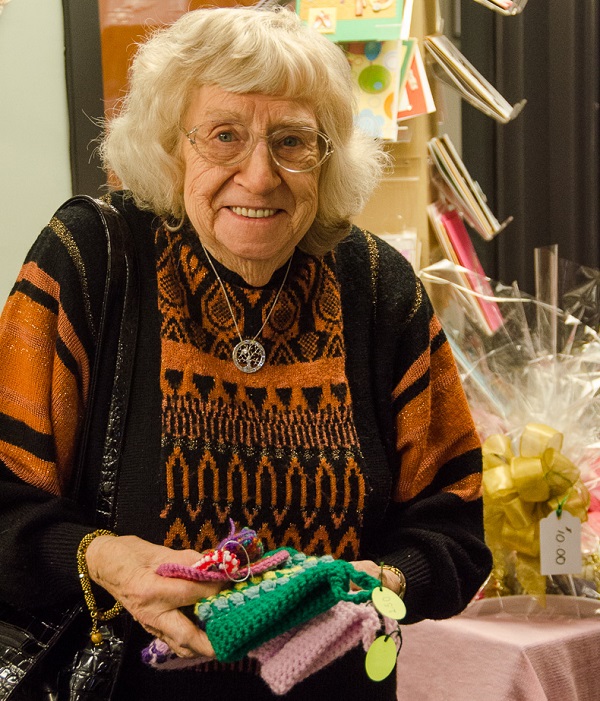
For Margaret, who's 86, getting the opportunity to meet someone around her own age (Florence, 93) has made a real difference, and they now support each other outside the centre.

Margaret: Someone from the public library suggested this group to me, and ever since the first day, everyone’s just been so friendly, and so kind. It’s a great group of women, and I think it’s because they feel for people. I’ve only been in Brantford for three years, and the program has given me a chance to meet someone in my own age group. I’m 86. Florence, who’s 93, we’ve figured out that we have a lot in common.

Florence: I’m the oldest one here. And I look forward to every Thursday. That’s the only day I get out. I’m going into a retirement home soon, so that will be a bit of a change for me, but I took Margaret there yesterday and we had a meal, and it was nice. I’ve also been able to contribute to the group – I had a 100-year-old pattern for baby sweaters that I’ve taught the knitters how to make. When it comes to age, if you feel young, then you are young.

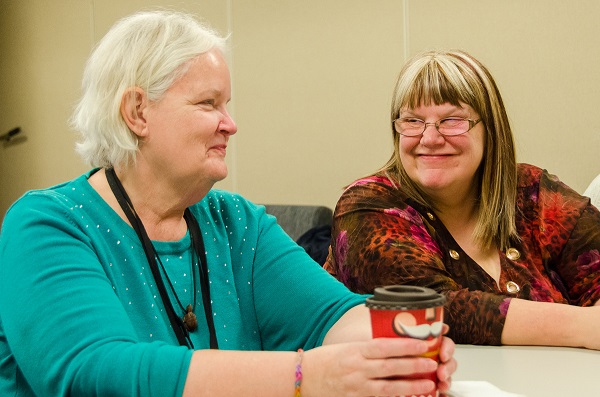
Working together in the gift shop has afforded Shirley, left, and Leslie the chance to build a strong bond and share plenty of laughs.

Joyce: I was pretty depressed and feeling lonely before I met Gloria and started coming out to do crafts and sewing with this group. Since I’ve been losing my sight over the last year, I haven’t been coming out as much since I can’t participate in the activities anymore, but Gloria made sure I was invited and came out today. The friendship, the fellowship I get with this group still matters. It’s harder for me to get out to the centre because I’ve lost my driver’s licence, but I recently got accepted for the Brantford Lift, so that will help.

Angelika: I had a health issue I needed to take care of at the centre, and that’s how I met Gloria, and how I found out about this program. I had only moved to Brantford a few months before that, and so we didn’t really know anyone in the community. These are the only people in Brantford I know. I find the older you get, the harder it gets to make new friends. So everything that Gloria has done, and this group has done for me is incredible. The women here are awesome.

 Having others to talk to when health problems arise has made a difference for many of the women who are part of Stitch 'N Chat.

Seniors sow seeds of belonging in Kingston

Tuesday, December 20, 2016

The women who teach kids knitting “have a ball,” Pat Lloyd says. What’s more, they bring balls of yarn to nursing homes to involve even more seniors. (Photo courtesy Friendship Blooms/KCHC)

By Jason Rehel, story producer and editor, AOHC

In the first week of December, the Patients First Act became law in Ontario. In the Act, “the promotion of health equity and development and implementation of health promotion strategies” is added to the mandate of Ontario’s 14 Local Health Integration Networks. To better imagine what this mandate could look like in action in primary health care, we’re bringing you stories about health promotion programs and health equity initiatives from AOHC member centres across the province. This week, we highlight a community-centred approach to combatting social isolation in Kingston.

Pat Lloyd is fresh from a session of Tech Tutors, where university students taught her how to Skype.

“I have a son and grandson in Newfoundland, and a great-grandson who’s almost three years old, who I’ve never met. I wanted to learn so I could see him,” she says with a smile.

Lloyd is a member of Friendship Blooms, the seniors-led volunteer program at Kingston Community Health Centres (KCHC), which the month-long Tech Tutors series grew out of. It’s one of the many branches of Friendship Blooms, whose vision is “to bring all ages of the community together in friendship to promote happy, healthy lifestyles.” Community development workers at KCHC support Friendship Blooms with training, space for events and meetings, expert guidance, and small budgets for program planning.

At its core, Friendship Blooms combats social isolation and loneliness by giving people a chance to connect with others while volunteering in meaningful roles. Some hear about the program through word of mouth. For others, occupational therapists, dietitians or other KCHC health providers can refer them directly to Friendship Blooms. For people who cannot get to the centre, volunteers bring the centre to them, visiting nursing homes to deliver yarn for knitting, good cheer, and a connection to the wider community that comes complete with a newsletter and regular check-in calls.

Dr. Verena Menec, a professor of Community Health Sciences at the University of Manitoba’s College of Medicine who’s examined the link between social ties and health for over a decade, says that efforts to address social isolation and loneliness are essential.

“They are health risks, and the risk is really as great as it is for lack of physical activity, obesity, or smoking,” says Dr. Menec. “With loneliness, there’s a lot of research that shows some basic mechanisms -- such as decreased immune system function, poorer sleep quality, and increased stress hormones -- can be linked directly to health problems.”

For the seniors involved in Friendship Blooms, though, the program’s benefits go far beyond protection from disease and chronic illnesses. For them, Friendship Blooms provides a basic and vital reward: friendships. The alternative – feeling disconnected, isolated and aimless – is something Lloyd says she’s all too familiar with.

“I was home with my husband, and my kids were moved out and gone, and I wasn’t getting out that much,” she says. “It got to be that I was getting up in the morning, and just sitting in my chair either watching TV or knitting, and I was getting very depressed.”

What happened next changed everything for her: “I happened to meet a lady who belonged to the North End Penguins (a KCHC-based seniors’ social group), and I attended a few meetings with her. Then one of the Penguins found out I could knit, and asked me to join Friendship Blooms. Now we have six ladies who knit, and 12 children who we teach in our knitting group. We have a ball!”

Looking at the larger picture of social isolation, the good news is that research shows that developing, maintaining and renewing strong relationships can lead to longer, healthier lives. And the really good news is that KCHC is just one of 107 community-governed primary care centres across Ontario where staff work every day with community members to create an environment rich with opportunities for getting involved, forging friendships, and making a difference. 

“Feeling socially included, having a place where you feel like you belong and people to share it with – these factors directly promote better health,” says Gary Machan, strategic lead for Health and Wellbeing at the Association of Ontario Health Centres. “So when you connect primary care services that people look to when they’re sick directly to health promotion programs, like Friendship Blooms, that help keep them well, you can achieve a level of care that’s able to address chronic health issues and risk factors long before someone has to head to a hospital or long-term care.”

Installer la confiance et améliorer les services de santé pour les Autochtones

Thursday, December 8, 2016

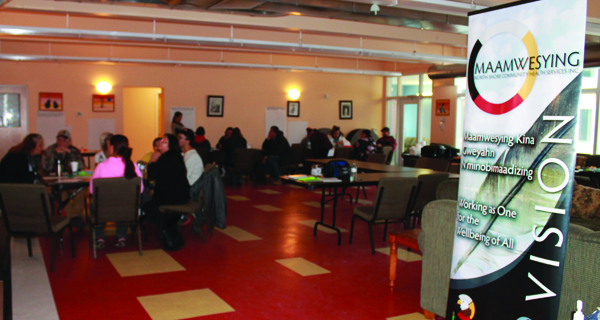
Aux soupers-conversations communautaires, les membres des communautés autochtones sont invités à partager leurs expériences au sein du système de santé dans un espace sécuritaire et ouvert. (Photo : Centre d'accès aux services de santé pour les Autochtones N’Mninoeyaa N’Mninoeyaa)


Par Jason Rehel, auteur et éditeur du contenu, ACSO

Des décennies de colonialisme et d’oppression ont fait peser un terrible fardeau sur la santé et le bien-être des Autochtones. Beaucoup d’entre eux souffrent de dépression, d’anxiété ou de maladies chroniques; dans certaines communautés, le diabète de type 2 a atteint des proportions épidémiques. Autre problème grave : en raison du racisme qu’ils ont subi dans les établissements de soins de santé, les Autochtones se méfient souvent des professionnels de la santé et n’ont donc pas accès à tous les services dont ils ont besoin pour favoriser une bonne santé.

Sur la rive nord du lac Huron, le Centre d'accès aux services de santé pour les Autochtones N’Mninoeyaa s’affaire à restaurer cette confiance grâce à une solution toute simple : l’aménagement d’un espace et d’un endroit où chacun est à l’aise de parler franchement de ses expériences et de ses besoins en matière de santé et de bien-être.

Plusieurs fois par an, à différents endroits le long de la rive nord, le centre organise des conversations communautaires et des soupers, et offre des bons d’essence à ceux qui doivent se déplacer. En fonction des commentaires recueillis lors de ces conversations communautaires dans une ambiance intime, les employés du centre adaptent leur travail afin de répondre le mieux possible aux besoins communautaires. « C’est plus utile que la meilleure enquête que nous pourrions imaginer, estime Gloria Daybutch, la directrice générale du centre. En mangeant autour de la même table que nous, les gens sentent qu’ils sont des participants à parts égales au processus. C’est à ce moment-là qu’ils ont le plus de facilité à s’exprimer sur ce que nous devrions faire autrement. »

Au début de la soirée, la direction et les coordonnateurs des programmes du centre se présentent, ainsi que les membres de leur famille. « Cela crée un sentiment de reconnaissance... et ainsi, la conversation devient un échange entre amis et membres d’une même famille », poursuit Gloria Daybutch.

À la suite des commentaires formulés dans ces échanges, le personnel de N’Mninoeyaa apporté de nombreux changements dans ses huit centres : achat d’autres chaises hautes pour accueillir les jeunes familles d’une communauté; et embauche prochaine d’une guérisseuse traditionnelle pour aider les femmes victimes de sévices sexuels. Le personnel travaille aussi à combler les lacunes dans les services signalés par les membres de la communauté : la nécessité de l’éducation et du soutien pour l’autisme, la perte d’audition et les personnes âgées qui demandent des renseignements sur le zona.

Après les soupers, les employés du centre font un suivi auprès des participants selon le moyen de communication qu’ils préfèrent. « Ainsi, les gens ont une synthèse des questions soulevées et des commentaires, conclut Gloria Daybutch. Même si les mesures peuvent prendre du temps, ils savent que le dialogue est amorcé et que leurs voix ont été entendues. »

Dans les prochains mois, Gloria Daybutch et son personnel du centre N’Mninoeyaa tiendront un souper-dialogue communautaire avec les jeunes hommes autochtones vivant dans la pauvreté, population qui a rarement accès aux services du centre, mais qui pourrait bénéficier d’un éventail de services de promotion de la santé. Pour inviter ces jeunes Autochtones, les coordonnateurs collaborent avec les travailleurs de proximité locaux d’Ontario au travail.

Le centre N’Mninoeyaa est l’un des 10 centres d'accès aux services de santé pour les Autochtones (CASSA) dans la province représentés par l’Association des centres de santé de l’Ontario (ACSO). Pour Gertie Mai Muise, directrice de la stratégie et de la transformation de l’ACSO du CASSA, les conversations communautaires de N’Mninoeyaa portent sur le rétablissement du sentiment d’autodétermination des peuples autochtones, ainsi que de leur confiance.

« La confiance est absolument fondamentale pour tout professionnel de la santé qui arrive dans une communauté, dit-elle. Il est donc essentiel de ménager des espaces accueillants où les gens peuvent trouver des solutions par eux-mêmes. C’est la raison d’être des centres de santé communautaire et des CASSA : reconnaître que les communautés ont en main les réponses aux questions qui les concernent. »

Elle explique que les conversations communautaires de N’Mninoeyaa relèvent aussi de la reddition de comptes envers les patients et les communautés autochtones, et du respect des droits issus de traités en ce qui concerne les services de santé. Respecter cette promesse sur le terrain est un objectif que cherchent à réaliser tous les CASSA et les CSC autochtones.

« Les personnes marginalisées, qui subissent les effets du racisme – il y a encore très peu de place pour leurs histoires dans le discours sur les soins de santé, affirme Gertie Mai Muise. Les conversations communautaires nous aident à approfondir notre compréhension de l’expérience des patients. Si nous pouvions véritablement étendre cette initiative à l’ensemble du système, je pense que nous comprendrions beaucoup mieux le vécu des gens, non seulement dans les soins de santé, mais dans la société dans son ensemble. »

Building trust and improving health services for Indigenous People

Thursday, December 8, 2016

At Community Conversations suppers, Indigenous community members are invited to share their experiences with the health system in a safe and open space. (photo credit: N’Mninoeyaa Aboriginal Health Access Centre)

By Jason Rehel, story producer and editor, AOHC

Decades of colonialism and oppression have taken a terrible toll on the health and wellbeing of Indigenous people. Many struggle with depression and anxiety or suffer from chronic disease; in some communities, Type 2 diabetes has reached epidemic proportions. Another serious problem is that because of the racism they’ve encountered in health care institutions, Indigenous people often distrust health providers and therefore don’t always access the services they need to promote good health.

On the north shore of Lake Huron, N’Mninoeyaa Aboriginal Health Access Centre is rebuilding that trust with a simple solution: creating a space and a place where everyone feels comfortable speaking frankly about their health and wellbeing experiences and needs.

Several times a year, at different locations along the north shore, the centre organizes community conversations along with suppers, complete with gas cards for those who’ve travelled. Based on what they hear during these intimate community conversations, the centre’s staff adjust their efforts to ensure they’re meeting community needs in the best possible way.

“It’s better than any survey we could design,” says Gloria Daybutch, Executive Director of the centre. “Because we’ve had supper with them, and sat around a table, people know themselves as equal participants. That’s when answers come more easily about what we need to do differently.”

The evening begins with centre’s management and program coordinators introducing themselves and their families. “That creates of feeling of ‘OK, now I know who you are’ … and the conversation becomes one between friends and family,” says Daybutch.

As a result of what they’ve heard during these conversations, N’Mninoeyaa’s staff have made many changes at their eight sites: more highchairs have been purchased to accommodate young families in one community; a female traditional healer will soon be hired to support women who have suffered sexual abuse. Staff are also working to address service gaps flagged by community members: the need for more education and supports for autism, hearing loss and seniors inquiring about shingles.

After the suppers, the centre’s staff follow up with participants through whatever communication method they request. “That way people have a record of the questions that were raised and comments made,” Daybutch says. “Even though actions may come much later down the road, there’s a knowledge that an open dialogue exists, and that their voices are being heard.”

In coming months, Daybutch and her staff at N’Mninoeyaa will conduct a suppertime community conversation with Indigenous young men living in poverty, a population who rarely access the centre’s services, but who would benefit from an array of health promotion services. To issue invitations to these young Indigenous men, coordinators are partnering with local outreach workers at Ontario Works.

N’Mninoeyaa is one of 10 Aboriginal Health Access Centres (AHACs) across the province that are represented by the Association of Ontario Health Centres (AOHC). For Gertie Mai Muise, AOHC’s Director of AHAC Strategy and Transformation, N’Mninoeyaa’s Community Conversations are about restoring a sense of self-determination for Indigenous peoples, as well as trust.

“Trust is really foundational for any service provider coming into a community,” she says. “So it’s critical that we create safe spaces where the people can find solutions for themselves. That’s the whole reason why Community Health Centres and AHACs were born: to recognize that communities have the answers for the issues that they’re dealing with.”

She explains that N’Mninoeyaa’s Community Conversations also demonstrate accountability to Indigenous patients and communities, and respect for treaty rights regarding health services. Delivering that promise on the ground is something all Aboriginal Health Access Centres and Aboriginal CHCs strive for.

“People who are marginalized, people who suffer the impacts of racism – there’s still very little place for their stories when we talk about health care,” Muise says. “Community Conversations bring patient experience knowledge to a brand new level. If we could actually scale this across the system, I think we would be a lot more intelligent in our understanding of what people are actually experiencing, not just in health care, but in society as a whole.”

Comment la législation du ministre Hoskins Priorité aux patients peut renforcer les services de santé en français

Friday, November 4, 2016
CSC l'Estrie

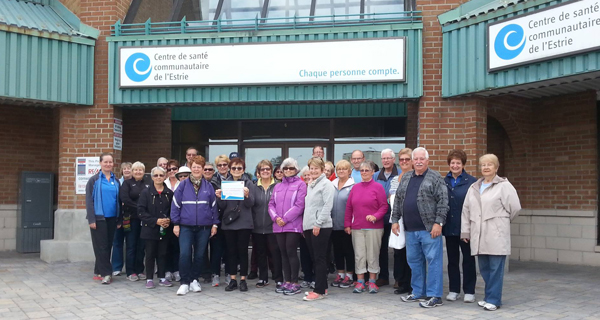
Le Centre de santé communautaire de l’Estrie, l’un parmi une vingtaine de centres membres de l’ACSO qui offrent des services en français aux Franco-Ontariens et Franco-Ontariennes de toute la province

Le 6 novembre 1986, le gouvernement provincial de l’Ontario a adopté la Loi sur les services en français. Cette loi confère aux francophones le droit de recevoir des services du gouvernement provincial en français, notamment dans les 26 régions désignées.

Trente ans plus tard, la province a-t-elle donné suite à l’intention de cette mesure législative? Quelles mesures sont nécessaires pour accélérer les progrès? Et quelles dispositions faut-il surveiller dans la loi Priorité aux patients du ministre Eric Hoskins, qui sera adoptée bientôt?

Pour obtenir réponse à ces questions, nous nous sommes entretenus avec Marc Bisson, directeur général du Centre de santé communautaire de l’Estrie et membre du Conseil consultatif des services de santé en français auprès du ministre de la Santé.

La prestation des services en français, n’est-elle pas une question concernant davantage les provinces comme le Québec et le Nouveau-Brunswick qui comptent beaucoup plus de francophones?

Je ne le pense pas. Il y a plus de 612 000 francophones qui vivent en Ontario. C’est la plus grande population francophone vivant à l’extérieur du Québec. De plus, le français est reconnu dans la Constitution canadienne comme l’une des langues officielles de notre pays.

L’adoption de la Loi sur les services en français s’est fait longtemps attendre. Pendant plus d’un siècle, les Franco-Ontariens et Franco-Ontariennes plaidaient pour que leurs droits linguistiques soient reconnus. Quand ils l’ont été, ce fut une grande victoire, qui a marqué le début d’un nouveau chapitre et de plus grandes aspirations pour les Franco-Ontariens et Franco-Ontariennes.

Dans quelle mesure le gouvernement provincial a-t-il donné suite à l’intention de la loi?

La bonne nouvelle, c’est que la loi a joué un rôle de sensibilisation et de promotion de la culture et des besoins des Franco-Ontariens et Franco-Ontariennes. Elle a également donné aux Franco-Ontariens et Franco-Ontariennes la confiance nécessaire pour demander des services gouvernementaux en français, au moins dans les régions désignées. Par exemple, elle a probablement contribué à la création de centres de santé communautaires francophones, comme celui que je dirige à Cornwall.

Cependant, trente ans après l’adoption de la Loi sur les services en français, il y a encore bien des lacunes à combler. De nombreux francophones plaident pour que leurs droits soient respectés.

Le ministre Hoskins a l’occasion d’intensifier les progrès accomplis grâce à la Loi Priorité aux patients qui vient de franchir l’étape de la deuxième lecture à Queen 's Park. Que recherchez-vous dans cette loi?

Eh bien, nous sommes ravis que la dernière version de la loi du ministre énonce explicitement que faire progresser l’équité en matière de santé sera un objectif clé des RLISS, et que cet objectif comprend la satisfaction des exigences de la Loi sur les services en français. Cependant, dans la version finale de la loi qui régit les RLISS, nous recherchons une formulation plus forte, plus précise. Par exemple, la loi doit enjoindre les RLISS de faire en sorte que les francophones participent à la planification du système. Cela peut se faire en faisant siéger des représentants francophones aux conseils d’administration des RLISS, ainsi qu’aux comités consultatifs des patients et des familles des RLISS.

La loi régissant les RLISS a aussi besoin de dispositions qui font en sorte que lorsque les RLISS héritent d’un contrat de service de soins à domicile des Centres d’accès aux soins communautaires (CASC), ils sont tenus de s’assurer que tous les sous-traitants offrent des services en français. Dans le passé, beaucoup de francophones n’avaient pas accès aux services à domicile des CASC en français. Cela a été un problème grave dans de nombreuses régions de l’Ontario.

Enfin, nous devons apporter des changements à la Loi sur la protection et la promotion de la santé afin de nous assurer que les bureaux de santé publique répondent aux exigences de la Loi sur les services en français en matière de planification, de conception, de prestation et d’évaluation des services. Les bureaux de santé publique forment un élément très important de notre système de santé et ils doivent faire leur part.

Vous trouverez plus de détails sur les changements nécessaires à la Loi Priorité aux patients dans le mémoire soumis par l’ACSO au Comité permanent qui étudie maintenant le projet de loi.

Beaucoup de Franco-Ontariens et Franco-Ontariennes sont bilingues. Parlez-nous de l’importance pour cette population de recevoir des services de santé en français.

Parler de sa santé, ce n’est pas la même chose que de parler de ses activités quotidiennes. C’est personnel. Il doit y avoir du respect, de la confiance et de la compréhension entre le professionnel de la santé et la personne qui reçoit les soins. Les intervenants en santé mentale vous diront que pour obtenir le bon diagnostic et le bon plan de traitement, la première étape consiste à établir un lien culturel et linguistique solide. Il a aussi été établi que les personnes souffrant de démence vont revenir à leur langue maternelle, même si elles ont parlé l’anglais pendant la majeure partie de leur vie.

À notre CSC, nous voyons tous les jours des gens qui peuvent à peine parler l’anglais. Ils ont eu des difficultés dans d’autres parties du système de santé parce qu’ils n’avaient pas accès à des services en français. Nous savons que, en leur offrant des services de soins primaires en français, nous avons une meilleure chance de les garder en bonne santé et de réduire leur besoin des autres types de services de santé.

La province vient d’annoncer le financement d’un nouveau site géré par votre centre de santé communautaire à Limoges, une petite communauté située environ 35 kilomètres à l’est d’Ottawa. Quels changements positifs cela apportera-t-il aux francophones qui y vivent?

C’est énorme pour eux. Ils seront en mesure d’accéder aux soins primaires ainsi qu’aux services liés aux maladies chroniques, à la santé mentale et à l’éducation sur le diabète. Nous serons également en mesure de collaborer avec d’autres organismes afin d’offrir d’autres types de services. Le site fera partie d’un centre communautaire – un excellent modèle pour promouvoir un accès élargi aux services de langue française et respecter les promesses faites dans la Loi sur les services en français.

How Minister Hoskins’ Patients First legislation can strengthen French Language Health Services

Friday, November 4, 2016
CSC l'Estrie

People served by le Centre de santé communautaire de l’Estrie, one of more than 20 AOHC members that provide French-language services to Franco-Ontarians across the province

On November 6th, 1986 Ontario’s provincial government enacted the French Language Services Act. The Act confers Francophones with the right to receive provincial government services delivered in French, notably in the 26 designated areas.

Thirty years later has the province followed through on this legislation’s intent? What’s required to step up progress? And what provisions should we look for in Minister Eric Hoskins’ soon to be passed Patients First legislation?

For the answers to these questions, we’ve turned to Marc Bisson, Executive Director of Cornwall’s Centre de santé communautaire de l’Estrie and a member of the Health Minister’s French Language Health Services Advisory Council.

Isn’t the delivery of French language services more an issue for provinces like Quebec and New Brunswick with significantly large numbers of Francophones?

I don’t think so. Over 612,000 Francophones live in Ontario. It’s the largest Francophone population living outside Quebec. What’s more, French is recognized in the Canadian constitution as one of our country’s official languages.

The passage of the French Language Services Act was a long time coming. For over a century Franco-Ontarians advocated for our language rights to be recognized. When they were, it was a huge victory, one that marked the beginning of a new chapter and greater aspirations for Franco-Ontarians.

To what extent has the provincial government followed through on the Act’s intent?

The good news is that the Act has educated and promoted Franco-Ontarian culture and needs. It has also given confidence to Franco-Ontarians to request government services in French, at least in designated areas. For example, it probably contributed to creation of Francophone Community Health Centres, like the one I lead in Cornwall.

However, thirty years after the French Language Services Act was passed, there are still many gaps to fill. Many Francophones are advocating for their rights to be honoured.

Minister Hoskins has an opportunity to step up progress with Patients First legislation which has just gone through its second reading at Queen’s Park. What are you looking for in that legislation?

Well, we’re pleased the Minister’s latest version of legislation explicitly states that advancing health equity will be a key objective of the LHINs and this objective includes meeting the requirements of the French Language Services Act. But in the final version of the Act governing the LHINs, we’re looking for stronger, more precise language. For example, the Act needs to direct LHINs to make sure Francophones are involved in system planning. This can be achieved by having Francophone representatives sitting on LHINs boards of directors, as well as LHINs’ Patient and Family Advisory Committees.

The LHIN legislation also needs wording that makes sure that when LHINs inherit home care service contract from Community Care Access Centres (CCACs), they’re obliged to ensure any third party contractors deliver services in French. In the past, many Francophones have not been able to access CCAC home services in French. This has been a serious problem in many regions in Ontario.

Finally, we need changes to the Health Protection and Promotion Act to ensure Public Health Units meet the requirements of the French Language Service Act as they plan, design, deliver and evaluate services. Public Health Units are a very important part of our health system and they must do their part.

You can find more details about the required changes to the Patient’s First legislation in AOHC’s submission to the Standing Committee now studying the Bill. 

Many Franco-Ontarians are bilingual. Tell us more about why it’s so important they receive their health services in French.

Talking about your health is not the same thing as talking about everyday activities. It’s personal. There needs to be respect, trust and understanding between the health provider and the person receiving care. Mental health worker will tell you that to reach the right diagnosis and treatment plan, the first step is establishing a strong cultural and linguistic connection. It’s been also established that people suffering dementia will return to their mother tongue even if they spoke English during most of their life.

At our CHC, every day we see people who can barely speak English. They’ve struggled in other parts of the health system because they haven’t been able to access services in French. We know that by providing them with primary health care services in French we have a better chance keeping them well and reducing their need for other types of health services.

The Province just announced funding for a new site run by your Community Health Centre in Limoges, a small community about 35 kilometres east of Ottawa. What positive change will this bring to Francophones living there?

It is huge for them. They’ll be able to access primary care as well as services related to chronic diseases, mental health, and diabetes education. We’ll also be able to partner with other agencies to deliver other kinds of services. The site will be part of a community hub -- a great model to promote expanded access to French language services and follow through on the promises made in the French Language Services Act.

Documentary and panel take close look at how harm reduction services put people and communities first

Wednesday, October 12, 2016

Lived experience helps inform Roxanne Smith’s role as a harm reduction worker at South Riverdale CHC.

The Stairs, a Toronto-shot documentary that presents a raw and honest picture of harm reduction efforts in the city’s Regent Park neighbourhood, is screening now at the TIFF Lightbox. On Wednesday, October 12, at 6:40 p.m., the film’s screening will be followed by a special panel discussion that includes Raffi Balian (program coordinator for COUNTERFit, which provides harm reduction services through South Riverdale CHC), Roxanne Smith (one of the doc’s subjects, and also a harm reduction worker at South Riverdale CHC), plus city councillors Gord Perks and Joe Cressy (city councils leads for Toronto’s drug strategy).

The documentary, which was shot over the course of five years, traces the origins, struggles, triumphs and involvement in harm reduction both personally and professionally of three people who use/used drugs in the Regent Park area. In addition to allowing the voices of an oft-ignored community to be heard relatively unfiltered, The Stairs makes the case for why harm reduction work embedded in an interprofessional primary care setting – with its connections to mental health, housing and employment services – can truly make a difference in people’s lives.

“People who understand the life experience of drug users, understand what it takes,” Smith told the audience at the film’s world premiere at the Toronto International Film Festival in September. “That’s why you let consumers build programs for consumers.”

The panel is set to discuss ongoing developments in harm reduction policies, the importance of the movement to include supervised injection services as part of the overall strategy, and the role of AOHC members in reducing the stigma and harm to individuals in Ontario who use drugs.

Check out this article in The Globe and Mail to learn more about the film’s director, Hugh Gibson, and one of the other harm reduction worker subjects of the film, Marty Thompson.

Here’s the trailer for The Stairs: