Les aînés nouvellement arrivés sont reliés aux services de santé, à la vie sociale et les uns aux autres grâce au programme innovant du CSC d’Ottawa

Wednesday, March 22, 2017

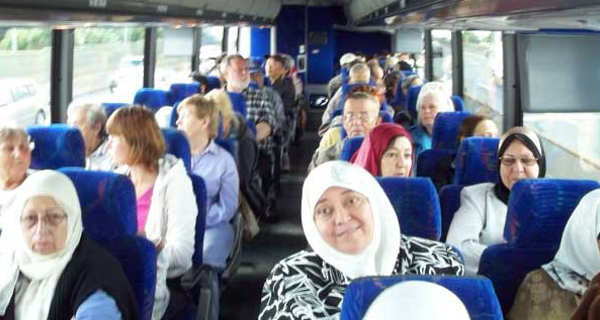
(Les services de transport et de traduction sont des éléments essentiels du programme des aînés multiculturels au CSC Pinecrest-Queensway. Photo avec la permission de Pinecrest-Queensway Community Health Centre)

Par Jason Rehel, auteur et éditeur du contenu, ACSO

Une nouvelle loi provinciale donne aux Réseaux locaux d’intégration des services de santé  (RLISS) de l’Ontario la consigne de réduire les disparités de santé en soutenant des programmes qui abordent directement les déterminants de la santé. Dans les prochains mois, nous vous présenterons des récits venus des lignes de front de notre système de santé illustrant les répercussions des programmes qui favorisent la santé et l’équité en santé quand ils sont intégrés à des soins de santé primaires complets.

Un foyer sécuritaire pour sa famille. Des débouchés pour ses enfants. Et l’occasion de contribuer au succès de sa nouvelle communauté. C’étaient les principaux objectifs de Samar Tabbara à son arrivée à Ottawa en provenance d’Oman (via le Liban, où elle est née) il y a 20 ans. Une enseignante élevant de jeunes enfants, Samar Tabbara se rappelle vivement les luttes de sa famille : apprendre à faire face à des problèmes de santé mentale, faire face à des doutes quant à leur décision d’émigrer et tâcher de tisser des liens tout en apprenant l’anglais.

« Il n’y avait pas autant d’informations données aux nouveaux arrivants, et nous n’avions aucune relation, précise Samar Tabbara. On pouvait facilement se sentir épuisé et seul. Je me rappelle que je prenais des comprimés pour la dépression. »

Pour de nombreux nouveaux immigrants, l’isolement social peut devenir une réalité prolongée, avec des effets cruels sur leur santé et leur bien-être général. Pour ceux qui arrivent au Canada à l’âge mûr, souvent pour vivre avec leurs enfants adultes, le risque d’isolement est aussi élevé.

« Les gens qui vivent seuls et qui ont peu de soutien social n’ont souvent personne sur qui compter en cas de problèmes de santé », explique Dre Laura Muldoon, médecin de famille au Centre de santé communautaire Somerset Ouest à Ottawa, qui lutte contre l’isolement social par plusieurs programmes ciblés. 

« Juste le stress de la solitude peut entraîner une aggravation de la maladie mentale et de la santé physique, aussi, ajoute-t-elle.  Je vois souvent des gens chez qui l’isolement a conduit à l’aggravation d’affections comme le diabète, l’hypertension artérielle et la MPOC. Parfois, les gens sont si craintifs de quitter leur maison qu’ils ne demandent même pas d’aide pour des problèmes de santé aussi graves qu’un cancer. »

Pour Samar Tabbara, faire du bénévolat – d’abord à l’école de ses enfants et dans son quartier, et finalement au Centre de santé communautaire (CSC) Pinecrest-Queensway – est un moyen de conserver des liens avec sa communauté et ses ressources, mais aussi d’aider les nouveaux arrivants qui se heurtent à des obstacles en raison de l’isolement social, comme cela lui est arrivé.

« Je fais du bénévolat pour savoir où je suis, confie cette grand-maman de 58 ans. Je sais à quel point l’isolement peut conduire à la dépression. Quand les gens sont frustrés et stressés, ils peuvent devenir exigeants envers eux-mêmes, envers leur famille et envers leur santé. J’aime enseigner aux gens comment utiliser le système. »

Vieillir en santé pour les aînés multiculturels

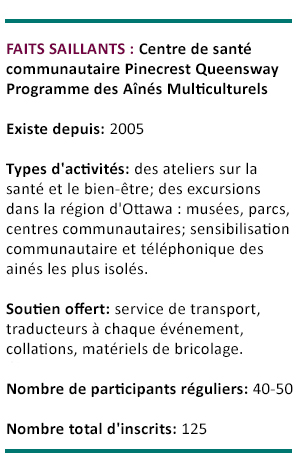
Au CSC Pinecrest-Queensway à Ottawa, Samar Tabbara travaille comme bénévole à la sensibilisation au programme « Vieillir en santé pour les aînés multiculturels ». Le programme comprend des séminaires de santé mensuels et des sorties de groupe régulières dans les musées et les parcs d’Ottawa. Des interprètes, de l’aide au transport public et un programme de sensibilisation par téléphone permettent de lutter contre l’isolement vécu par ces aînés (toute personne de 55 ans et plus) issus de l’immigration, y compris des réfugiés syriens, indépendamment des obstacles liés à la langue ou à la mobilité. 

Les participants sont aiguillés par les médecins de soins primaires au CSC Pinecrest-Queensway, et aussi grâce à des initiatives de sensibilisation du quartier. Pour sa part, Samar Tabbara est enthousiaste à propos de ses visites hebdomadaires (ou parfois plus fréquentes) à Saada, une musulmane de 80 ans vivant seule dans le centre-ville d’Ottawa, qui offre à Samar Tabbara la chance de partager ses propres expériences d’une manière significative.

« Parfois, elle me confond même avec sa fille, dit Samar Tabbara. Nous parlons en arabe, et elle me raconte des histoires. Elle me fait confiance, et je sais qu’elle me voit comme un membre de sa famille. »

L’appartenance et la communauté en tant que fondements de la santé et du bien-être

Pour les nouveaux arrivants en particulier, la possibilité de participer à des programmes qui améliorent la santé et le bien-être et qui promeuvent les relations sociales peut renforcer considérablement leur sentiment d’appartenance. Afin de surmonter les obstacles comme la maîtrise de la langue, la compréhension et la sécurité culturelle, et les expériences de racisme, des interprètes et des documents traduits comme des dépliants forment des éléments essentiels du programme multiculturel pour les aînés du CSC Pinecrest-Queensway. Et comme beaucoup d’aînés ne conduisent pas et ont des difficultés à circuler en transport en commun, encore une fois pour des raisons de langue, l’aide au transport est un autre facteur clé.

Or, le CSC Pinecrest-Queensway doit compter sur le financement accordé d’année en année par Centraide à Ottawa pour les éléments critiques que sont les traducteurs et le transport. Après 2018, lorsque le flux de financement actuel expirera, le programme des aînés multiculturels, qui a aidé des centaines de personnes âgées isolées pendant plus de 12 ans, pourrait disparaître. Avec un nouveau mandat du gouvernement pour soutenir la promotion de la santé au niveau local, les RLISS peuvent faire en sorte que le programme continue d’aider les nouveaux arrivants âgés pour les années à venir, estime Adrianna Tetley, directrice générale de l’Association des centres de santé de l’Ontario.

« Les soins de santé primaires complets ne concernent pas seulement l’accès aux médecins, aux infirmiers et aux tests de diagnostic pour aider les gens à récupérer quand ils sont malades, précise-t-elle. Les soins vraiment enveloppants visent à garder les gens en bonne santé dès le départ, en s’attaquant aux déterminants de la santé. Les programmes de promotion de la santé tels que les aînés multiculturels favorisent activement un sentiment d’appartenance à la communauté plus profond en faisant participer les gens directement aux programmes et services qui contribuent à leur bien-être. La prestation de soins primaires efficaces en combinaison avec des programmes de promotion de la santé pourrait changer la donne dans notre système de santé en portant la lutte contre les problèmes et les maladies chroniques beaucoup plus en amont que jamais auparavant en Ontario, tout en contribuant à réduire le fardeau qui pèse sur les autres parties du système de santé. »

(La possibilité pour les aînés nouveaux arrivants de participer à des séminaires de promotion de la santé portant sur le diabète et d’autres sujets est l’un des nombreux avantages qu’offre le programme, avec des aiguillages venant souvent des professionnels des soins primaires du centre.Photo avec la permission de Pinecrest-Queensway Community Health Centre)

BIRT recognized internationally for health data innovations in Ontario

Wednesday, March 22, 2017

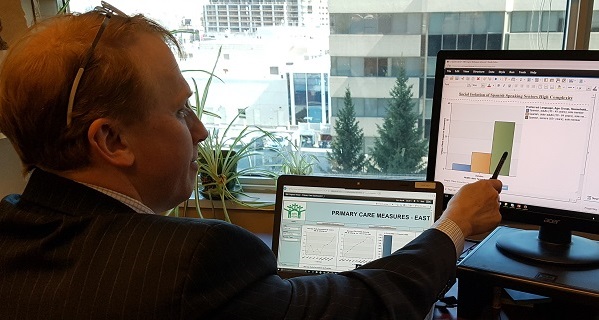
Mark Mycyk, BIRT Program Lead at AOHC, demonstrates some of the ways that the data analysis tool allows centres to drill down and better understand the people they serve, and the programs and services they need. Photo credit: Oleksandra Budna/AOHC

The Business Intelligence Reporting Tool (BIRT) -- developed by Community Health Centres and the Association of Ontario Health Centres to help inform quality improvement while measuring impacts of programs and services on people AOHC members serve -- has been internationally recognized by Healthcare Informatics, a leading publication in the Health IT sector based in the United States.

BIRT was shortlisted as a semifinalist for the Healthcare Informatics Innovator Awards Program and was the only Primary Care sector submission. BIRT was competing primarily against hospitals and health systems for the honour. In an article announcing the placement among top innovators in the field of analyzing health data, Healthcare Informatics said BIRT “gives member centres a holistic view of operations by consolidating key data and presenting it in an integrated and easy-to-analyze manner.”

“The vision was to produce a high-quality electronic dashboard that you could use to monitor in near real-time what any Community Health Centre was doing across the province,” Rodney Burns, CIO of AOHC, says in the article. Noting the importance of a strong data quality framework and high participation rates among AOHC members in the BIRT program, Burns says the level of analytics that the tool provides means that members can improve data quality, deliver better services, and measure outcomes and impacts more completely, and “in ways others cannot do.” In a nutshell, BIRT enables AOHC members to be at the forefront of quality improvement and health data analysis in Ontario, with a strong focus on the determinants of health and health equity initiatives.

Congratulations to the BIRT team, and to staff at the centre level. To read the full article outlining BIRT’s achievement, click here

Newcomer seniors get connected to health services, social life and each other through innovative Ottawa CHC program

Wednesday, March 22, 2017

(Transportation and translation services are vital parts of the multicultural seniors program at Pinecrest Queensway CHC. Photo credit: Pinecrest-Queensway Community Health Centre)

By Jason Rehel, story producer and editor, AOHC

New provincial legislation directs Ontario’s Local Health Integration Networks (LHINs) to reduce health disparities by supporting programs that directly address the determinants of health. In the months to come, we will bring you stories drawn from the front lines of our health system that show the impacts health promotion and health equity programs have when they’re embedded in Comprehensive Primary Health Care.

A safe home for her family. Opportunities for her children. And the chance to contribute to her new community. Those were Samar Tabbara’s main goals when she arrived in Ottawa from Oman (via Lebanon, where she was born) 20 years ago. A teacher raising a young family, Tabbara vividly recalls her family’s struggles: learning to cope with mental health issues, doubts about their decision to move, and trying to connect with others while still mastering English.

“There wasn’t as much information given to newcomers, and we were not connected,” Tabbara says. “You could feel burned out and alone. I remember I used to take depression pills."

For many new immigrants, social isolation can become a prolonged reality, with stark effects on their health and overall wellbeing. For new immigrants who come to Canada as seniors, often to live with adult children, the risk of becoming isolated is also high.

“People who live alone and have few social supports often don’t have anyone they can trust if problems arise with their health,” says Dr. Laura Muldoon, a family physician at Somerset West Community Health Centre in Ottawa, which addresses social isolation through a number of targeted programs.

“Just the stress of being alone can lead to worsening of mental illness and physical health, too,” Muldoon adds. “I often see people whose isolation has led to worsening of conditions like diabetes, high blood pressure and COPD. Sometimes people are very anxious about leaving their home, and may not even seek help for very serious conditions such as cancer.”

For Tabbara, volunteering -- first at her kids’ schools and in her neighbourhood, and eventually at Pinecrest-Queensway Community Health Centre (CHC) – is way to stay connected to her community and its resources, but also to help newcomers who face barriers due to social isolation in the same ways she did.

“I volunteer to know where I am,” the 58-year-old grandmother says. “I know how isolation can lead to depression. When people become frustrated and stressed, they can become hard on themselves, on their families, on their health. So I like to teach people how to use the system.”

Healthy Aging for Multicultural Seniors

At Pinecrest-Queensway CHC in Ottawa, Tabbara works as an outreach volunteer for the “Healthy Aging for Multicultural Seniors” program. The program features monthly health seminars and regular group outings to museums and parks in Ottawa. Translators, public transportation assistance and a phone outreach program make it possible to combat isolation experienced by these seniors (anyone 55 and over) from newcomer backgrounds, including Syrian refugees, regardless of language or mobility barriers.

Participants are referred through Primary Care physicians at Pinecrest-Queensway CHC, and also through neighbourhood outreach initiatives. For her part, Tabbara enthuses about the weekly (or sometimes more often) calls she makes to Saada, an 80-year-old Muslim woman living on her own in downtown Ottawa, which offer Tabbara the chance to share her own experiences in a meaningful way.

“Sometimes she even confuses me with her daughter,” Tabbara says. “We speak in Arabic, and she tells me stories. She trusts me, and I know I am like family to her.”

Belonging and Community as Foundations of Health & Wellbeing

For newcomers especially, the chance to participate in programs that benefit health and wellbeing and promote social connections can be a big boost to their sense of belonging. In order to bridge barriers such as language ability, cultural understanding and safety, and experiences of racism, translators and translated materials such as brochures are vital parts of Pinecrest-Queensway CHC’s Multicultural Seniors program. And because many of the seniors don’t drive and have difficulty navigating transit, again due to language reasons, providing transportation assistance is another key enabler.

But Pinecrest-Queensway CHC must rely on year-to-year funding from United Way in Ottawa for the critical elements of translators and transportation. After 2018, when the current stream of funding expires, the Multicultural Seniors program, that’s helped hundreds of isolated seniors over 12 years, could disappear. With a new mandate from the government to support health promotion at the local level, LHINs can ensure the program continues to help newcomer seniors for years to come, says Adrianna Tetley, CEO of the Association of Ontario Health Centres.

“Comprehensive Primary Health Care isn’t just about access to doctors, nurses and diagnostic tests to help people recover when they’re sick,” says Tetley. “Truly wraparound care aims to keep people well to begin with by addressing the determinants of health. Health promotion programs such as Multicultural Seniors actively promote a deeper sense of belonging in the community by involving people directly in the programs and services that contribute to their wellbeing. Delivering effective primary care in combination with health promotion programs could be a game-changer for our health system by taking the battle against chronic illness and disease far further upstream than we’ve ever seen in Ontario before, and helping to reduce the burden on other parts of the health system at the same time.”

(The opportunity for newcomer seniors to take part in health promotion seminars on diabetes and other topics is one of the many benefits the program offers, with referrals often coming through the centre’s Primary Care providers. Photo credit: Pinecrest-Queensway Community Health Centre)

Spotlight on Health Equity: Black Creek CHC engages with community to build better programs and combat anti-Black racism

Wednesday, March 1, 2017

Photo credit: Kofi Frempong/Black Creek CHC

By Jason Rehel, story producer and editor, AOHC

Kofi Frempong is a Community Health Worker at Black Creek Community Health Centre (CHC) in Toronto’s Jane and Finch neighbourhood. Frempong creates programs, like Freedom Fridayz and Dads Doing Hair, that aim to break down barriers for people who face anti-Black racism. Like all AOHC members, Black Creek’s staff are guided in their work by the Health Equity Charter, which helps them achieve results for people facing barriers to health and wellbeing. In light of the new provincial legislation that directs Local Health Integration Networks (LHINs) to reduce health disparities and combat all forms of systemic racism and discrimination, we asked Frempong about the programs he designs, how he engages with and finds inspiration in the community, and the role of Black History Month in combatting racism.

Kofi, you’re an artist and someone who takes pride in nurturing creative spaces. How does art and its capacity to bring people together underpin your work at Black Creek CHC?

It just fits with the model of care that Black Creek promotes. When it comes to promoting access to all people in the community, I think that creating positive spaces is definitely a key part of that. But it’s also just being sure that we address the issues people face; that’s how we break down barriers.

Can you speak to some of the things you do at Black Creek CHC to engage the community and identify people’s needs?

I know it’s very popular to have town hall meetings and formal focus groups, but I think our job becomes a whole lot easier when the relationships are already there. What I mean by that is, the better your relationships are with the community, the more access you’ll have to information around their needs, interests and what kinds of things will engage them.

Because then people will come to you?

Exactly. It really starts when they walk in the door of the centre, and then encounter certain staff, and how they’re received. Black Creek CHC isn’t a cold machine; it’s a warm environment where someone will take a few extra minutes to see how your day is going, and hear your story while you’re waiting to see a doctor.

When it comes to engaging with youth in your community, what’s been your strategy?

The biggest thing is building up confidence in youth because it’s easier to help people when they are empowered to help themselves. So that’s about education on the one hand, but it’s also about creating opportunities to take leadership roles, opportunities to improve their own quality of life. I think a big piece of this is that we aim to meet people where they are.

Can you give us an example of how you plan programs to meet people where they are?

It’s about designing different platforms for people to share their experience, but then allowing them to evolve according to people’s needs. For example, at one point, we had a BBM (BlackBerry Messenger) youth group. People would post their assignments and they would ask the staff or other students for assistance with their work. The magic thing is that the group transitioned from being just about homework to being about life in general. People disclosed mental health challenges they were dealing with, self-esteem issues and were able to talk about racism and its effects on them. The conversation got really deep with this group, and things that normally wouldn’t come out during a youth program – no matter how great the program is – were able to come out through BBM.

Black History Month just came to a close and plays an important role in building community. How can we all work to ensure Black History Month messages of strength and empowerment resonate throughout the year?

It’s good that there’s a month dedicated to Black history. But it also sends the message that it’s only a small part of history, when the truth is that throughout history, Black people have contributed in every sector, in many different ways. So it’s about asking, “What’s going on in your community that’s impactful? Or in the city you live? In the country as a whole? Around the world?”

The truth is that Black history is a part of everything that we study, it just seems like a lot of it is erased or not mentioned. Addressing that would do a lot in terms of representation and creating positive images and role models.

Can you describe one of your newest programs, Dads Doing Hair?

It’s interesting how Dads Doing Hair got started. I was on Facebook, and I just posed a question: “Are there any programs out there that teach Black dads how to do their kids’ hair?” And I got a HUGE response, both from other fathers who were interested in learning, as well as from people who were interested in teaching.

The power of social media!

I’m telling you! So then I took the idea back to Cheryl Prescod, our Executive Director, and told her there was a huge response. And she moved on the idea right away. The sessions are held directly at the centre.

How was the response to the first session?

It went well. First, a lot of fathers came out. Second, because we were open on a Saturday, it created a beautiful environment. A lot of people who were just doing their shopping and had lived in the community for years were saying things like, “Wow, I didn’t know you guys existed.” So not only were people out learning about how to do hair, they were also learning about the services that Black Creek CHC provides. I thought that was really amazing.

And enjoying the great vibe, too.

Exactly. And that for me was the most important thing. Leaving aside the hair care stuff for a minute, it’s the fact that people could walk into the centre and feel free enough to ask questions and get excited about discovering Black Creek.

Staff from Black Creek CHC will present a workshop on building health equity programs such as Freedom Fridayz at this year’s Shift the Conversation: Community Health and Wellbeing conference, June 7 and 8 in Richmond Hill, ON. Here’s a rundown of all the learning sessions happening at the conference.

Résolutions de la nouvelle année pour le ministre Hoskins

Tuesday, January 10, 2017

par Adrianna Tetley, chef de la direction de l’Association des centres de santé de l’Ontario

Bonne et heureuse année, Monsieur le Ministre Hoskins! Nous vous souhaitons également une bonne santé. En fait, prenons la résolution de faire de cette année celle où tous les Ontariens n’auront jamais été en si bonne santé. Afin de vous aider à cibler vos efforts, nous nous sommes permis de préparer neuf résolutions afin que vous passiez à l’action en cette nouvelle année 2017.

1. Prenez des mesures concrètes pour assurer l’équité en santéMonsieur le Ministre, en 2017, contrôlez l’application des nouvelles directives que vous avez adressées aux réseaux locaux d’intégration des services de santé (RLISS) en vertu de la nouvelle Loi donnant la priorité aux patients afin de réduire les inégalités en matière de santé et de combattre toutes les formes de racisme et de discrimination systémiques, dont le racisme anti-Autochtones, le racisme anti-Noirs, l’islamophobie, l’homophobie/la transphobie et la discrimination fondée sur la capacité physique. Pour commencer, les RLISS doivent collecter des données socio-économiques afin de planifier des services axés sur les besoins de la population en tenant compte des exigences en matière d’équité. Les RLISS devront également travailler avec tous les secteurs des soins de santé et avec tous les ministères compétents pour s’assurer que les populations confrontées à des obstacles à la santé bénéficient de meilleurs services et pour combler les lacunes de l’accès aux soins de santé. La prise de décisions fondées sur des données probantes n’est qu’une des nombreuses méthodes employées par les centres membres de notre organisme pour s’assurer que les personnes confrontées à des obstacles à la santé reçoivent les services dont elles ont besoin (voici quelques exemples de mesures prises à cette fin). Cette approche rigoureuse de la prestation des services de santé doit être appliquée de façon beaucoup plus systématique dans toute la province.

2. Opérez la réconciliation dans le domaine de la santé des AutochtonesMonsieur le Ministre, comme vous le savez, tous les Autochtones, y compris ceux qui vivent en milieu urbain, en milieu rural et dans les régions éloignées, et indépendamment de leur « statut », ont droit à des soins de santé respectueux des valeurs culturelles et intégrés, comme le stipule la Politique de santé applicable aux Autochtones (1994) en vigueur. Les centres d’accès aux services de santé pour les Autochtones (CASSA) et les centres autochtones de santé communautaire (CASC) font véritablement partie de la solution dans ce domaine. Allouez une partie équitable des 222 millions de dollars du Plan d’action pour la santé des Premières Nations à tous les soins de santé des Autochtones, y compris au financement de base et au financement des programmes des CASSA et des CASC. Permettez aux CASSA et aux CASC de siéger officiellement aux RLISS et aux tables de concertation technique bilatérales et trilatérales. Et mettons véritablement en œuvre la réconciliation.

3. Adressez des directives claires aux RLISS afin qu’ils se conforment aux exigences de la Loi sur les services en français (LSF)Merci d’avoir donné aux RLISS des instructions afin qu’ils mettent en œuvre la LSF dans la planification, la conception, la prestation et l’évaluation des services. Afin de vous assurer que les RLISS se conforment à ces exigences, en 2017, veuillez formuler celles-ci avec clarté et précision dans leurs ententes de responsabilisation et de rendement. De plus, nous vous demandons de vous assurer que la personne ou l’entité qui offre des services soit assujettie à la LSF, y compris au Règlement 284/11 (Prestation de services en français pour le compte d’organismes gouvernementaux).

4. Prévenir davantage pour traiter moins Votre nouvelle loi, la Loi donnant la priorité aux patients, exige que les RLISS travaillent avec les organismes qui dispensent des soins primaires afin d’élaborer et de mettre en œuvre des stratégies de promotion de la santé. Afin d’optimiser cette approche, assurez-vous que les RLISS priorisent le type de stratégies qui promeuvent la santé générale de la communauté en s’attaquant aux déterminants de la santé. Examinez l’action du Maillon santé de la communauté de Simcoe-Nord-Muskoka qui, en une année, en ciblant délibérément les déterminants sociaux de la santé, a réduit les coûteuses visites aux urgences et hospitalisations de plus d’un tiers.

5. Soutenez sans réserve et renforcez les équipes interprofessionnelles de soins primairesLa recherche démontre que ce sont les équipes interprofessionnelles de soins primaires qui obtiennent les meilleurs résultats en matière de santé. En revanche, elles sont sous-financées et confrontées à des difficultés pour recruter et conserver leurs fournisseurs de soins de santé clés. L’année dernière, vous avez augmenté le financement de base de 31,1 millions de dollars. Bien que cette hausse soit la bienvenue, ce n’est qu’un acompte pour répondre à tous les besoins. À partir de 2017, investissez annuellement 130 millions de plus afin d’offrir aux équipes interprofessionnelles les taux de 2012 recommandés par le Hay Group et de réduire l’écart avec les hôpitaux, les centres d’accès aux soins communautaires (CASC) et le secteur de la santé publique.

6. Intégrez des coordonnateurs des soins aux soins primairesLa coordination des soins pour chaque patient sans exception est une fonction fondamentale des soins primaires. Cette année, nous vous demandons d’intégrer des coordonnateurs de soins des CASC aux milieux de soins de santé primaire. Pendant cette phase de transition, gardez présent à l’esprit que les coordonnateurs de soins et les guides du patient qui travaillent dans et avec les communautés autochtones doivent être placés sous la responsabilité d’organismes de soins primaires gérés par les Autochtones afin de garantir l’adaptation des soins aux valeurs culturelles et leur adéquation. Nos centres membres, dont les CASSA et les CASC, sont prêts à travailler avec vous pour faciliter cette transition.

7. Élargissez l’accès aux équipes interprofessionnelles de soins primairesLes Ontariens ne sont que 25 pour cent à avoir accès aux équipes interprofessionnelles de soins de santé. Les centres de santé communautaires de toute la province dirigent déjà une initiative sans précédent qui s’appelle « People in Need of Teams » (PINOT). Celle-ci met en relation 370 médecins de soins primaires et plus de 4 500 personnes auxquelles ils offrent leurs services avec 17 centres de santé communautaires ayant plusieurs décennies d’expérience approfondie des services aux personnes ayant des besoins complexes. Afin de généraliser l’accès aux équipes interprofessionnelles, financez les initiatives qui mettent les médecins qui ne travaillent pas en équipe en relation avec les organismes en mesure de soigner les personnes aux besoins complexes. Si PINOT était mis en œuvre systématiquement dans la province, cette initiative pourrait modifier radicalement notre système de santé.

8. Élargissez l’accès aux soins de santé bucco-dentaireVous avez promis d’étendre les programmes de santé bucco-dentaire publics aux adultes à faible revenu d’ici à 2025. Mais, Monsieur le Ministre, les personnes qui souffrent ne peuvent pas attendre si longtemps. Toutes les neuf minutes en Ontario, une personne se rend à un service d’urgence parce qu’elle n’a pas les moyens de consulter un dentiste pour traiter sa douleur dentaire. Mettez fin à cette souffrance et à ces coûts inutiles dès maintenant : investissez dix millions de dollars pour que les CSC et les CASSA puissent offrir des soins de santé bucco-dentaire à un plus grand nombre de personnes en ayant besoin.

9. Concrétisez votre engagement de soutenir les sites d’injection supervisée Votre déclaration de cette semaine, dans laquelle vous avez réitéré votre soutien de la proposition de sites d’injection supervisée (SIS) à Toronto et confirmé votre soutien financier en vue de les créer, nous a profondément satisfaits. Quel merveilleux début d’année! Nous attendons avec impatience le cadre de référence provincial que vous avez promis de publier dans quelques semaines afin de donner suite aux propositions actuelles et futures d’ouverture de SIS. De plus, finançons dès que possible les services d’injection supervisée de Toronto et d’Ottawa pour les rendre opérationnels afin qu’ils puissent prévenir des décès évitables.

Monsieur le Ministre, comme il ne vous reste plus que deux ans avant la fin de votre mandat gouvernemental, il importe de mettre en œuvre ces résolutions sans tarder. Êtes-vous prêt à relever ce défi? Les membres de l’ASCO sont prêts à retrousser leurs manches. Nous sommes certains que nous pourrons créer ensemble un système de santé favorable à la meilleure santé et au meilleur bien-être possible pour tous les Ontariens.

New Year’s Resolutions for Minister Hoskins

Tuesday, January 10, 2017

by Adrianna Tetley, Chief Executive Officer of the Association of Ontario Health Centres

Happy New Year, Minister Hoskins! We hope it will be a healthy one, too. In fact, let’s resolve to make it the healthiest year yet for everyone living in Ontario. To help focus your efforts, we have taken the liberty of preparing nine New Year’s resolutions for you to take action on during 2017.

1. Get serious about health equityMinister, in 2017, follow up on your new Patients First legislation’s direction to the Local Health Integration Networks (LHINs) to reduce health disparities and combat all forms of systemic racism and discrimination, including anti-Indigenous racism, anti-black racism, Islamophobia, homophobia/transphobia and ableism. For starters, LHINs need to collect socio-demographic data to guide equity-informed population needs-based planning. It also means LHINs need to work across areas of the health sector and government ministries alike to ensure populations facing barriers to good health are better served and gaps to accessing care are closed. Evidence-informed decision-making is one of the many ways our member centres make sure people who face barriers to health get the services they need (here are some examples in action). This rigorous approach to health service delivery must be applied much more consistently across the province.

2. Follow through on Indigenous health reconciliationMinister, as you know, all Indigenous people, including those in urban, rural and remote areas, and regardless of “status”, have a right to culturally safe and integrated care, as outlined in the existing Aboriginal Health Policy (1994).  Aboriginal Health Access Centres (AHACs) and Aboriginal Community Health Centres (ACHCs) are part of the solution to ensuring this happens. Put a fair share of the $222 million First Nations Action Plan into supporting all Indigenous health care, including allocations for AHACs’ and ACHCs’ core and program funding. Give AHACs and ACHCs a formal seat at LHIN, bilateral and trilateral technical tables. And let’s see true reconciliation in action.

3. Provide clear direction to the LHINs to implement the requirements of the French Language Services (FLS) ActMerci for instructing the LHINs to implement the FLS Act in the planning, design, delivery and evaluation of services. To make sure LHINs fulfill these requirements, in 2017, please provide clear and precise language in their accountability and performance agreements. In addition, we call on you to ensure that the person or entity that provides services will be subject to the FLS Act, including Regulation 284/11 (Provision of French Language Services on behalf of Government Agencies).

4. Prevent more to treat less Your new Patients First legislation instructs LHINs to work with primary health care organizations to develop and implement health promotion strategies. To maximize the potential of this approach, make sure LHINs prioritize the type of strategies that promote the overall health of the community and address the determinants of health. Check out what’s happening in the North Simcoe Muskoka Health Link, where, in one year, a strong focus on social determinants of health reduced expensive emergency department visits and hospitalizations by more than a third.

5. Fully support and strengthen interprofessional primary care teamsResearch shows interprofessional primary care teams deliver the best health outcomes. However, they are underfunded and face challenges recruiting and retaining key health providers. Last year, you allocated a $31.1 million base funding increase. While appreciated, this is only a down payment towards what is needed. In 2017, invest the additional $130 million annually to get interprofessional teams to the 2012 rates recommended by the Hay Group, and narrow the gap with hospitals, Community Care Access Centres (CCACs) and public health.

6. Embed care coordinators in primary careCare coordination for each and every patient is a fundamental function of primary care. This year, we call on you to embed CCAC care coordinators within primary care settings. As these transitions roll out, keep in mind that care coordinators and system navigators working in and with Indigenous communities must be managed by Indigenous governed primary health care agencies to ensure culturally safe and appropriate care. Our member centres, including AHACs and ACHCs, are ready to work with you to support this transition.

7. Expand access to interprofessional primary care teamsOnly 25 per cent of people in Ontario have access to interprofessional primary care teams. Across the province, Community Health Centres already lead a ground-breaking initiative called “People in Need of Teams” (PINOT). It connects 370 primary care physicians and more than 4,500 of the people they serve, with 17 Community Health Centres who have decades’ worth of in-depth of experience serving people with complex needs. To make access to interprofessional teams more widely available, fund initiatives that connect physicians not working within teams to primary care organizations equipped to care for people with complex needs. If PINOT were scaled up across the province, this approach could be a game-changer for our health system. 8. Expand access to oral health care You’ve promised to extend public dental programs to adults living on low incomes by 2025. But, Minister, people in pain can’t wait that long. Every nine minutes someone in Ontario visits an emergency department because they can’t afford a dentist to treat their dental pain. End this suffering and needless cost now: invest $10 million so that CHCs and AHACs can serve more people in need of dental care.

9. Follow up on your commitment to support supervised injection services We were pleased to see this week’s statement reiterating your support for Toronto’s supervised injection services (SIS) proposal and confirming your commitment to provide financial support. What a great way to start the year! We look forward to the provincial framework for responding to current and future SIS proposals, which you promised to release in the next few weeks. And let’s see funds for supervised injection services in Toronto and Ottawa flowing as soon as possible to ensure the services are up and running to help prevent avoidable deaths.

Minister, you have just two years left in your government’s mandate, so it’s important to move quickly on these resolutions. Are you up for the challenge? AOHC members are ready to roll up our sleeves. Together, we’re certain we can create a health system that supports the best possible health and wellbeing for everyone living in Ontario.