Video | Transformative Change Awards 2017: South Riverdale CHC, Sandy Hill CHC, and Parkdale Queen West CHC share honours for Supervised Injection Services
Wednesday, June 14, 2017

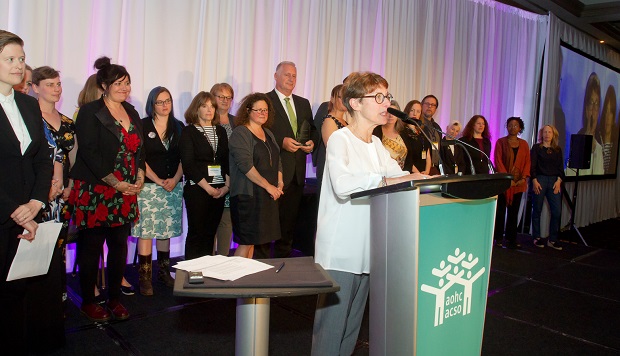
Lynne Raskin, CEO of South Riverdale Community Health Centre, speaks after accepting a Transformative Change Award for the centre's role in achieving government approval for Supervised Injection Services.

The Transformative Change Award recognizes leaders, innovators, collaborators and health champions who have been working at the forefront of transformative change helping us achieve our vision of the best possible health and wellbeing for everyone living in Ontario. On June 7, Parkdale Queen West Community Health Centre, Sandy Hill Community Health Centre, and South Riverdale Community Health Centre were recognized for their work in expanding harm reduction programs to included Supervised Injection Services.

For the past five years, Parkdale Queen West CHC, Sandy Hill CHC and South Riverdale CHC have worked to expand their longstanding harm reduction programs by adding Supervised Injection Services (SIS). Their years of hard work included collecting and presenting evidence, building partnerships, engaging communities, developing policies, preparing submissions to both the federal and provincial governments, and working with the media. Now, all three CHCs are on the cusp of getting (or have just received) government approval and funding to set up the first SIS in Ontario.

These services will undeniably save lives and help reduce risk factors that lead to infectious diseases. The fact that SIS will be located in Community Health Centres means more people who use injection drugs will have access to other much needed health and social supports. The impact of the work done by these three CHCs is already significant. Their efforts have helped shift the conversation around substance use and mental health, and enhanced the engagement in many communities towards transforming the landscape of harm reduction, drug policy and evidence-based practices.

Related Links

Reduction in overdose mortality after the opening of North America’s first medically supervised safer injecting facility: A retrospective population-based study

Ontario Health Centres Vote to Unanimously Support the Development of Supervised Injection Services in the Province

AOHC’s statement on changes to Ontario labour laws

Date: 
Tuesday, July 18, 2017

On May 30th Premier Wynne announced a number of changes to Ontario labour laws which aim to better protect part time and contract workers. These changes will be part of new draft legislation,The Fair Workplaces, Better Jobs Act, which will be introduced in the Fall. The legislation responds to the recommendations of the Changing Workplaces Review report which held consultations with stakeholders over the past two years. AOHC provided input to the consultations and has actively supported the ‘$15 and Fairness campaign’ and the Decent Work and Health Network in calling for 7 paid sick days and other specific changes to labour legislation.

AOHC welcomes the announced changes which will increase income for low wage workers, improve working conditions and support better health outcomes for precarious workers in Ontario. We applaud the government’s decision to raise the minimum wage to $15/hour by 2019 and to mandate equal pay for part time and temporary workers. Our members see firsthand the impact of poverty on health so we know that greater income security will improve the health and wellbeing of the people they serve in communities across Ontario.

AOHC is disappointed that the government chose not to ensure a minimum of 7 paid sick days for all employees. The decision to legislate a minimum of 2 paid sick days as part of 10 days of personal emergency leave for all workers is a step forward. We are pleased that there will be no requirement of a sick note when people take personal emergency leave as this was not a good use of health service providers’ time. As the legislation moves into committee discussion we will continue to call for a minimum of 7 paid sick days for all employees.

AOHC's Submission to the Standing Committee on Finance and Economic Affairs regarding Bill 148, Fair Workplaces, Better Jobs Act

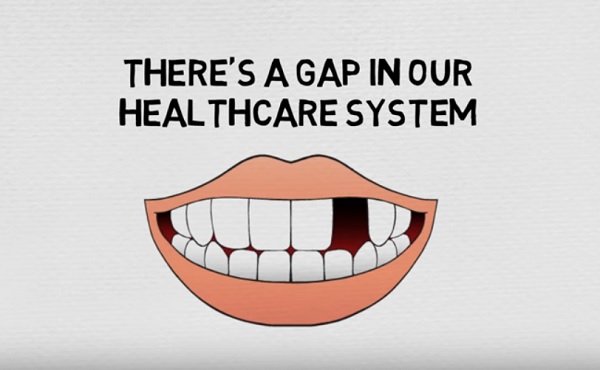
Video: Let's close the gap on oral health care in Ontario

Wednesday, May 24, 2017

Most people in Ontario have dental services covered through a private insurance program. But an estimated two to three million people in our province don’t visit a dentist because they don’t have insurance and can’t afford the cost to see one.

To help people spread the word on social media about this gap in our healthcare system, the Ontario Oral Health Alliance produced a whiteboard video (below) that spotlights the connection between chronic disease and poor oral health care, as well as the social effects of not having access to dental care. 

The video also gives a good overview of the limited public oral health programs in the province (coverage for low income children 17 and under, and a patchwork of services for those on social assistance). And it also explains that those people who slip through the cracks often end up in emergency departments at hospitals, or at a doctor's office, neither of which is equipped to offer treatment for dental problems, costing Ontario's health system millions of dollars every year for ineffective care.

While the video is a great overview to introduce someone to the topic and the efforts to advocate for public oral health programs in Ontario for low-income adults and seniors, if you want to delve much deeper into the issue and its background materials, don't miss our complete oral health resource section.

The video was produced for the Ontario Oral Health Alliance by the Haliburton, Kawartha, Pine Ridge District Health Unit.

Spotlight on Health Equity: Improving cancer screening rates by focusing on the social determinants of health

Monday, May 15, 2017

Bramalea CHC utilized an innovative youth poster competition to help raise the level of cancer awareness and screening education among the families it serves.

By Jason Rehel, story producer and editor, AOHC

Cancer screening rates in Ontario aren’t as high as they should be, and nowhere near provincial benchmarks. Health Quality Ontario (HQO) suggested as much in its April 2016 report, “Income and Health”. The report linked low income levels to lower rates of colorectal, breast, and cervical cancer screening, and included some startling statistics about disparities:

• Just over half (54.3%) of women living in the poorest urban neighbourhoods have had cervical cancer screening in the last three years, compared with two-thirds (66.7%) of women living in the wealthiest urban neighbourhoods.

• Nearly half (49.7%) of people living in the poorest urban neighbourhoods are overdue for colorectal cancer screening, compared with just over one-third (34.9%) of people living in the wealthiest urban neighbourhoods.

Being a newcomer to Canada can also mean you’re much less likely to receive preventive screening. For cervical cancer, Cancer Care Ontario (CCO) notes that “women with low income and education, who are older, who speak a foreign language or who are not Canadian-born are less likely to be screened.” In fact, CCO points out that “newcomers and immigrants often experience challenges [just] finding information about cancer screening.”

The provincial government tried using financial incentives for physicians to boost cancer screening rates in Ontario. But those efforts have mainly failed, owing to what Canadian health policy analyst Steven Lewis says is an over-emphasis on “extrinsic motivations” (money) and not enough attention to “intrinsic motivations” (the desire to do a good job, help people). Examining “the more durable and powerful” intrinsic motivations of both providers and patients, Lewis argues, is what allows us to get to the root causes of low screening rates, and thereby know what we might do to help nudge people towards getting screened.

“Appropriate screening should be baked into the performance expectations of organizations and individuals, and no extra pay or funding should be required,” Lewis says.

Without using financial incentives, and with doctors who are paid using a salary model, Ontario’s Community Health Centres are seizing opportunities to increase screening rates with a robust health equity approach that is “baked into performance expectations.” In the process, they’re achieving higher cancer screening rates than provincial averages. To better understand some of the ways that Ontario’s 74 Community Health Centres break down barriers that keep people from getting screened for cancer, here are six case studies from across the province:

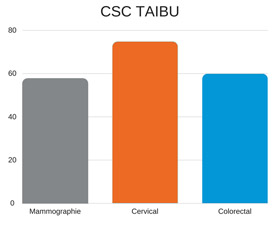
TAIBU CHC: TRANSFORMING CANCER SCREENING THROUGH AN EQUITY LENS

Located in Scarborough, TAIBU Community Health Centre recognizes the prevalence of anti-black racism, including its impact on how the community they serve accesses services. “We plan and develop programs and services with a specialized focus on how we can address the needs and barriers faced by this community,” says Liben Gebremikael, Executive Director of TAIBU CHC.

What that means:

  • TAIBU’s staff start by understanding and then responding to cultural factors that affect screening rates: For example, its call-back program ensures providers do not call Muslim clients during Ramadan. 
  • Town halls deepen understanding of factors affecting screening, and awareness programs highlight that the black population served by the centre is disproportionately affected by cancer.

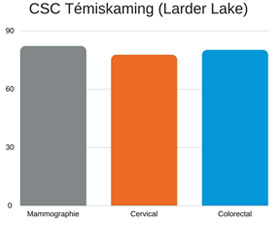
CSC TÉMISKAMING: SUSTAINING A CULTURE OF QUALITY IMPROVEMENT

“Examining things on a quarterly basis wasn’t good enough for us. So day-to-day attention to screening is now part of every encounter, even prescription renewals,” says Roxanne Rodgers, a Registered Nurse at the Larder Lake location of Centre de santé communautaire Témiskaming in northeastern Ontario. “Our [Electronic Medical Records] EMR dashboard is simplified so that all the indicators are in one spot, so that we can quickly see when a person is due for screening. Then we can prepare and offer a requisition right on the spot.”

What that means:

  •  Using an in-house designed dashboard tool, clinicians at the centre’s five sites can compare how others are doing, which helps to foster healthy competition and collaboration.
  • A volunteer driving initiative gets people without transportation to appointments, a key factor for a centre that serves mainly a rural and semi-rural population.

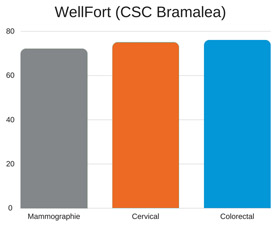
WELLFORT COMMUNITY HEALTH SERVICES: A UNIQUE AWARENESS APPROACH

“At WellFort, we continue to achieve our cancer prevention goals by living our values of being responsive to our community needs, and striving to be creative leaders on health equity in Peel,” says Mayo Hawco, Executive Director of WellFort.

What that means:

  • Clients have access to cancer screening education and awareness materials in languages they’re comfortable with, and delivered in a culturally-appropriate manner. For example, youth from the community were involved in a cancer awareness poster competition to broaden the reach of prevention messages and help tailor them to the community.
  • BIRT (an internationally recognized data analytics tool developed by AOHC and its members) is used to coordinate client appointments to take advantage of prevention opportunities for those due for screening.

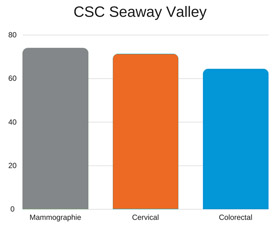
SEAWAY VALLEY CHC: FROM EDUCATION TO PREVENTION

“People in the area we serve need a high level of education and support on how important cancer screening is to an overall prevention approach. Once people are educated, they become active partners in their own health,” says Debbie St. John-de Wit. “So our investment in education and explaining the ‘why’ of screening serves a purpose for years ahead.”

What that means:

  • Nurses lead the way to ensure prevention awareness is part of every encounter. Education is tailored to priority populations, such as seniors and the LGBTQ+ community, to ensure the right approach for people facing health equity barriers. 
  • Clinical and data management staff have taken steps to ensure staff utilize the Electronic Medical Records (EMR) in consistent ways, to ensure quarterly reports on cancer screening are as accurate as possible for nurses, who then can take a systematic approach to outreach.

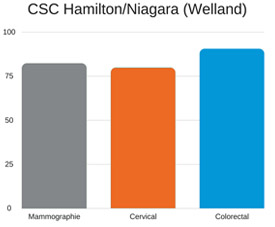
CSC HAMILTON/NIAGARA: FOSTERING RELATIONSHIPS THAT PROMOTE PREVENTION

“Relationships – both between the clients and their family members and their physician, and between interprofessional team members themselves – are at the core of how we keep our cancer screening rates high,” says Marcel Castonguay, Executive Director of the Centre de santé communautaire Hamilton/Niagara.

What that means:

  • French-speaking physicians develop strong relationships with the Francophone population they serve, partly by ensuring annual exams serve as important points for education of clients and their families, many of whom are also caregivers. 
  • Clinical and non-clinical team members collaboratively address barriers that clients face, through informal huddles and case conferencing where necessary to ensure no social determinant is left untouched if someone isn’t getting preventive care.

Of course, the examples above are only part of the story of how AOHC members are working to boost their cancer screening rates. Next month, at AOHC's annual Shift the Conversation Conference, the West End Quality Improvement (WEQI) collective, a group of seven GTA CHCs working collaboratively on cancer screening rates, will present the results of their initiative, and the process and tools that got them there. The session (C7) takes place at 3:30 p.m. on June 7. For details of that session and others, click here.

Basic Income Guarantee: Can it be a sustainable solution to poverty? Stay tuned as Ontario's pilot rolls out

Monday, May 15, 2017

Will the numbers from Ontario's Basic Income pilot add up to people being able to lift themselves out of poverty? 

By Erin Walters, Health Promoter and Educator at Quest CHC, St. Catharines

Across Ontario’s political spectrum, support is growing for a Basic Income Guarantee. The idea isn’t a new one: “Mincome” has roots in the policies of the Manitoba NDP in the 1970s. Now, the concept has backing from a former Canadian senator, a former Canadian bank CEO, the World Economic Forum, and now the Ontario government, which is launching a pilot project in three communities across the province.

The reasons for the growing support are many.

For each of the current provincial and federal income support programs available to Ontarians, conditions are attached, which means that many people fall through the cracks. For those who do qualify for social assistance, the amount of financial support provided makes it hard to live a dignified life. As one of many Health Promoters working in Community Health Centres across Ontario, I witness first-hand the negative effects of these challenges on people’s overall health and wellbeing.

An Ontario Works recipient receives $706 per month, which often isn’t nearly enough to cover basic needs such as housing, food, clothing, medications, and transportation. People are forced to make choices about whether to pay the electricity bill or buy a bus pass, or to buy nutritious food or allow their child to attend a class fieldtrip. These are heartbreaking decisions that limit a person’s ability to fully participate in life, and ultimately harm their chances of leaving poverty – and its ill effects on health -- behind.

With a volatile labour market that has seen a rise in precarious employment and job losses due to automation, more people than ever are struggling to attain income security. That’s why now is the time for changes to Ontario’s social assistance system. Can a Basic Income Guarantee be part of the solution?

Basic Income Pilot

Radically re-thinking the way in which social assistance is delivered to the people who need it could be an effective way not only to address shortcomings of the current system, but also might be a way to reduce stigma related to income assistance, encouraging more participation in the labour market and community life overall.

That brings us to Ontario’s Basic Income pilot project.

The pilot project will replace the current Ontario Works (OW) program and Ontario Disability Support Program (ODSP) with one that: provides an adequate amount of income every month to ensure all basic needs are covered; requires less monitoring as money is provided without conditions; and distributes income support automatically without a difficult application process. This income support, which is delivered through a negative income tax model, would be available to individuals whose income falls below a certain threshold, whether or not they are currently receiving OW or ODSP.

On April 24, the provincial government released additional information regarding the design of the pilot project based on feedback from 35,000 people. The pilot will randomly invite individuals 18-64 years of age living on a low income from Hamilton, Brantford, Brant County; Thunder Bay and the surrounding area; and Lindsay to participate in the pilot.

Participants will receive up to $16,989 per year for a single person, or $24,027 per year for a couple. People with a disability will receive an additional $6,000 per year. Importantly, people on social assistance who are chosen to participate won’t lose their drug and dental benefits.

Policy Discussions and Concerns

Policy circles have been abuzz since the pilot was first announced in 2016. Countless social policy think tanks, including the Canadian Centre for Policy Alternatives, Mowat Centre, and Maytree released reports discussing important considerations about the implementation of a Basic Income program. Other organizations, including AOHC, have released official statements on the topic (AOHC’s official statement can be found here in English or French.) And while it remains clear there is broad support for the idea, there are reservations about potential design elements and concerns that the pilot project may postpone other necessary poverty reduction actions, such as raising social assistance rates, increasing the minimum wage, and investing in new affordable housing. Another key question will be whether $16,989 - 75 percent of the Low Income Measure (LIM) - will be enough for individuals to lift themselves above the poverty line.

For now, proponents of poverty reduction and health equity must await the Ontario pilot project’s full launch this spring and be prepared to monitor its roll out and progress carefully. Since there are AOHC member centres in Thunder Bay, Hamilton/Brantford and Lindsay, it’s our hope that we’ll get to see what the benefits can be for a person when a Basic Income Guarantee is combined with the kind of wraparound, interprofessional, team-based services and programs that my colleagues and I deliver across the province every day. While those of us who work on the frontlines of community-governed primary health care know the significance of income as a determinant of health, we also know that the intersection of income and other social determinants – such as education, race, gender and sexual orientation, housing or social support – can have profound impacts that go well beyond what a boost to income alone can address.

As a Health Promoter, I’m optimistic and I look forward to the coming years because I see a Basic Income Guarantee as an incredible opportunity to go from the constant uphill battle of trying to help people beat the odds to attain the best possible health and wellbeing, to permanently changing the odds for all people affected by poverty.


Confronting complacency and responding to racism: a conversation with Lawrence Hill

Monday, May 8, 2017

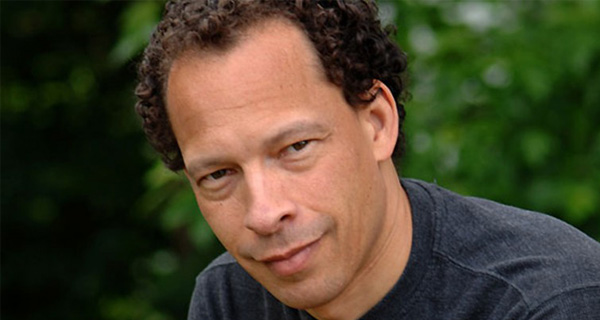
To improve health outcomes and reduce health disparities, the Association of Ontario Health Centres works to eradicate social inequality and advance health equity. For this reason we’re very pleased that on June 8, award-winning author Lawrence Hill will speak at AOHC's annual conference and reflect on how we can achieve these goals. In The Book of Negroes, The Illegal as well as many other works, Hill has written extensively about social inequality -- in particular racism. In advance of his conference keynote, Lawrence Hill joined us for a brief conversation to set the stage.

In your 2001 book Black Berry, Sweet Juice, you noted that Canadians don’t like to talk about racism.

Yes, Canadians loathe discussing racism, and its corollary -- racial identity. We tend to feel it’s beneath us, that these are problems faced by our nasty neighbour to the south, not ours.

Sometimes people still use the term “post-racial” to suggest that we’ve moved beyond racial injustice. We’re happy to talk about To Kill a Mockingbird that tells the story of racism in Alabama instead of discussing the history of slavery in Canada. It’s morally convenient to turn to Harper Lee for instruction on injustice instead of looking at ourselves. My job is to shake people out of that complacency.

What’s the impact of this reluctance when it comes to anti-black racism?

Many people are skeptical about advocacy groups that talk about anti-black racism and demand change. As recently as the 1950s, my parents were fighting to persuade the Ontario government to enact anti-discrimination legislation. At the time, the government’s response was: “We don’t need legislation because we don’t have racism. Prove to us that racism exists and then we will enact anti-discrimination legislation.” And so this is what my mother did with a group called the Toronto Labour Committee for Human rights, a coalition of Jewish people and blacks who pushed the government to enact anti-discrimination laws -- laws that eventually formed part of the Ontario Human Rights Code. To this day, many people are unaware of deeply systemic issues, for example the low expectations placed upon students with racial minority backgrounds. Students from racial minority backgrounds continue to be streamed into non-academic programs. Many black parents who have children in the school system will express these concerns.

Through your work as an artist, you’re helping Canadians come to terms with racism – past and present. At our June conference you’ll be speaking to delegates who work in Ontario’s health system. What’s the call to action for them?

To know their clients and to continue to innovate. For example, we know that many people in this country do not have legal status or documentation. Your centres respond to their needs even though they don't have an OHIP card. This is extremely important.

Building social acceptance is also key and it is important health centres pay attention to this. Many people who lack privilege naturally distrust institutions. This includes health care institutions. For example, in the black community there’s tremendous stigma around mental illness, so some people won’t seek help. The same is often true of domestic violence. So part of the job is to provide good care but another part of the job is to create conditions that encourage people to come forward and seek help. At your conference I’m looking forward to hearing about how your centres create a sense of community to get people through your doors. That is probably half the battle.

To learn more about Lawrence Hill and the rest of our conference program click here.

Ontario's Community Health Centres offer a solution so more people can access team-based care

Wednesday, May 3, 2017

Leading Canadian physicians say that increasing access to interprofessional team-based care -- such as the services and programs offered by this team at Rexdale CHC -- is one of the keys to ensuring no one is being left behind by the health system. A new initiative called TeamCare is doing just that by connecting independent physicians and their patients to their local CHC.

If we want to improve access to primary care in Canada, we have to get away from thinking that it’s a problem of not having enough doctors, leading family physicians told CBC Radio’s The Current on Wednesday.

“The number of family doctors per capita in Canada has gone up very substantially in the last few years,” Dr. Michael Rachlis, an author and family physician who has consulted on health care policy for the federal government and all 10 provinces, told host Anna Maria Tremonti. “But we’re continuing to hear these stories [of people being unable to find a family doctor].”

Dr. Rachlis went on to reiterate what he says dozens of government reports have said for years about the problem: “It’s not the number of doctors, it’s how we’re using them.”

The program then delved deeper into the issue – one which is sure to be part of upcoming election debates in Ontario as voters are scheduled to go to the polls on June 7, 2018.

Dr. Danielle Martin, family doctor and author of Better Now: Six Big Ideas to Improve Health Care for All Canadians, agreed with Dr. Rachlis, noting that encouraging doctors to work differently isn’t enough, and that changes to the structure of how they work needs to be a big part of any solution.

“One of the ways that we can address this problem is by working more effectively in teams of health care providers,” she said.

This is especially true for people managing multiple chronic conditions, and those who face barriers to accessing health care services due to social determinants such as low income and education levels, racism, sexism and homophobia, and being socially isolated.

In Ontario, Community Health Centres, who have a mandate to serve those who face barriers to access, are working with family physicians who don’t currently work in teams to bridge the gaps that providers and the people they serve can face. But the work is just beginning.

To get a sense of the problem: Only 25 percent of people in Ontario have access to interprofessional primary care teams. Across the province, CHCs are leading a ground-breaking initiative called “TeamCare”. It connects 370 primary care physicians and more than 4,500 of the people they serve, with 17 CHCs who have decades’ worth of in-depth of experience serving people with complex needs. To take a line straight from Dr. Martin’s book, which advocates “scaling up successful health care ideas across the country,” TeamCare could be a game-changing move that begins to reimagine primary health care.

But for TeamCare to be scaled up, more resources are needed to facilitate the process. In its April 27 budget, the Ontario government committed $15 million to increase access to interprofessional teams – and this initiative seems like a golden opportunity to ensure providers and their patients can get connected to team-based care.

“TeamCare gives a provider who had been working on their own access to a virtual team – virtual for the provider, but very real for a client who hasn’t been able to access the full complement of comprehensive primary health care services,” said Adrianna Tetley, CEO of the Association of Ontario Health Centres. “This is about much more than enhancing the referrals process – this is a way of building a collaborative approach in primary health care, an approach that we know allows for deeper relationships between providers and their clients that can help close gaps and surmount entrenched barriers, especially for anyone who has difficulty accessing the health care system.”