Alliance's 2026 Pre-Budget Recommendations: Strengthening Primary Health Care and Expanding Attachment Using the Neighbourhood Health Home and Link Workers

Date: 
Monday, February 2, 2026

January 30, 2026

Hon. Peter Bethlenfalvy Minister of Finance of Ontario
Re: Pre-Budget Submission – Strengthening Primary Health Care and Expanding Attachment

Dear Minister Bethlenfalvy,

Ontario has set a commendable and necessary goal: ensuring every Ontarian is attached to a primary care team by 2029. The Alliance for Healthier Communities represents 118 community-governed primary health care organizations that serve people and communities facing the greatest barriers to care. Every day we see and measure how team-based primary care strengthens population health, reduces emergency department pressures, and helps people stay well, in their own communities.

We appreciate your government’s focus on expanding primary care and the steps taken to grow team-based models across the province. As sincere partners in this work, we want to highlight for Budget 2026 two practical, high-impact approaches that community clinicians are using successfully to increase attachment and improve efficiency: the Neighbourhood Health Home and Link Workers.
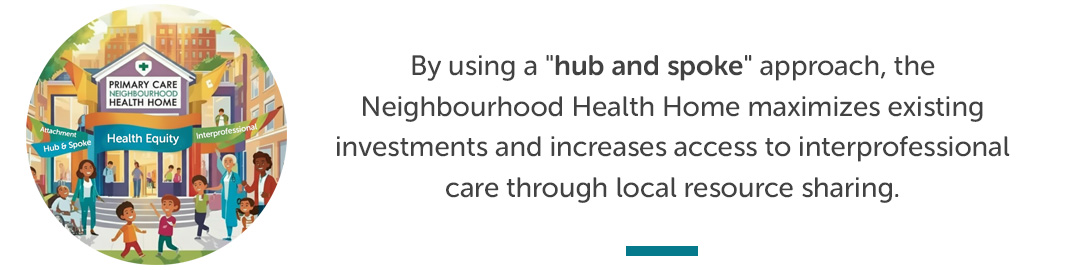
The Neighbourhood Health Home builds capacity by pooling and sharing resources among local primary care partners. It uses a “hub and spoke” approach: an established team-based organization  acts as the hub that provides ongoing primary care, social supports, and health promotion, while connecting patients to community programs and services. This neighbourhood-level collaboration helps maximize existing investments, increases access to interprofessional care, and allows more people to be attached to a primary care team. Overall, working this way improves patient and provider outcomes and experiences while being more efficient with taxpayer dollars.
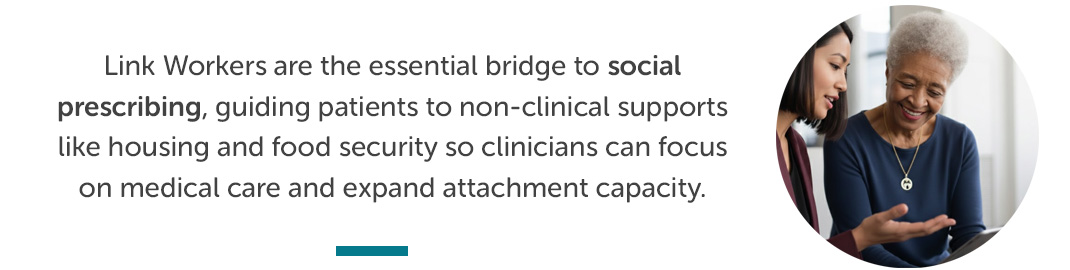
Link Workers are a critical component of this coordinated approach. Filling the Link Worker role allows physicians, nurse practitioners, and their teams to focus on medical care while ensuring their patients get support for the social and practical issues affecting their health. When clinicians identify a patient who would benefit from non-clinical supports, the Link Worker guides them to the appropriate resources — whether that involves accessing benefits, joining seniors’ exercise programs, finding housing supports, or connecting with local peer groups, often across partner organizations within the Neighbourhood Health Home. Ensuring access to Link Workers through primary care teams reduces repeat primary care visits, decreases emergency department use, and creates the capacity needed to attach more patients. This approach is already working in many parts of Ontario and shows strong promise for expansion and scalability.
At the same time, Ontario’s primary care workforce continues to face significant pressures. Recruitment and retention challenges, rising operational costs, and long delays in capital modernization make it difficult for teams to maintain services and expand attachment. We also know that to succeed in mental health and addictions care, we need investments in supportive housing.

We believe that with targeted investments, Ontario can build on recent progress and strengthen the system in a way that benefits patients, communities, and the broader health system.
To support this work, we respectfully ask the Government of Ontario to consider the following priorities for Budget 2026:

  • Support the growth of the Neighbourhood Health Home approach through the IPCT expansion (no further investment required) and expand Link Worker roles across primary care teams, including embedding link workers as a mandatory part of IPCT expansion to increase capacity and attachment.
  • Expedite recruitment and retention funding by unlocking Years 2 and 3 immediately so teams can stabilize staffing and close long-standing wage gaps; this includes $430.9 million over five years for the primary care sector, with $164.5 million needed for Alliance members.
  • Invest in digital tools that improve attachment and efficiency, including interoperable systems, online appointment booking, and innovations such as AI-enabled scribing.
  • Modernize and accelerate the capital approval process for community-based primary care organizations to help expand local capacity and improve access.
  • Continue stabilization and operational funding, including a 5% base budget increase ($33.7 million) for community-governed primary health care organizations.
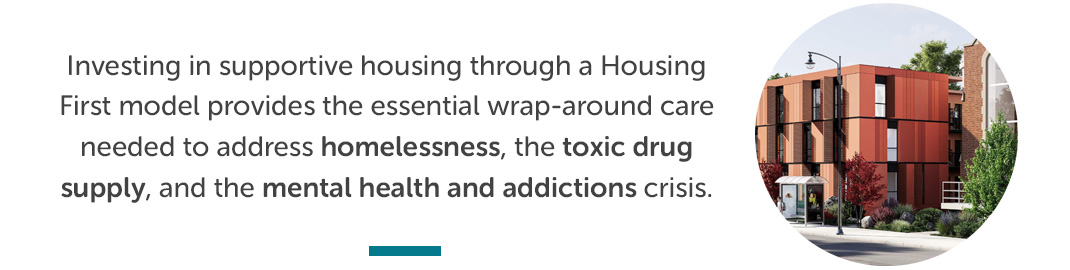
  • Investments in supportive housing ($60 million over two years) to create 5,000 new supportive housing units, as part of the continuum of care for mental health and addictions to support the work of HART Hubs and to help address homelessness and the toxic drug supply across Ontario.

With the right supports, we can increase patient attachment, and ensure Ontarians receive the right care, in the right place, close to home.

Thank you for your consideration of this Budget 2026 submission,   and for your continued leadership in strengthening primary care in Ontario. We would welcome the opportunity to discuss these recommendations and to continue working together toward our shared goals.

Sincerely,

Sarah Hobbs CEO, Alliance for Healthier Communities


Cc: Hon. Doug Ford, Premier of Ontario Hon. Sylvia Jones, Deputy Premier and Minister of Health Matthew Anderson, CEO, Ontario Health


# Invest in Health Human Resources and Operations for Comprehensive Primary Health Care: a strong foundation for an integrated health system  

Alliance members are losing primary health care staff to other sectors and parts of the health care system. When Ontarians cannot access primary health care in their community, it causes strain on other parts of the health care system, such as emergency and acute care.    

We believe investments in adequately funding comprehensive primary health care are critical to the foundation of an integrated and sustainable health system. A fully staffed primary health care system helps take pressure off emergency rooms and hospitals while ensuring efficient use of healthcare funding overall. 

The people and communities in Ontario who face the greatest barriers to health care rely on Alliance for Healthier Communities members to provide primary health care, mental health, community services, and supports. It is essential for our entire health system that people who face barriers can access the supports they need in the community.  

We thank the government for their initial investments to address recruitment and retention in primary care in Ontario. However, without further investments, there is a real risk to achieving the goal of 100% attachment for all Ontarians by 2029. Ontario must address the human resource crisis in primary care by properly funding recruitment and retention for health care professionals. Community health care organizations also need a solid base of funding for operations. With sufficient funding, Alliance members can attach more people in Ontario to primary health care, starting right now. 

Summary  

# 1. Invest in Health Human Resources for inter-professional primary health care teams

Budget Request—Close the Wage Gap to meet Primary Care Attachment Goals 

$430.9 million over five years 

Ontario needs to unlock Year 2 and 3 recruitment and retention dollars (the remainder of the $142 million already announced) in 2026/27 to ensure we can meet attachment goals. Ontario needs to invest $430.9 million over five years, including an annual adjustment of 2.90%, in the primary care sector in Ontario to close the significant wage gap. Of this ask, Alliance members require a Government of Ontario investment of $164.5 million to reach the 2023 recommended salaries to ensure recruitment and retention can keep up with the Government’s goal of 100% attachment. This funding will ensure a fully staffed primary health care system that can support people and communities and ensure the health system is not overwhelmed.


# 2. Invest in community primary health care organizations through base funding increases to sustain health for communities in Ontario.

Budget Request—Base funding:  

$33.7 million 

Ontario needs to invest in a base budget increase of 5% or $33.7 million for community-governed comprehensive primary health care organizations. Members have only seen a 6% increase over 27 years. This investment will maintain and improve service delivery, keep the lights on, and meet the growing needs of clients and communities as they grow and age. 
Budget Request—Link Workers:

$9.7 million 

Link Workers connect people in Ontario to non-clinical programs and services that support their health and wellbeing.  

Link Workers relieve administrative burden for doctors, nurse practitioners, and interprofessional health providers, as they connect clients with community-based programs such as food security supports, physical activity, arts and culture, and social connection. Ontario needs to invest $9.7 million so that primary health care teams in Ontario can implement Link Workers. 

Link Worker programs operate in diverse communities that serve people who are Francophone, Black, Indigenous, and seniors, among others.  

In the Alliance’s Rx: Community Social Prescribing Pilot, 42% of providers reported that they observed a decrease in the number of repeat visits among their clients who participated in a Link Worker program. According to a recent survey, 59% of family doctors stated that Link Workers can help reduce their workload. Ensuring Link Workers across Ontario will enable primary care clinicians to increase attachment for people without a primary care provider.


# 4.  Invest in supportive housing ($60 million over two years) to create  5,000 new supportive housing units as part of the continuum of care  for mental health and addictions across Ontario.


Budget Request—Supportive Housing:

$60 million

Supportive housing is an essential component of recovery from mental illness and can support people to recover from and avoid severe mental health issues. Simply put, supportive housing integrated with the continuum of primary health care supports and mental health treatment is a massively important part of preventative health care, with the potential to reduce strain on emergency departments, acute care, and primary care. Ensuring the success of HART Hubs and other mental health services requires a wraparound approach, a Housing First model that is proven to save lives and public health care and social services dollars, while truly helping to address the underlying barriers people face to mental health and wellbeing.

Total Investment: $534.3 million 

# Conclusion

Evidence provided by the Institute for Clinical Evaluative Sciences (ICES) found that, even though most Alliance members serve people with more socially and medically complex needs, they do a significantly better job than other primary care models at keeping these people out of hospital emergency rooms.

We call on the Government to invest $430.9 million over five years to address the HHR crisis impacting the primary care sector; a 5% increase or $33.7 million in base budget funding for community-governed comprehensive primary health care organizations; $9.7 million to fund Link Workers for equitable, culturally safe inter-professional team-based care; and $60 million for critically needed supportive housing to ensure a full continuum of care is available for mental health and addictions care across Ontario. These essential investments will improve population health for everyone living in Ontario, to ensure Ontarians have access to the right care, at the right time, close to home. Working together, we can ensure primary care works for everyone as the foundation of our health system.

Indoor environmental quality (IEQ) in shelter settings: What it means and why it matters

This webinar is presented by the National Collaborating Centre for Environmental Health (NCCEH)

The word “shelter” evokes a safe indoor environment. However, good indoor environmental quality (IEQ) requires careful building management to achieve and maintain. Parameters such as temperature, humidity, carbon dioxide (CO2) and fine particulate matter (PM2.5) can independently affect the health of shelter residents and staff and can be associated with increased risk of biotoxins and pathogenic agents. This talk will provide a holistic overview of IEQ and suggest strategies for managing risks in shelters and other congregate living environments.

# Learning objectives

Participants will learn how to:

  • Identify indoor environmental quality (IEQ) considerations for congregate settings
  • Explore impacts of aspects of IEQ on the health of people in shelters
  • Understand the connection between IEQ and the spread of infectious diseases

The presentation will be followed by a Q&A session.

Details
Wednesday, February 11, 2026 - 10:00
10:00 -11:00 am
Cost: 
Free
Internal/External: 
Event Type: 
Location

Facing the Season Part II: Responding to a Changing Flu Landscape

This webinar is presented by the Canadian Association of Community Health Centres (CACHC).

Join CACHC for an engaging webinar focused on strengthening flu vaccine uptake in Canadian communities. In addition to key updates and guidance from our Public Health partners, Community Health Centres from across the country will share their strategies, challenges, and successes in promoting influenza vaccine uptake and confidence to support effective and equitable vaccination access.

Details
Wednesday, February 11, 2026 - 12:30
12:30-1:30 pm
Cost: 
Free
Internal/External: 
Event Type: 
Location
Webinar

Making the Most of the Canadian Health Measures Survey

This event is presented by Statistics Canada as part of their Health Data Webinar Series.

The Health Statistics Program at Statistics Canada is pleased to introduce a new webinar series tailored for health data users. These 1-hour sessions held every 2–3 months, will be customized based on your feedback to reflect your needs and interests.

# Upcoming Session

Date: February 4, 2026

French session: 11:00am (EST)

English session: 1:00pm (EST)

Register now: Complete the registration form to secure your spot.

# What You'll Learn

Join us to:

  • Understand the Canadian Health Measures Survey (CHMS): Explore what makes CHMS unique and why it's essential for health research and policy.
  • Discover recent health insights: Review highlights of key indicators such as obesity, physical activity, and oral health trends.
  • Learn how to access CHMS data: Find out about Real-Time Remote Access, Research Data Centres and custom data services.
  • Get practical tips and resources: Access tools, documentation, and supports to help you make the most of CHMS data.
  • Preview what's next: See what upcoming data releases and future cycles are on the horizon.

# Presenters

  • Janine Clarke, Unit Head, Analytical Insights, Centre for Health Data Integration and Direct Measures (English session)
  • Mélie St-Laurent, Manager, Analytical Insights, Centre for Health Data Integration and Direct Measures (French session)

# Who Should Attend

Researchers, analysts, policymakers, and health professionals interested in leveraging Statistics Canada’s health data for research and decision-making.

For questions, contact: statcan.hspoutreach-sensibilisationpss.statcan@statcan.gc.ca

Details
Wednesday, February 4, 2026 - 11:00
Wednesday, February 4, 2026 - 13:00
English: 11am-12pm | French: 1-2pm
Cost: 
Free
Internal/External: 
Event Type: 
Location
Webinar

Strengthening Public Health Capacity Through Competency Frameworks

This webinar is presented by the National Collaborating Centre for Healthy Public Policy (NCCHPP) on behalf of the National Collaborating for the Determinants of Health (NCCDH)

Public health systems in Canada are evolving rapidly amid growing challenges and organizational transformations. Common competency frameworks serve as a key lever to build capacity, support training, and better align practice.

Hosted by the NCCHPP, on behalf of the National Collaborating Centres for Public Health, this webinar will include a presentation by the NCCDH on the Core Competencies for Public Health 2.0, developed through a broad national engagement led by the NCCPH.

It will also present two complementary frameworks: public health communication competencies, developed with Jennifer McWhirter (Health by Design Lab) to strengthen responses to misinformation; and organizational leadership competencies for public health system governance, developed with Erica Di Ruggiero (Centre for Global Health).

Through short presentations and a panel discussion, participants will reflect on practical ways to use these frameworks in teaching and practice.

Join us for this great learning opportunity!

Details
Thursday, February 12, 2026 - 13:00
1:00-2:00 pm
Cost: 
Free
Internal/External: 
Event Type: 
Location
Webinar

Community Engagement: From Debate to Dialogue.

This workshop is presented by the Tamarack Institute.

Teams and individuals who work with communities are experiencing significant changes in how they do community engagement. There is a growing sense of polarization, intolerance, and hate, which can cause significant harm, fear and can reduce the desire for people to work together.

On February 12, join Tamarack's Consulting Director of Community Engagement, Lisa Attygalle, to enhance your ability to create spaces for healthy dialogue in her popular 3-hour virtual workshop Community Engagement: From Debate to Dialogue

# Learning Objectives

Diverse perspectives are important for solution-making, and finding ways to break the divide are necessary at the local level if we want to find ways of moving forward.

Attend this event to:

  • Learn techniques and tools to help you navigate polarization in real time when facilitating engagement.
  • Create shared realities (or shared language) between those holding different perspectives and increase the chances of healthy dialogue.
  • Consider how to build relationships and reduce barriers to engagement.
  • Frame polarized situations to create the conditions to move from debate to dialogue.
  • Increase your knowledge of consensus-based and dialogue practices.

Learners will walk away with an understanding of the current trends in community engagement, the confidence to overcome barriers and create spaces for inclusive engagement, the ability to foster spaces for healthy dialogue, and the tools to develop your understanding of dialogue-based practices.

Registrants also receive access to Workshop Pre-Learning Resources and a 1-Hour Group Coaching Session. 

Details
Thursday, February 12, 2026 - 13:00
1:00-4:00 pm
Cost: 
$275
Internal/External: 
Event Type: 
Location
Virtual event

​​Seeing the System: Identifying Gaps and Barriers in Structural Health Determinants

This anti-racism and cultural competency workshop is presented by Women's Health in Women's Hands Community Health Centre (WHIWH CHC)

Structural racism in healthcare continues to harm racialized women —especially African, Caribbean, and Black women.

From pain being dismissed to life-saving care being delayed, these experiences are not rare or isolated. They reflect a broader pattern of systemic racism and gaps in clinical training that disproportionately affect people with darker skin tones.

Through the We Matter Project and the Thrive Together Project, WHIWH CHC is working to raise awareness and support community-led solutions that promote equity, accountability, and improved care.

Join WHIWH for an interactive workshop designed specifically for health and service providers. This session focuses on practical tools, real-life case studies, and meaningful reflection to support culturally safe and anti-oppressive practice.

# What to expect

  • Engaging facilitation
  • Real-life case studies
  • Practical tools you can apply immediately
  • Space to connect and network with peers
  • Special guest speaker and interactive activities

📍 Central YMCA, 20 Grosvenor Street 🎤 Facilitator: Shanice Harris 📸 Learn more on Instagram: @wematter.whiwh

Have questions? Reach out to mame@whiwh.com

You can also support this work by joining WHIWH's public awareness campaign—share this post and help amplify the message in your communities.

Together, we can push for accountability and equity in healthcare.


Details
Thursday, February 19, 2026 - 17:00
5:00-9:00 pm
Cost: 
Free
Internal/External: 
Event Type: 
Location
Central YMCA
20 Grosvenor Street
Toronto, ON M5A 2T4

OH Menopause Quality Standard Community of Practice

This Community of Practice session is presented by Ontario Health

At the Menopause Quality Standard Community of Practice learning sessions, you can expect a comprehensive learning experience with presentations from experts on various aspects of menopause care and from clinicians and team members on their implementation work.  

At this upcoming session, Dr. Susan Goldstein will be discussing menopause care and more specifically the MQ6 Menopause Management Tools. There will be opportunities for open discussion and Q&A sessions with peers to share experiences and exchange ideas! 

Details
Tuesday, February 3, 2026 - 12:00
12-1 pm
Cost: 
Free
Internal/External: 
Event Type: 
Location

Leveraging Digital Tools for Quality Improvement

This webinar is presented by Ontario Health.

Discover how digital tools can drive quality improvement in primary care, ease administrative workload, and enhance patient outcomes. Hear directly from primary care teams actively integrating digital solutions in their practices as they share their experiences, including both challenges and successes, on their journey toward digitalization. 

This session is open to all care professionals advancing quality improvement – primary care providers, clinicians, administrators, and members of inter-professional and multi-disciplinary teams. 

This 1-credit-per-hour Group Learning program has been certified by the College of Family Physicians of Canada and the Ontario Chapter for up to 1.0 Mainpro+Ⓡ credits.

A recording of the session and news about upcoming sessions will be available on the Primary Care Quality Improvement Hub on Quorum. Please register and subscribe for the group here.

Details
Tuesday, February 10, 2026 - 12:00
12-1 pm
Cost: 
Free
Internal/External: 
Event Type: 
Location
Webinar

H.E.A.L. Healthcare: Hearts-based Education and Anticolonial Learning in Healthcare

This webinar is presented by the National Collaborating Centre for Indigenous Health.

This webinar will engage participants in anti-bias training using anticolonial arts-based learning tools available from the H.E.A.L. Healthcare website – HEALhealthcare.ca. H.E.A.L. Healthcare, a project completed in collaboration with the National Collaborating Centre for Indigenous Health, was created in response to gaps identified in healthcare education. The website hosts over 30 individual curricula that address personal biases in healthcare, and were created by artists, Indigenous storytellers, and people with lived experience. In the webinar, the facilitators will introduce the project and website, then work through two of the curricula with participants. Through an anticolonial lens, participants will be invited to engage in active listening, write poetry, and reflect on their own personal biases.

# Learning objectives

  • Explore resources on the H.E.A.L. Healthcare website.
  • Understand arts-based learning as an effective way of decolonizing practice.
  • Identify personal biases and reflect on transformation through arts-based exercises.  

# Learning resource

This webinar will include working through two resources from the HEALhealthcare.ca website. To prepare for the webinar, participants are asked to:

  • Have blank paper, pen, colouring pens/pencils/markers for the webinar
  • Review the following resources ahead of the webinar:

# Presenters

Dr. Sarah de Leeuw, a creative writer and human geographer, is a Professor and Canada Research Chair (Humanities and Health Inequities) with the University of Northern British Columbia’s (UNBC) Northern Medical Program (NMP), the Faculty of Medicine at the University of British Columbia (UBC). Between 2012 and 2020, she held a Michael Smith Foundation for Health Research Career Investigator Scholar with the National Collaborating Centre for Indigenous Health (NCCIH) where she has been a Research Associate for more than a decade. Her academic research—funded by CIHR, SSHRC, and MSFHR, focuses on health inequalities, creative arts and critical humanities, marginalized geographies, colonial violence, and Indigenous peoples. Her research appears in more that 140 scholarly and creative publications. Author or co-editor of eleven books, including creative works nominated for Canada’s Governor General’s Literary Prize (Where it Hurts) and awarded the Dorthey Livesay BC Book Award (Geographies of a Lover), de Leeuw is also a two time recipient of a CBC Literary Prize for non-fiction and holds a Western Magazine Gold Award. In recognition of her outstanding interdisciplinary contributions across the country and beyond, de Leeuw was appointed in 2017 to The Royal Society of Canada, the College of New Scholars Artists and Scientists. She grew up on Haida Gwaii, completed high school on Ts’msyen lands in Terrace, and now divides her time between Lheidli T’enneh/Dakelh Territory (Prince George) and Syilx Territory (Okanagan Centre), in so called British Columbia.

X’staam Hana’ax (Nicole Halbauer), is a dedicated member of the Ts’msyen community, Kitsumkalum, and belongs to the Ganhada p’teex (clan) of the Waap (House) of K’oom. With over a decade of advocacy work in northern British Columbia, Nicole has been a strong advocate for decolonized governance in community organizations. She has held significant leadership roles, including Chair of the Board of Governors at Coast Mountain College, Vice Chair of BC Assessment, and various other provincial and community positions. Beyond her professional endeavors, Nicole is deeply committed to her family, raising six children and cherishing her four grandchildren. Her personal experiences shape her work, with a strong belief that reconciliation is essential to the health and well-being of a community.

 Michelle Roberge lives with her family tucked away in the trees on a beautiful west facing hill within the traditional territories of Saik’uz Whut’en, in north-central British Columbia, Canada. Here, when not working her day job(s), she grows food with her husband and children on their off-grid farm. Inspired by her childhood of catching (trying to catch) fish on the ocean and lakes of Vancouver Island, Michelle pursued a Bachelor of Science degree in Ecology and Environmental Biology at UBC and immediately followed it with a Master of Science degree in Zoology. Although Michelle started her working life as a fisheries biologist, her life and career has led her down many different and intersecting paths and experiences working in graphic design, health, education, agriculture, and anti-racism awareness. Michelle joined the HARC team to support the HEALhealthcare.ca project as the digital archivist and designer.

Details
Tuesday, January 20, 2026 - 14:30
2:30-4:00 pm
Cost: 
Free
Internal/External: 
Event Type: 
Location
Webinar