Nonprofit Driven Regional Connects: London & Region

This series of regional gatherings is presented by the Ontario Nonprofit Network (ONN)

It’s time again for some real talk, in real life This is not your average “conference” - Nonprofit Driven Regional Connects are small gatherings with big impacts. These are opportunities for nonprofit peers to share space and ideas for our collective well-being, explore systemic solutions locally, learn more about ONN’s work, and break bread together. Our sector continues to be intentionally under-resourced and privatized, is experiencing growing legal attacks from the community for doing its critical work, and grapples with increased scrutiny and eroding public trust. To combat the current climate of deep polarization, we must invest in building relationships to help our sector and communities thrive. Regional gatherings, co-hosted in collaboration with local partners, are an ongoing exercise in movement-building, and actively shaping the future together. 💚

# What to expect:

  • Get practical data, information about policies and trends impacting nonprofits in London and across Ontario, and discuss how these are showing up in your work and communities.
  • Make connections over the issues that matter to you - engage in conversations and learn from local peers and team members from Pillar and ONN.
  • Enjoy breakfast and lunch with nonprofit colleagues.
  • After the event, all registrants will receive slides, notes, and links to resources.

# Other Regional Connects Sessions

  • Peterborough - October 21- Registration is now open
  • Sault Ste. Marie-Algoma - Coming soon in October 
  • Halton region - Coming soon in November

We cannot address complex community needs alone - and we don’t have to. Join us at an event near you!
Details
Thursday, June 4, 2026 - 09:30
9:30-3:30
Cost: 
$103.80-182.02
Internal/External: 
Event Type: 
Location
Innovation Works London (CommUNITY Living Room)
201 King Street
London, ON N6A 1C9

Basic Income Earth Network Congres 2026 | Basic Income and the Polycrisis: The Key to Unlocking the Puzzle

This conference is presented by the Basic Income Earth Network (BIEN) and Basic Income Ontario.

# Basic Income and the Polycrisis: The Key to Unlocking the Puzzle

*In Person and Virtual Conference

The BIEN Congress will officially open on August 20. All Congress participants are also invited to a half-day, pre-congress session the afternoon of August 19 focused on Canada. 

The 2026 Congress is being held as the early decades of the twenty-first century are defined by a polycrisis: the causal entanglement of multiple, overlapping crises. These pressures span interconnected systems, including the natural environment (climate disruption), the economy (inflation, unaffordability, widening income and wealth inequality, and persistent poverty), political institutions (erosion of public trust, democratic strain, and the rise of exclusionary populism and authoritarian governments), and the rights-based international order. Together, they expose the limits of fragmented welfare systems that respond to risks in isolation rather than as cumulative and systemic challenges. In this context, basic income is gaining renewed attention not only as an anti-poverty measure, but as a foundational policy for strengthening social inclusion and solidarity.

This Congress theme positions basic income as a unifying response to the polycrisis—one that cuts across policy silos and reconnects income security to broader questions of justice, sustainability, and democratic capacity. The theme invites critical examination of basic income as part of a renewed social contract capable of countering precarity, fragmentation, and exclusion in complex, interdependent systems.

# Registration fees 

# Tier 1: Organization and Academic Rate ($350 CAD)

  • This tier is designed for participants whose attendance is supported by organizations with significant resources and professional staff.
  • Who should select this tier: Representatives of governments, large non-profits, academic institutions, and corporations. This tier also applies to individuals attending independently who possess better-than-average economic means.

# Tier 2: Standard Rate ($200 CAD)

  • The standard rate supports the core costs of the Congress and is intended for those with moderate institutional or personal resources.
  • Who should select this tier: Staff from smaller non-profits with modest resources and few paid employees, as well as individuals with moderate personal incomes.

# Tier 3: Low-income Rate ($100 CAD)

  • BIEN is committed to inclusive dialogue. This reduced rate is intended to remove financial barriers to participation.
  • Who should select this tier: Individuals with limited financial resources for whom the standard rate would make participation unaffordable or cause undue hardship.

More information available on the conference website. 

Details
Wednesday, August 19, 2026 - 08:00
Thursday, August 20, 2026 - 00:00
Friday, August 21, 2026 - 00:00
Saturday, August 22, 2026 - 00:00
August 19-22
Cost: 
$100-350
Location
Hybrid: online and Toronto Metropolitan University
Toronto, ON

Palliative Care: Culturally Safer and Trauma Informed Care Across Diverse Populations

This event is presented by Northern Ontario School of Medicine (NOSM) University, Continuing Education and Professional Development as part of their Palliative Care education Series

Topic: Culturally Safer and Trauma Informed Care Across Diverse Populations

Speakers: Holly Prince

Date: Thursday, April 2, 2026 9:00 - 10:30 a.m. EST *Different Time Than Usual

Learning Objectives

At the end of this session participants will be able to:

  1. Define cultural humility
  2. Apply culturally safer care with humility

CME credits are available from the College of Family Physicians of Canada.

Details
Thursday, April 2, 2026 - 09:00
9:00-10:30 am
Cost: 
Free
Internal/External: 
Event Type: 
Location
Online event

ECHO Evening | Liver Diseases in Primary Care: Approach to Fatty Liver

This online learning activity is presented by ECHO UHN and funded by the Ontario Ministry of Health

This no-cost evening ECHO session is open to all healthcare professionals. It will consist of a didactic lecture by our interprofessional team and real de-identified patient case presentation.

CME credits are available for family physicians. Other members of the health care team are equally welcome to attend. 

# Present a case for this session: 

Have a question about one of your clients?  If you wish to present a patient case, please contact echo.ontario@uhn.ca


Details
Thursday, June 4, 2026 - 19:00
7:00-8:15
Cost: 
Free
Internal/External: 
Event Type: 
Location
Online (Zoom)

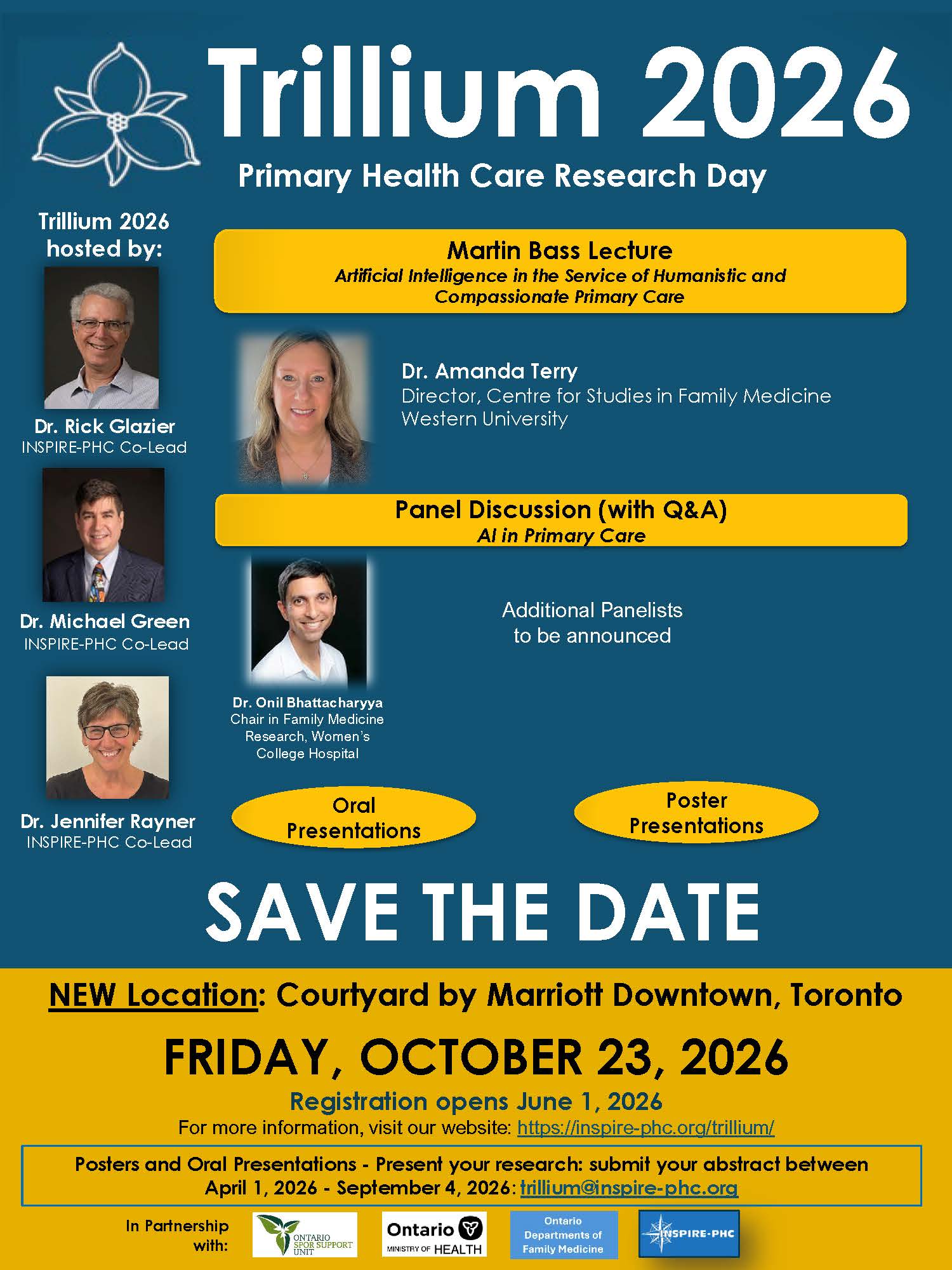
Trillium 2026 Primary Health Care Research Day

This in-person learning event is hosted by INSPIRE-PHC in partnership with the Canadian Primary Care Research Consortium (CPCRC) and CIHR-IHSPR.

SAVE THE DATE! Friday, October 23, 2026. Updated information will be posted on the Trillium PHC Research Day website.

# Event Highlights

  • Martin Bass Lecture: Artificial Intelligence in the service of Humanistic and Compassionate Primary Care
    • Dr. Amanda Terry, Director, Centre for Studies in Family Medicine, Western University
  • Panel Discussion with Q&A: AI in Primary Care. 
    • Dr. Onil Bhattacharyya, Chair in Family Medicine Research, Women's College Hospital
    • Additional panelists to be announced
  • Oral presentations
  • Poster presentations

# Important dates

# Event hosts

  • Dr. Rick Glazier, INSPIRE-PHC Co-Lead

  • Dr. Michael Green INSPIRE-PHC Co-Lead

  • Dr. Jennifer Rayner, INSPIRE-PHC Co-Lead


Details
Friday, October 23, 2026 - 00:00
TBD
Cost: 
TBD
Internal/External: 
Event Type: 
Location
Courtyard by Marriott Downtown Toronto
475 Yonge Street
Toronto, ON M4Y 1X7

What is distinctions-based health impact assessment

This webinar is hosted by the National Collaborating Centre for Indigenous Health. 

# Webinar description

Health impact assessment (HIA) provides a systematic process to identify and analyze the potential effects of a proposed development project on the health and well-being of a population. For Indigenous Peoples in Canada, standardized HIAs are not able to adequately measure potential health impacts as these processes do not consider the full range of cultural, social, spiritual and economic determinants of Indigenous well-being. Instead, distinctions-based HIA approaches are required that begin from place-based, community-specific and holistic environmental health frameworks. In this webinar, join Drs. Diana Lewis and Elana Nightingale for a discussion of distinctions-based health impact assessment: what it is, what it could look like in Canada, and how it could transform HIA into a process that reflects Indigenous Peoples’ diverse worldviews, knowledge systems and values. Drawing on more than a decade of Indigenous community-led health research experience, the presenters discuss what it means to meaningfully collaborate with Indigenous communities and develop impact assessment processes grounded in distinctions-based models of well-being.

# Learning objectives

  • Identify distinctions-based models of health and well-being and how they differ from mainstream health models.
  • Understand the implications of Indigenous community-specific models of health and well-being for HIA processes in Canada.

# Presenters

Dr. Diana Lewis is a member of Sipekne’katik First Nation and Associate Professor/ Canada Research Chair (Tier II) in Indigenous Environmental Health Governance in the Department of Geography, Environment and Geomatics, University of Guelph. She is also Director of the IndigenERA Lab and a Member of the Royal Society of Canada (2025). Her research focuses on promoting understanding of Indigenous worldviews in environmental decision-making and advocating for Indigenous-led approaches to give communities baseline health data and sovereignty over the data in environmental decision-making. She is currently working with Indigenous communities across Canada to develop an Indigenous-led environmental health risk assessment approach.

 Dr. Elana Nightingale is a Postdoctoral Scholar in the IndigenERA Lab at the University of Guelph where she works on Indigenous economic impact assessment. She holds a PhD in Geography from Western University, a MSc in Local Economic Development from the London School of Economics, and a BA in Economics from Carleton University. Elana aims to support community-led research as a means to advance health and social equity for First Nations, Inuit and Métis communities in Canada. Her research interests include the social determinants of Indigenous health, community economic development, community-based research methodologies and knowledge translation.

Details
Tuesday, March 31, 2026 - 14:00
2:00-3:30 pm
Cost: 
Free
Internal/External: 
Event Type: 
Location
Online (Zoom)

Manager, Integrated Care & Services

Posting Date: 
Tuesday, March 24, 2026

# Summary

Job Title

Manager, Integrated Care & Services


Employment Type (Full-Time etc.) Full-Time Contract
Total Hours of work per week 35
Compensation Amount / Range $88,600 - $106,300 per year (with 4% vacation pay)
Existing Vacancy  ☒Yes ☐ No
Is Artificial Intelligence used for screening or assessment of candidates ☐Yes ☒ No

# About the Organization

Heath Access Thorncliffe Park (HATP) is committed to providing coordinated Health & Wellness services to the Thorncliffe Park community. It is a community driven initiative aimed to enhance interdisciplinary comprehensive primary health care, improve access to health, social and community services in Thorncliffe Park. HATP is an innovative partnership between Flemingdon Health Centre (FHC) and TNO-The Neighbourhood Organization (TNO) funded by the Ontario Health- Toronto region. This position is focused primarily on serving with FHC.   

FHC is a registered charity and an incorporated not-for-profit Community Health Centre (CHC), with a vision of Strong Health Communities. FHC provides a range of health-related services based on the social determinants of health with extensive community engagement. At FHC, we know that health is about much more than just the absence of disease. Our approach to community health encompasses the social determinants of health which includes education, employment, isolation, food security and social supports, and utilizes a community development model to promote health, prevent disease, and strengthen community capacity. We value health equity, inclusion, community engagement, accountability & transparency, excellence and collaboration & partnerships.

# About the Position

This role provides strategic and operational leadership to clinical services, ensuring high-quality, interdisciplinary primary health care and positive community outcomes. It oversees team performance, service delivery, and resource management, while supporting recruitment and staff development. The position drives quality improvement, monitors performance against organizational and funder targets, and supports strategic planning. It also promotes collaboration with internal and external partners, advocates for equitable access to care, and contributes to client-centered service design and continuous improvement. This position reports to the Director, Community Health at FHC.  

Main Tasks and Responsibilities

  • Support the development, implementation and monitoring of HATP’s strategic goals and operational  plans 
  • Provide leadership and support of a strong interdisciplinary team, which includes Physicians, Nurse Practitioners, Registered Nurses, Social Workers, students and volunteers
  • Conduct HR activities related to the recruitment, supervision and retention of team members
  • Ensure teams meet accountability measures and associate quality indicators and goals through QIP
  • Manage the coordination of service delivery and interdisciplinary care within context of the Community  Health Centre model of health and well‐being
  • Ensure accessibility for non-insured individuals and HATP’s priority populations, and advocate on behalf of these groups towards inclusive and equitable treatment and services
  • Collaborate with FHC and TNO management team to monitor/communicate funder set service targets,  provide analysis of data and lead quality improvement initiatives as necessary
  • Manage the effective and responsible use of financial resources available for clinical services. 
  • Work with various stakeholders from HATP, FHC and TNO in support of creating an organizational culture of collaboration and innovation
  • Design or assist in the design and execution of various people related projects
  • Maintain a connection with peers at FHC and TNO to assist with and promote connections and coordination and to address specific issues
  • Initiate and/or participate in community-based research; analyze data, from this and other research, to  identify trends related to population health. 
  • Seek insight into client-centered care needs and work with the clinical team to develop solutions/service delivery that provide exceptional care. 
  • Act as a resource for the development of health communication internally and externally. 
  • Facilitate the development and maintenance of strong collaborative working relationships with the community we serve as well as existing and potential partner agencies/service providers. 
  • Organize and facilitate groups and meetings, creating an environment and atmosphere for effective and thoughtful discussion of issues. 
  • Participating in project and planning committees as required
  • Other duties as assigned by Director, Community Health or designate
  • This position maintains a dotted‑line reporting relationship to Medical Director for matters related to  clinical integration, system‑level alignment, and strategic planning

# Your Qualifications

  • Two to four years of strong management experience within Community-based health organization(s),  Public health, or other health sector organizations. 
  • Degree from a recognized university with a health sciences or community health related discipline (e.g.  public health, Social Work, Registered Nurse) or combination of education with relevant experience.
  • Experience in managing and implementing “Quality Improvement” strategies and processes in a Health  sector services setting 
  • Self-motivated with the ability to shift priorities with ease and resiliency 
  • Demonstrated professionalism with ability to make sound judgment
  • Demonstrated competency in program planning, implementation, monitoring, and evaluation
  • Experience in community development/engagement would be an asset.
  • Experience working with funding bodies, contributing to proposals and reporting
  • Experience leading a multi-disciplinary and diverse team and facilitating effective team planning
  • Demonstrated analytical and organizational skills
  • Commitment to providing leadership in reducing barriers to health care experienced by marginalized  communities 
  • Demonstrated ability to manage multiple priorities and ability to build relationships at all levels of the  organization 
  • Demonstrated commitment to anti-racism and anti-oppression
  • Knowledge of communities in FHC’s catchment area as well as knowledge of the community health center approach and model are assets
  • Excellent spelling, grammar and written communications in English 
  • Proficiency in computer hardware and software applications particularly EMRs 
  • Ability to speak languages other than English an asset
Application Deadline: 
Sunday, May 31, 2026
How to apply: 

Deadline for Application: Open until filled. Expected Start Date: April/May 2026

Application Process: Please submit your cover letter and resume in a single document through this link: 

Click Here  

HATP – Health Access Thorncliffe Park is committed to employment equity initiatives. We encourage residents of Thorncliffe Park, Flemingdon Park, and surrounding communities, and people who are racialized, Indigenous, people from the 2SLGBTQI+ community, people with disabilities and other equity-seeking groups to apply. Please note that FHC/HATP does not use Artificial Intelligence in their recruitment process. If you believe any job posting is fraudulent, please call our office: Flemingdon Health Centre at 10 Gateway Boulevard in Toronto.

Building a Newcomer Health Plan in Ontario - the time is right

This learning event is hosted by Access Alliance Newcomer and Community Health, an Alliance-member CHC. 

It is time to design, validate, and evaluate an equity-focused Newcomer Health Plan (NHP) in Ontario. Join us for a community conversation to reimagine Ontario's health system for immigrants and refugees.

We envision a co-designed Newcomer Health Plan that will involve policy and program interventions, workforce (i.e. better inclusion of Internationally Educated Health Professionals) and service delivery models, and governance frameworks. It will strengthen prevention, health promotion, equity-focused outreach, and system navigation through improved access, cultural safety, accessible language, including translation, and coordinated pathways linking newcomers to health services and health-adjacent social supports. The plan will integrate trauma-informed, culturally tailored strategies and address governance and workforce barriers.

If we are successful, future newcomers arriving in Ontario will no longer face persistent barriers to healthcare access, such as language exclusion, fragmented navigation, limited culturally safe services, racism, and systemic discrimination. They will discover a welcoming and inclusive health system, built with them in mind.

# Who should attend:

You should attend if you work at the intersection of health, settlement, equity, and inclusion. This is a working session. You will be participating in active discussions to help shape ideas and discuss how best to co-create a Newcomer Health Plan with health, settlement, community, and newcomers themselves.  The goal is to embed the NHP into Ontario’s health system. System transformation; not new research, or a new program. What role might you or your organization play in moving this forward? What do you need to be able to contribute?

Find out more about our ideas and the full session agenda at https://accessalliance.ca/research-blog/a-newcomer-health-plan-for-ontario-the-time-is-right/#NHPevent and join us on April 29th!

Details
Wednesday, April 29, 2026 - 09:30
09:30 am - 12 pm
Cost: 
Free
Internal/External: 
Event Type: 
Location
Online (Zoom)

Big F***ing Deal: Compounding Effects of Stigma for People Living with HIV

This video call is hosted by the Dr. Peter Centre. It is funded by the Public Health Agency of Canada. 

This session will feature a presentation from Casey House as they share their new short film, Big F***ing Deal. Produced as a part of their Smash Stigma campaign, this short demonstrates how stigma intensifies and outcomes diverge when an HIV diagnosis intersects with challenges such as housing insecurity, substance use dependency, mental health challenges, and discrimination tied to identity. During the session, Casey House will discuss their Smash Stigma campaign and detail the intentions, production, and reception of their new short.

This video call will be conducted in English, with simultaneous French translation provided. 

Featured speaker: Lisa McDonald, Director, Communications and Public Policy, Casey House. 

# Why Join?

  • Gain insight into how healthcare organizations are addressing stigma to improve health outcomes for their clients.
  • Explore practical lessons in confronting socially constructed barriers to equitable health outcomes for people living with HIV from a communications perspective.
  • Reflect on the effects of being judged, misunderstood, or unsupported for clients seeking care for complex health issues, including HIV.
  • Engage in shared learning with peers navigating similar system-level challenges


Details
Tuesday, March 31, 2026 - 14:00
2:00-3:00 pm
Cost: 
Free
Internal/External: 
Event Type: 
Location
Online (Zoom)

What Happens When Care Gets Cut Off? A conversation on ethics, accountability, and the real impacts of policy decisions.

This webinar is presented by the Substance Use Health Network (SUHN) as part of their Research Spotlight series.

# MySafe Final Evaluation Report: Impacts of Program Closure

Join us for a critical and timely conversation on the independent evaluation of the MySafe biometric medication dispensing program - and what its closure reveals about the current direction of drug policy in Canada.

At its core, this is not just a story about one program. It raises urgent questions about what it means to pilot high-impact interventions for populations at extreme risk - and then withdraw them without continuity, safeguards, or accountability. As harm reduction services are scaled back or shut down across jurisdictions, the findings point to a growing gap between evidence, ethics, and policy.

# In this webinar, we will:

  • Share key findings from the evaluation

  • Examine the real-world impacts of program withdrawal on people’s lives

  • Situate MySafe within a broader landscape of shifting drug policy and restricted access to prescribed alternatives

  • Interrogate the ethical implications of short-term pilots without continuity-of-care protections

  • Discuss what accountability, responsibility, and evidence-informed policy should look like moving forward

For healthcare and social service providers, researchers, policy-makers, and people with lived and living experience, this session offers space to grapple with a difficult but necessary question: what do we owe people when we introduce - and then remove - interventions that shape their survival?

# About MySafe

MySafe was a low-barrier, person-centred model that provided secure, flexible access to prescribed alternatives through biometric dispensing machines, paired with wraparound supports. Participants described improved stability, autonomy, and engagement in care. In 2024, the program was abruptly defunded amid shifting political and regulatory pressures on prescribed alternatives, leaving many people without safe, reliable access to care.

This evaluation, based on in-depth interviews with former clients and service providers, documents not only what worked but what happened when it was taken away. Participants describe rapid destabilization, loss of autonomy, and forced transitions into more restrictive or inaccessible systems of care. These are not abstract policy shifts; they are decisions with immediate, material consequences for people’s health, safety, and survival.

# Speakers

  • Tara Taylor, SpenceCreo Founation

  • Isabelle Boisvert, Changemark

  • Kaitlin Calligiari, Changemark  

Details
Thursday, March 26, 2026 - 12:00
12-1 pm
Cost: 
Free
Internal/External: 
Location